🏠 Breathe Easy, Stay Ahead: Radon Safety in Your Hands
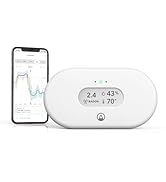
The Airthings Corentium Home Radon Detector 223 is a cutting-edge, battery-operated device that delivers accurate, real-time radon level monitoring with no need for power outlets or annual calibration. Lightweight and portable, it provides both short and long term radon readings on an easy-to-read LCD, empowering homeowners and professionals to detect and mitigate radon risks effectively for over 10 years of reliable use.


| ASIN | B00H2VOSP8 |
| ASIN | B00H2VOSP8 |
| Batteries | 1 AA batteries required. (included) |
| Batteries | 1 AA batteries required. (included) |
| Batteries Included? | Yes |
| Batteries Required? | Yes |
| Battery Cell Type | Alkaline |
| Battery life | 3 years |
| Best Sellers Rank | #56,309 in Tools & Home Improvement ( See Top 100 in Tools & Home Improvement ) #19 in Smoke & Carbon Monoxide Alarms |
| Color | black |
| Customer Reviews | 4.6 4.6 out of 5 stars (10,295) |
| Customer reviews | 4.6 4.6 out of 5 stars (10,295) |
| Date First Available | 1 January 2024 |
| Date First Available | 1 January 2024 |
| Included components | Radon sensor, 3 AAA batteries |
| Is Discontinued By Manufacturer | No |
| Item Package Quantity | 1 |
| Item Weight | 99.8 g |
| Item model number | 223 |
| Item model number | 223 |
| Manufacturer | Airthings |
| Manufacturer | Airthings |
| Part number | 223 |
| Power source type | Battery Powered |
| Product Dimensions | 11.94 x 6.86 x 2.54 cm; 99.79 g |
| Product Dimensions | 11.94 x 6.86 x 2.54 cm; 99.79 g |
| Size | 1 Pack |
| Style | Corentium Home Radon |
L**H
Sin problemas con este detector, sólo hay que leer el instructivo porque no da lecturas hasta después de 1 día. No es un dispositivo que responde instantáneamente a los cambios de concentración de Radón, el método de detección requiere su tiempo y lo que se muestra es un promedio.
J**C
The Corentium 223 should be in every home where Radon is a concern! Several years ago, I had a sub-slab depressurization system installed after a charcoal test measured 7 pCi/L. At the time, two follow up charcoal tests came back at 3.4 and 2.3 pCi/L so I felt better but for the past few years, I've still wondered what a longer term test would show. For peace of mind, I purchased the Corentium 223 and I have since learned so much about how Radon levels vary given the weather and how a charcoal test, while accurate, is going to only tell you so much. I've had the Corentium 223 set up in my basement for the past 3 months in mostly closed house conditions and found my long term average to be 1.76 pCi/L, but the daily average was as high as 8.3 pCi/L! The more rain fall in the past 24 hours, the higher the Radon level in the basement. On clear sunny calm days, the levels dropped to around 1 pCi/L. There are a lot of sites that talk about how Radon levels vary depending on the weather, but I've never found any site that details exactly how the levels increase by rainfall. This could be unique to my property, but the correlation has been eye opening. Hoping I could improve the effectiveness of the mitigation system, I decided to seal the crack between the wall and floor next to the suction pipe by adding silicone along that wall to seal the joint. (I've seen several sites suggest this and I could hear a slight hissing with the air leaking so figured I'd give it a try to see if there was any change.) The next day, the 1 day average was just 0.10 pCi/L! The following week, the 7day average dropped to 0.71 pCi/L, even after one day of heavy rain that week!!! Another concern I have had is the amount of Radon in my water. I have a private well and have considered having the water tested, although research I have read on the topic indicate almost all water from private wells will contain Radon, but the danger is really the amount of Radon that you breath in, not consume. While the Corentium 223 only measures the amount of Radon in the air, it will measure the amount of Radon in the house that is given off by water use in the house such as showering and doing laundry. My concern was that I have a whole house humidifier that runs occasionally in the winter months and uses water from the well. While I do see a slight increase in Radon in the house when the humidifier is running, it only seems to be 1 - 1.5 pCi/L increase and it is hard to say if it is really from the humidifier or just natural fluctuations. I have yet to read any warnings on the EPA site or other sites about the hazards of increased Radon exposure when using a whole house humidifier on a private well, but this monitor was able to help put my mind at ease on the issue. If you really want to know the Radon levels in your home, and measure effects of various mitigation strategies, this is the only device I've found on the market that will give you immediate, reliable and accurate data. After 24 hours of powering on, you have your first readings and after 7 days you have your first long term average. It is simple in the design and implementation and the quality of construction is superb. I should also mention that I ordered the Safety Siren Pro Series3 Radon Gas Detector - HS71512 by Family Safety Products, Inc. , but the device I received wouldn't power on. I returned it the next day and purchased the Corentium 223. There is no comparison between the quality of construction between the two devices and with annual calibration requirements of the Safety Siren, the price for the Corentium for 10+ years of use is an easy sell. The device has a micro USB port on the side. My only wish is that there was support for downloading of Radon readings to a computer. Being able to download historical readings would allow for graphing and comparison to local weather reports. If it did this, I'd give it 10 stars! I would highly recommend the Corentium 223 if you have had 2 charcoal tests with results >4.0 pCi/L. In my mind, the Corentium 223 is the absolute best digital Radon monitoring device on the market today!
T**N
I'm really glad to have this device. When we bought our house 15 years earlier, we had done a radon test and found the levels to be low. But within the last few years I'd started using the unfinished basement quite a bit (home gym), and randomly ordered a charcoal radon test off Amazon. It took me a few months before I finally used it, but after getting the results back, I found that our radon levels were above safe limits (~10+ pCi/L). That freaked me out, and I wanted to quick answers, so I bought this Airthings radon detector from Amazon and had it the next day. It confirmed that our levels were higher than they should be. Further, it also revealed our levels were above safe limits even on the floor above the basement. I'm so glad we didn't have to wait for another charcoal test. A few days later, we had a radon system installed that basically sucks the radon out of the ground, underneath the crawlspace and concrete basement floor. This was a year ago and it has been very effective, reducing our radon levels down to a 1-year average of ~1.3 pCi/L. I've found the Airthings device to be quite accurate, nearly matching the 2-week results from an independent test using two Sun Nuclear radon testing devices. I like how quickly I can get results. For instance, I recently found that opening windows on the top level of our house causes radon levels to increase in the basement (to ~3-4 pCi/L), and this happens due to a chimney effect creating negative pressure in the house, causing it to draw more radon out of the ground. I also learned that I could prevent the negative pressure by also opening windows on the lower level of the house. If I didn't have the Airthings device, I would not be able to tell how these kinds of changes affect radon levels. For any kind of test like this, it's important to give it some time (a day or two minimum), as radon levels naturally increase and decrease all the time, so you can only trust longer term averages. And the longer the test, the more accurate the number. The Airthings device doesn't give you minute-by-minute readings for this reason. Instead, it gives you, short term 24-hour, 7-day, and long term averages, which is ideal. I also like how simple this device us, it's foolproof. There's really nothing for you to do other than finding a good place to put it, and reading its screen. There are no buttons (unless you count the tiny reset button on the back, which you may never use). It shows you the 1-day, 7-day and long-term averages by rotating the numbers every few seconds on the screen. The batteries last a really long time. We've been running the device on the original batteries nonstop for over a year, with no sign of slowing down. Lastly, I also like that you can easily test different places in your house, or even different houses (we recently tested my parents house). It would be a pain to do this with charcoal tests. I highly recommend this device, especially if a charcoal test makes you want further testing, and it is well worth the price. I can't think of any downsides and I will never be without one of these devices.
A**2
Buen producto , confiable y las mediciones comparadas con otros equipos lo hacen confiable... recomendado totalmente para medición de gas radón en domicilio
T**1
I am a retired chemist so I’m concerned about radon emissions. I had absolutely no knowledge of this product or company until I found out that have a lot of radon in my new home. So, I purchased a model 223 a couple weeks ago and am using it to help me understand the situation while I wait for remediation. It’s doing a wonderful job of informing me of ‘hot spots’ and the average level throughout the house while I hold my breath. Now to its accuracy. The Corentium 223 specification is perhaps the most honest approach to accuracy I have ever seen in a consumer product. It’s based on: ‘sigma = less than [a percentage and the length of test]. It is statistical probability specification of accuracy and it is rich in accuracy information. However, you need to do the math, understand what ‘sigma’ means in variance statistics, understand probability distribution curves, and then the use the spec to calculate the worst case accuracy of the device associated with your own radon situation). So, please do that before you criticize the device. If you studied the specification and did the math, as I have, you would see that it is quite accurate for an inexpensive radon continuous monitoring device.... and way more than suitable for home use. Let me repeat that again. If you use the device as instructed by the manufacturer and are willing to trust the specification as determined by some very smart people who spent a lot of time, money and brainpower to prepare it, then you will be measuring Radon and its variability in your home in a way that is vastly superior to doing periodic mail away tests. The radon in your home varies from day to day, month to month, hour to hour. The anecdotal ‘evidence of accuracy’ presented in virtually all of these reviews is absolutely without merit. Why, because determining the accuracy of the device against a standard source is extremely complicated. As a chemist I know that for a fact. We, as customers, do not have the time, money, equipment, or knowledge to do it - period. If you are somehow guessing that you need better accuracy in a shorter period of testing then please consider buying the Corentium pro for $1200 or perhaps some other professional device. You may not get better accuracy but you will likely get equivalent accuracy in a shorter period of time.... that’s how the statistics work. Please read the last two sentences again. Consider this too. The manufacturer, Air Things, is based in Europe and it appears to be a spin off of CERN in Geneva, Switzerland. Look up CERN in Wiki. You will be impressed. They are the world’s leading experts on making and measuring radiation. I am impressed because their ‘no calibration necessary’ technology for this device (and their more expensive professional models) seems to be the result of a micro miniaturized, more precise spectroscopic technology for measuring radioactive decay of radon daughters alpha particle emissions. Finally, I’ve read literally hundreds of these Amazon reviews where accuracy is mentioned... and actually is somehow mysteriously determined in the basement of their home. However, I’ve not seen one review that references the manufacturer’s specification. Everyone here that’s comparing ‘this to that’ or ‘that to this’ and making claims about ‘accuracy’ doesn’t have a clue what they are talking about. However, a number of thoughtful reviewers seem to have run side by side tests with other devices or mail away canisters. Assuming those tests were done properly, then they can be considered slightly helpful but otherwise of no use in determining the device’s accuracy. I’m going by the specification. I’m confident in my device and am very relieved that I own one. —- UPDATE: April 28, 2021 I bought a second unit a couple months after purchasing the first, so both are now over two years old. I am very happy with both units. No problems - I lent one out to my daughter for a few months. Now I keep one in the basement and the other on the first floor. I recently replaced the batteries in the first unit (a two year battery life - just like the manufacturer said) and have had no problems at all with either unit. Regarding Accuracy - I am reiterating that the Airthings accuracy specifications (which result from the highly advanced ‘spectroscopic’ technology behind it) are extraordinary for a low priced unit. Don’t believe the misinformation from reviewers here who claim to have determined the ‘accuracy’ of their Airthings unit as bad or good by running some kind of ‘test’. You/ Me / Other Reviewers / cannot in any way determine the accuracy of any type of radon device or test kit on the market - not for any device - not for any manufacturer). Period. The only choice you have for determining the accuracy of any device you buy is to trust the manufacturer, the manufacturer’s statistical process control, and that the manufacturer truly, deeply understands the extremely complex issues in radon measurement. The Airthings company was founded by CERN scientists. CERN is where many of the smartest on this planet create and measure radiation with the Large Hadron Collider (LHC). So... I trust the Airthings accuracy specification. So - If you really want to know the accuracy of any type of any radon monitoring detector you purchase (regardless of the manufacturer), here is what I would recommend so as to get decent accuracy results. - identify an analytical laboratory highly specialized and experienced in the many complexities of radon measurement - ensure that it is a laboratory using standards and equipment based on measuring radon in the atomic form(s) in which it is most carcinogenic, - send them your device and have it tested under tightly controlled laboratory conditions for a period of time (that is dependent on the rate at which that particular device model approaches the true radon value). For me, buying two of the Airthings devices was an easy decision once I researched and understood the issues in Radon measurement, and the various devices available. As I said previously, I have no affiliation of any kind with this company, but I do get frustrated when reviewers who have no clue what they are talking about provide horrible misinformation for the rest of us.
Trustpilot
2 weeks ago
1 month ago