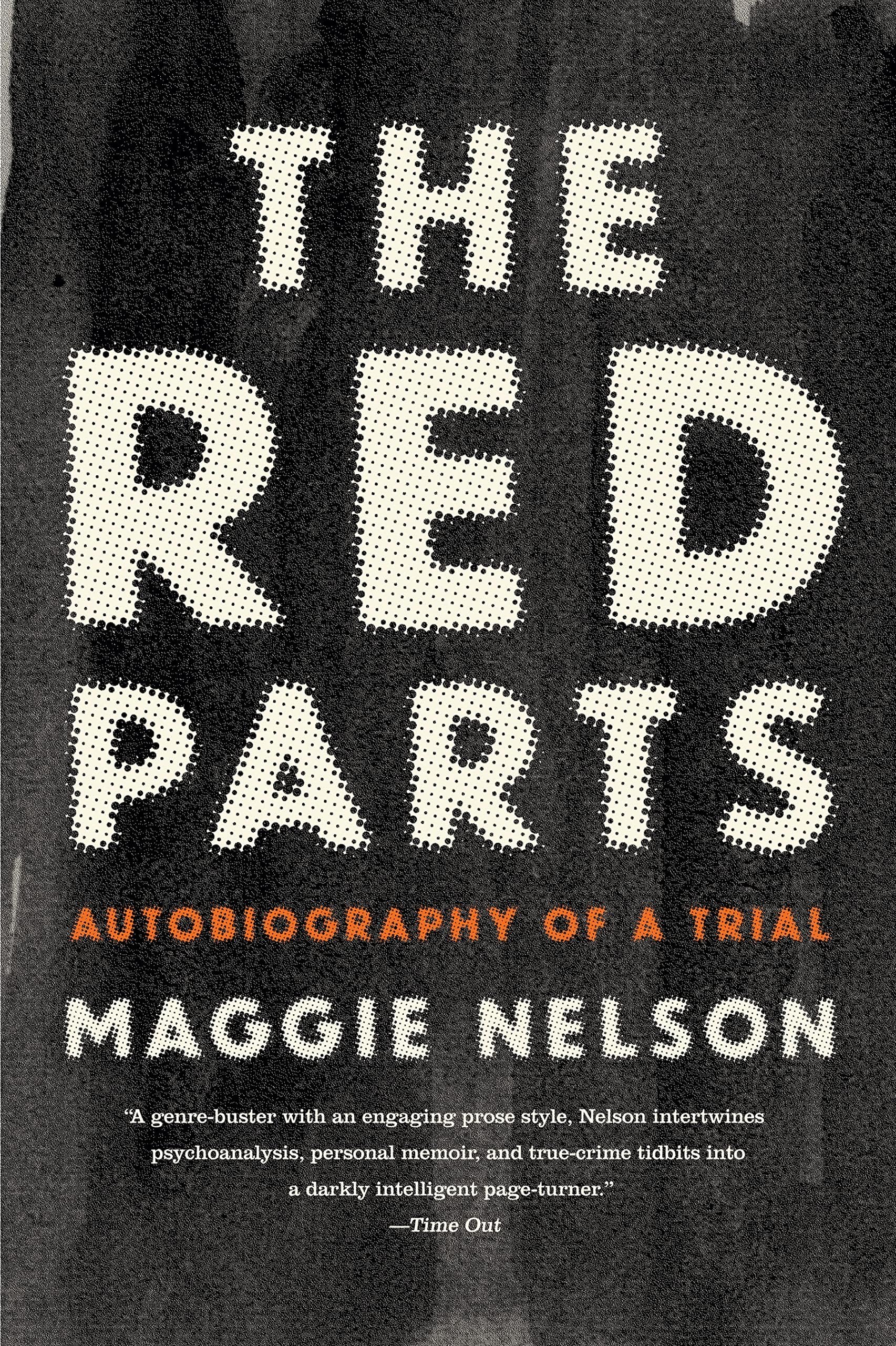

The Red Parts: Autobiography of a Trial
Product ID: 26474876
Desertcart purchases this item on your behalf and handles shipping, customs, and support to USA.
Late in 2004, Maggie Nelson was looking forward to the publication of her book Jane: A Murder , a narrative in verse about the life and death of her aunt, who had been murdered thirty-five years before. The case remained unsolved, but Jane was assumed to have been the victim of an infamous serial killer in Michigan in 1969. Then, one November afternoon, Nelson received a call from her mother, who announced that the case had been reopened; a new suspect would be arrested and tried on the basis of a DNA match. Over the months that followed, Nelson found herself attending the trial with her mother and reflecting anew on the aura of dread and fear that hung over her family and childhood--an aura that derived not only from the terrible facts of her aunt's murder but also from her own complicated journey through sisterhood, daughterhood, and girlhood. The Red Parts is a memoir, an account of a trial, and a provocative essay that interrogates the American obsession with violence and missing white women, and that scrupulously explores the nature of grief, justice, and empathy. Review: Difficult, nuanced, excellent - This is not a true crime book in the general sense. It's a memoir of a woman dealing with the family trauma of a murder trial. The murder itself is far removed in time, the author never met the victim, who would have been her aunt. Still, it's gripping stuff. Incredibly well-written, moving, terrifying, lyrical. I'm glad I read it, and am not sure that any other book will be as satisfying for a while after this. Review: The Michigan Murders Revisited - In late 2004, a Michigan man whose only previous conviction was for a forged prescription was charged with the murder of woman who was thought to be a victim of serial killer John Norman Collins. Collins murder spree occurred in the late sixties. Almsot forty years later, old ghosts were dug up at a courthouse in Ann Arbor. The Red Parts is the story of Collins case revisited, but focuses on the one murder that never really fit with the rest. Jane Mixer was not raped. She was not stabbed or dumped in a secluded area. All of John Collins victims fit that M.O. She was shot in the head once to kill her, shot again in the head and then strangled. Her body was then dumped in The Denton Road Cemetery off of Michigan Avenue, four miles outside Ypsilanti. Author Maggie Nelson is the niece of Jane Mixer. She recalls as a child picking up a book called The Michigan Murders and looking for information on the aunt she never met. Years later, as an adult, she would go through her aunt's journals and discover what she was really like, no longer just the victim of a famous serial killer. This would lead to a book called Jane: A Murder, published in 2004. That same year, on the eve of it's publication she would get a phone call from an Ypsi detective saying "Your aunt's case is moving forward." After all this time, they had a suspect who was not John Norman Collins. The rest of the book is the personal story of Nelson's life around the time of the trial of Gary Leiterman, the man who eventually was convicted of her aunt's murder. It reminded me more of a book like Sylvia Plath's The Bell Jar than a true crime book like The Michigan Murders. It's not just the facts, but more of a reflection on life, death, and justice. Nelson says she developed a "murder mind," an obsession with death and serial killers while researching Jane. The title has to do with the parts of the bible where Jesus spoke, which are often printed in red ink. When Nelson hears that term for the first time she immediately thinks of a disemboweled body, a symptom of her "murder mind." Overall the book is very well written and even if you have no interest in the case it's a good read. As I followed the case as it developed in 2004, it's especially interesting to read about it from an insider perspective. She describes the difficulty of seeing her aunt's autopsy photos with her family, as well as her relationship with the detectives, and Jane Mixer's college boyfriend. The death of Nelson's aunt affected her family not only for her mother's and grandparent's generation, but for her's as well, even though she wasn't even born when it occurred. The Michigan Murders happened forty years ago, and they still haunt Ypsilanti and Ann Arbor. If you have read The Michigan Murders, this book is probably as good a sequel and we can expect to get. It is perhaps the last twist of Michigan's most famous murder spree. The Mixer case itself is one of the most bizarre murder cases I have ever read about.
| Best Sellers Rank | #664,247 in Books ( See Top 100 in Books ) #170 in Serial Killers True Accounts #2,434 in Memoirs (Books) |
| Customer Reviews | 4.1 out of 5 stars 523 Reviews |
B**H
Difficult, nuanced, excellent
This is not a true crime book in the general sense. It's a memoir of a woman dealing with the family trauma of a murder trial. The murder itself is far removed in time, the author never met the victim, who would have been her aunt. Still, it's gripping stuff. Incredibly well-written, moving, terrifying, lyrical. I'm glad I read it, and am not sure that any other book will be as satisfying for a while after this.
M**T
The Michigan Murders Revisited
In late 2004, a Michigan man whose only previous conviction was for a forged prescription was charged with the murder of woman who was thought to be a victim of serial killer John Norman Collins. Collins murder spree occurred in the late sixties. Almsot forty years later, old ghosts were dug up at a courthouse in Ann Arbor. The Red Parts is the story of Collins case revisited, but focuses on the one murder that never really fit with the rest. Jane Mixer was not raped. She was not stabbed or dumped in a secluded area. All of John Collins victims fit that M.O. She was shot in the head once to kill her, shot again in the head and then strangled. Her body was then dumped in The Denton Road Cemetery off of Michigan Avenue, four miles outside Ypsilanti. Author Maggie Nelson is the niece of Jane Mixer. She recalls as a child picking up a book called The Michigan Murders and looking for information on the aunt she never met. Years later, as an adult, she would go through her aunt's journals and discover what she was really like, no longer just the victim of a famous serial killer. This would lead to a book called Jane: A Murder, published in 2004. That same year, on the eve of it's publication she would get a phone call from an Ypsi detective saying "Your aunt's case is moving forward." After all this time, they had a suspect who was not John Norman Collins. The rest of the book is the personal story of Nelson's life around the time of the trial of Gary Leiterman, the man who eventually was convicted of her aunt's murder. It reminded me more of a book like Sylvia Plath's The Bell Jar than a true crime book like The Michigan Murders. It's not just the facts, but more of a reflection on life, death, and justice. Nelson says she developed a "murder mind," an obsession with death and serial killers while researching Jane. The title has to do with the parts of the bible where Jesus spoke, which are often printed in red ink. When Nelson hears that term for the first time she immediately thinks of a disemboweled body, a symptom of her "murder mind." Overall the book is very well written and even if you have no interest in the case it's a good read. As I followed the case as it developed in 2004, it's especially interesting to read about it from an insider perspective. She describes the difficulty of seeing her aunt's autopsy photos with her family, as well as her relationship with the detectives, and Jane Mixer's college boyfriend. The death of Nelson's aunt affected her family not only for her mother's and grandparent's generation, but for her's as well, even though she wasn't even born when it occurred. The Michigan Murders happened forty years ago, and they still haunt Ypsilanti and Ann Arbor. If you have read The Michigan Murders, this book is probably as good a sequel and we can expect to get. It is perhaps the last twist of Michigan's most famous murder spree. The Mixer case itself is one of the most bizarre murder cases I have ever read about.
I**I
I like that God is present in the story and that ...
A stunning piece of writing . A powerful and deeply personal memoir that expound the grief of a family after a horrific act of violence. I like that God is present in the story and that the author doesn't sugar coat the horrific violence and how it effect not only the victim but those associated with the victim. There. Are a lot of chilling moments in this book told from a person that doesn't mince words. It is a fearless look at violence and its aftermath. This is a good read.
A**R
undoubtedly a compelling read that touches and examines the perpetual ...
undoubtedly a compelling read that touches and examines the perpetual problem of violence against women. Sadly, despite experiencing and carrying the burden of violence done to women for her entire life, the author supports one of the most vile, violent, and exploitative industries imaginable: pornography. When she announces in her book that she "likes porn" it truly cheapens the entire work as it makes one wonder what its creation and message could possibly have taught or meant to her if she can sustain such a contradictory interest and conclusion.
M**S
Original, ambitious, sensitive.
The Red Parts is, on top of everything, a very original book. Built on a family tragedy (the killing of the aunt of the author, before she was even born), the book has the backdrop of an improbable (but true) trial, trying to find the killer of Jane 36 years after the murder. With that, Maggie Nelson reflects on the long lasting impact some events have on a personal and family level, the transgenerational trauma and her own traumas derived from the hazards and challenges of her nuclear family life. The story is compelling, very well written, with a focus on the omnipresence of death and of view: she even describes photographs from the autopsy and the finding of the body, but refrains to show them in the book. As a reader, I was moved by Maggie Nelson’s profound sensitivity and her “defense” strategy: she shows feeling, but (to paraphrase Vivian Gornick), we know her through a transparent membrane: we can see, but we can’t touch. It seems as if even the deepest insight on one’s past and present is always elusive.
V**R
arrived on time
Book arrived on time but was disappointed in it. I assumed it was about the murder of the author's aunt but it was more a autobiography of the authors life which was not that interesting. Never finished the book and ended up giving it away
S**N
What Goes Beyond a Trial
I read Jane: A Murder, before I read this. While it isn't absolutely necessary too, I believe you should! You are already immersed in the story when you learn the ending. While the story will never end for the family, a sense of closure is found in no longer wondering. Fabulous blend of past, present, poetry and journal entries.
T**Y
A murder story, as told by the victim's self-centered, narcissistic niece.
Maggie Nelson never met her aunt Jane - Jane was murdered years before Maggie was born. Nevertheless, when the cold case unexpectedly breaks open decades later by new DNA evidence and a suspect is arrested, Maggie decides she must "bear witness" to the trial. She travels from NYC to Michigan to reunite with her mother, her grandfather, and other family to witness the proceedings. This could have been compelling but it mostly fails for me because the author's lack of focus and self-indulgence are too much of a distraction. There's no other way to say it: she comes off as a self-centered, narcissistic drama queen. She somehow takes a story about her murdered aunt and the man on trial for it, and makes it all about herself. Her avowed purpose was to "bear witness" to the trial, but she actually seems to have been rather bored by the trial, provides only scant detail about it, and instead treats us all to long, meandering daydreams about her lovers, ex-lovers, books she's read, other books she's written, childhood anecdotes, etc. There's an incredible human drama unfolding around her in this case, but most of it takes a back seat to what Nelson really cares about: her own precious insights and memories about tangential matters. There are also some episodes of self-aggrandizement that don't ring true. There are times when Nelson represents that she's so distraught by her loss that goes off alone and does things like walk around in the pouring rain, or lay down in the mud staring at the sky just thinking, thinking... But remember that Nelson's aunt died before she was born. She never knew her. Now, if an aunt or uncle I never knew was murdered, I'm sure I'd feel some sorrow over that and I'd especially feel sympathy for my parents, grandparents and other relatives who were more directly affected by it. But would that murder really haunt me throughout my life, would it cause me to occasionally lay down in the mud and stare at the sky? Of course not. It was during these moments of The Red Parts where the term "drama queen" comes to mind.
K**N
Excellent
Slightly roundabout indirect path to the trial which isn’t as central to the book as you’d think. She can write and this is well worth a read, especially if you enjoyed The Argonauts.
I**E
Excellent, meditative piece
In 1969 Nelson's Aunt Jane was brutally murdered and little progress was made on the case. Then in 2004 Nelson's mother was told that a suspect was in custody. Nelson's book follows the case from this point through to the suspect's trial. Her book is not a dry or sensationalist true crime narrative rather it is a thoughtful, beautifully written set of meditations on the loss of her aunt, the impact on her family, grief and the ways in which the formal justice system can or cannot address these things. The more of Nelson's work I've read the more impressed by her I am, an excellent piece.
C**A
Interesting
This is a unique look at the attendance at a trial from a family member of a woman who was murdered 35 years earlier. Interesting read
L**.
NOT AS GOOD AS "JANE"
I much prefer Ms Nelson's JANE, her earlier book about her aunt Jane's murder. I was disappointed with The Red Parts as it is so intellectual and less about the heart. That said, Ms Nelson is a wonderful writer and I would recommend anything that she puts pen to.
F**S
excellent
i loved this book even though the subject matter was dark. partly it was because i identified so strongly with how her mind seemed to be processing the past and the present. if you are looking to read a straightforward true crime then this isnt for you. it has a very simular feel to "the fact of a body " in that its a multilayered inquiry into tragedy and how it resonates throughout the lives of the people involved within it. she captures so well how these things can unroot us from the ground we stand upon. my favourite quote reflecting this is "a dark crescent of land, where suffering is essentially meaningless, where the present collapses into the past without warning..............where grief lasts forever and its force never fades"
Trustpilot
2 weeks ago
1 month ago