🔗 Connect Like a Pro, Last Like a Legend
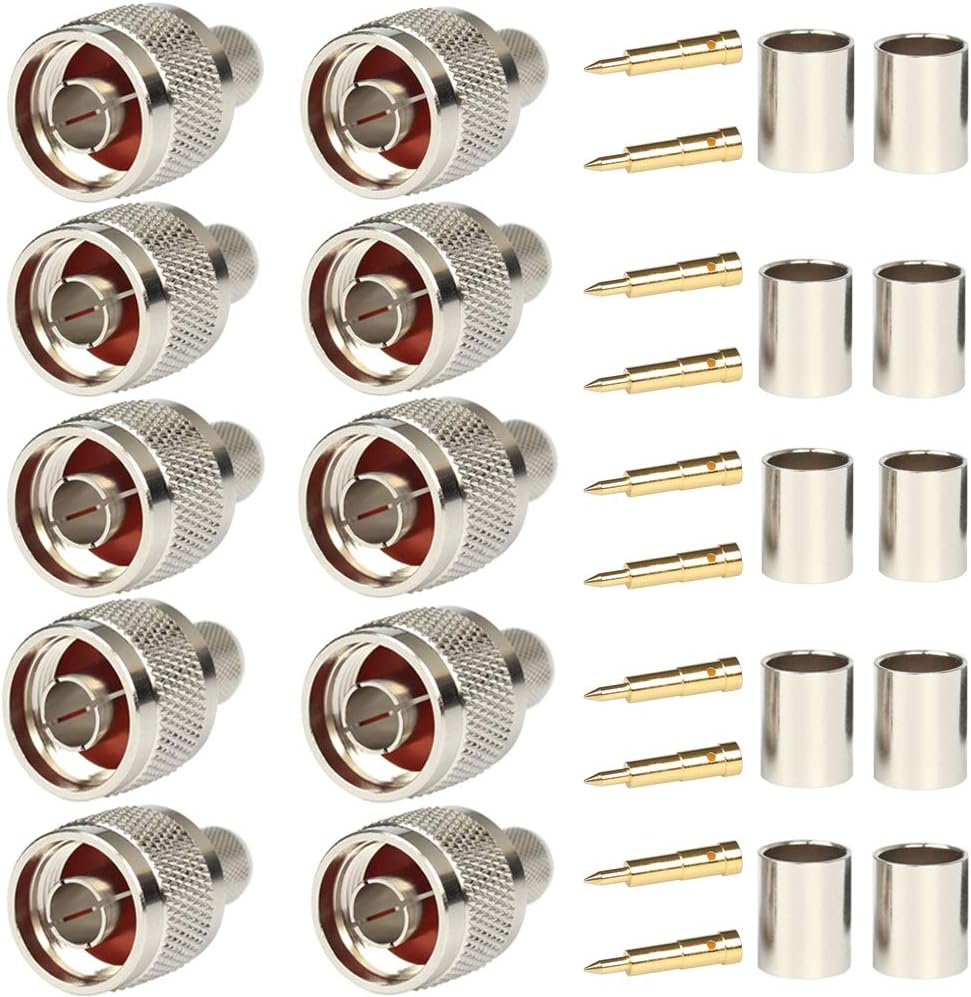
This 10-pack of N Male Plug Crimp RF Coaxial Connectors features nickel-plated brass bodies and gold-plated pins with PTFE insulation, delivering reliable 50 ohm impedance and low signal loss (VSWR <1.3 up to 6 GHz). Designed for easy crimp installation on LMR-400, Belden 9913, and RG8 cables, these connectors withstand harsh environments with a 48-hour salt spray rating and operate between -40°C and +85°C. Each connector includes a black heat shrink tube for water resistance and offers over 500 durable crimp cycles, ensuring professional-grade wireless communication setups that last.
| ASIN | B0779ZQKS8 |
| Best Sellers Rank | #87,551 in Electronics ( See Top 100 in Electronics ) #214 in Coaxial Cables #162,418 in Electronics Accessories & Supplies |
| Item model number | N-C-J400-2 |
| Manufacturer | Riotaxy |
| Package Dimensions | 21.59 x 16.1 x 3.51 cm; 290 g |
R**E
For years I've fought with N-connectors. I love them for function...but I hate assembling them. Probably because I've picked up loads of used solder-style N-connectors at swap meets and have disassembled and reassembled them with mixed success. Boy, are there a lot of different types; externally they all look alike but internally there is quite a variety. I finally treated myself to the crimp style, which of course means I had to buy a crimping tool. I bought the rmsdeal77, also at Amazon because it has the die for LMR400 and at $28 seemed like a reasonable price (see my separate review for the crimping tool). And I bought this 10-pack of N connectors by Riotaxy. Price seemed fair and I appreciated that they show the engineering dimensions of the connector. As you know, LMR400 has a copper-plated aluminum inner conductor, which seems to be just a skootch larger in diameter than some N-connector center pins will accept. These Riotaxy connectors fit the inner conductor just fine. Upon receiving the connectors and the crimping tool I went ahead and installed a couple of N-connectors on a 100ft length of LMR400. Here are a few hints that might help you out - I found that a hacksaw is a good way to cut the cable before installing the connector. You can use a large wire cutter but it tends to somewhat distort and crush the inner dielectric foam. You want a perfect circular cross-section to crimp to. There are some YouTube videos that show how to crimp an N-connector that are worth a view. I don't have a fancy LMR400 cable stripper tool; I just used a sharp pen knife. For dimensions, you can find on the web a PDF chart by Amphenol called "Assembly Instructions - C11 N-Type" that shows how far back to strip the jacket and how much inner conductor to expose for a variety of cables. This worked fine for my LMR400. I used a micrometer to measure where to cut. These connectors allow you to either solder the center pin, or crimp it. Being a Chinese connector, which are notorious for using metal platings that are very difficult to solder, I elected to crimp the center pin. Note - of the 10 connectors I got, 9 of them had center pins that allow soldering, having the tiny little hole on the side where you introduce the solder. One of them had no hole. I'll assume this was a QC problem. Didn't matter to me because I was going to crimp anyway, but I would have been annoyed if I had intended to solder it. The rmsdeal77 tool crimps the center conductor perfectly - use the 0.128 slot on its die. And of course, use the large 0.429 slot on the die for the outer ferrule. I firmly tugged on both the center pin crimp and the ferrule ring crimp and they were both secure. One last piece of advice - unless you're a "what could possibly go wrong?" type of person, use an ohmmeter and check that you don't have a short between the center conductor and outer shield before you make that ferrule crimp. Just one whisker of shield touching the center conductor will ruin the entire operation. And there is no going back once you've made the ferrule crimp. Just saying. N-connectors are favored because they are water-tight. If you've taken apart standard solder-type N-connectors you can see the various rubber gaskets inside. These Riotaxy connectors do not appear to have internal gaskets other that the large red one inside the shell where it mates to the female receptacle. The connector comes with a short length of heat shrink that is to be shrunk over the outer ferrule. I think this is where the resistance to water getting into the outer shield comes from. So don't forget to 1) slip it over the cable BEFORE you assemble the connector, and 2) definitely slide it over the ferrule and heat shrink it once you've made the ferrule crimp.
D**R
Used on some LMR400 and it fit perfectly.
R**N
ok
J**N
My team has ordered these in the past with great success. Arrived on time and great quality.
M**K
I had no issue with these on LMR400 style coaxial cable. I have used quite a few of them now. There is one issue.... th included heatshrink has no glue, and it's too short of a piece. If that is rectified then these would be a great kit. As it stands now they are great connectors for the price but I had to throw out the included heatshrink. For that it loses a star.
Trustpilot
2 weeks ago
2 days ago