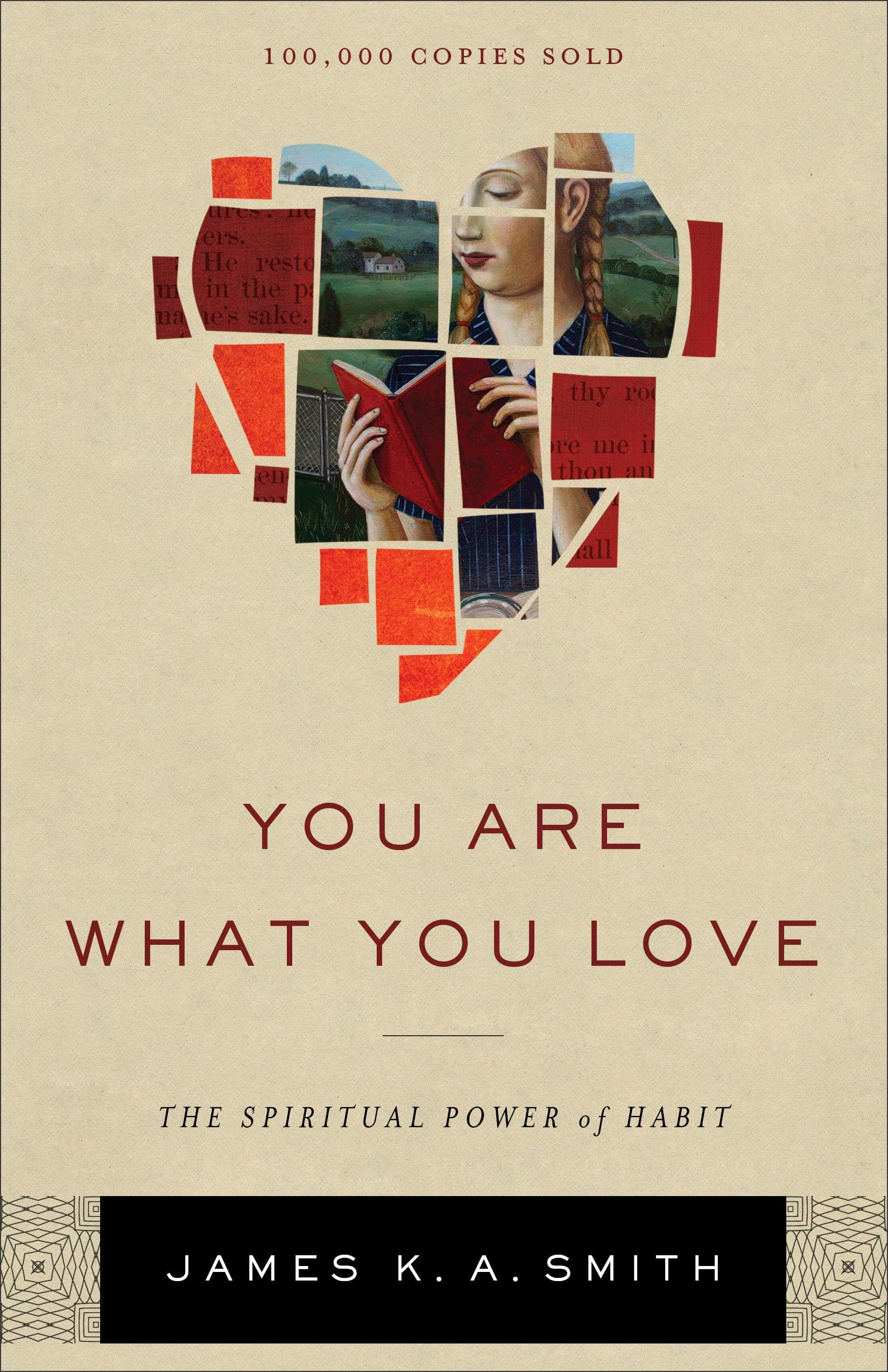
You Are What You Love: The Spiritual Power of Habit | Examining How Culture Shapes Us | Deepening Discipleship through Christian Practices
Product ID: 26075713
Desertcart purchases this item on your behalf and handles shipping, customs, and support to USA.
Christianity Today Book Award Winner ● Martin Institute and Dallas Willard Center Book Award You are what you love. But you might not love what you think. Who and what we worship fundamentally shape our hearts. We may not realize, however, the ways our hearts are taught to love rival gods instead of the One for whom we were made. And while we desire to shape culture, we are not often aware of how culture shapes us. In this book, popular speaker and award-winning author James K. A. Smith helps us recognize the formative power of culture and the transformative possibilities of Christian practices. Includes: ● film, literature, and music illustrations to engage readers ● new material on marriage, family, youth ministry, and faith and work ● individual and communal practices for shaping the Christian life Review: Discipling Our Desires - You Are What You Love by James K. A. Smith is a small book with large ambitions. It aims to reshape the way evangelical Christians understand discipleship, replacing their emphasis on thought with an emphasis on desire. Rather than saying, “You are what you think,” Smith urges Christians to say, “You are what you love.” For Smith, this reshaping of discipleship is not something new, but something old. Both the Bible and the pre-Enlightenment Christian tradition taught that “the center of the human person is located not in the intellect but in the heart.” For example, consider Jesus’ words in Matthew 15:19: “out of the heart come evil thoughts—murder, adultery, sexual immorality, theft, false testimony, slander.” Or consider Augustine: “You have made us for yourself, and our heart is restless until it rests in you.” Jesus’ words reveal that the heart orients us toward evil thoughts and evil deeds. Change the heart, and the thoughts and actions will follow. Augustine’s words remind us that our heart is oriented toward a telos, an end or goal, a vision of human flourishing. Because God made the heart, only the heart that seeks His telos—the kingdom—finds rest. Every other kingdom leaves our hearts weary and restless. The problem is, how do you disciple the heart? How do you properly form human desire? Through practice, which develops habits. A cousin of mine likes to say that practice makes permanent. That’s as true for playing the piano as for developing moral character. What we do repeatedly shapes who we are. According to Smith, the practices that shape our hearts can be called “liturgies,” a churchy term for the order of worship. Martin Luther said, “Whatever your heart clings to and confides in, that is really your god.” There is a liturgy, then, that develops a good heart for the true God. There are also liturgies that develop bad hearts for false gods such as consumerism. Smith urges us to take a “liturgical audit” of our lives to make sure our practice is oriented toward the proper telos, God and His kingdom, not some lesser goal. Smith uses the term liturgies expansively. In the final three chapters of the book, he uses it to describe Christian practices in the home, at school, and in one’s vocation. The heart of his book concerns the worship practices of the gathered church, however. It is here that the Christian heart is most formed. Smith states that his book “articulates a spirituality for culture-makers, showing…why discipleship needs to be centered in and fueled by our immersion in the body of Christ. Worship is the ‘imagination station’ that incubates our loves and longings so that our cultural endeavors are indexed toward God and his kingdom.” For him, worship is about “formation” more than “expression.” It is God himself meeting us to shape us into the kind of people who do His will, not just an outpouring of our sincere feelings about Him. (Pentecostals might be tagged as “expressivists” because of their exuberant services, but it seems to me that their theology of spiritual gifts aligns with the notion that God is the agent of worship, not just its audience.) Seen this way, and mindful that practice is repetitious, Smith urges Christians to hew closely to the traditional “narrative arc” of worship—which consists of gathering, listening, communing, and sending—and to eschew “novelty.” (He’s not talking about the “worship wars,” by the way. This has to do with the structure of the worship service, not the style of its music.) That liturgy “character-izes” us, meaning, it shows us that we are “characters” in God’s story and then forms the appropriate “character” in us. Interestingly, Smith argues that Christian cultural innovators need to be rooted in Christian liturgical tradition: “the innovative, restorative work of culture-making needs to be primed by those liturgical traditions that orient our imagination to kingdom come. In order to foster a Christian imagination, we don’t need to invent; we need to remember. We cannot hope to re-create the world if we are constantly reinventing “church,” because we will reinvent ourselves right out of the Story. Liturgical tradition is the platform for imaginative innovation.” I hope I have accurately and adequately communicated the gist of You Are What You Love. It is a thoughtful, thought-provoking book that I would encourage pastors, church leaders, and interested laypeople to read. Having said that, though, I want to make two “yes, but” points. First, yes desire, but also thought. In other words, I agree with Smith that the heart is the heart of discipleship. This is a point on which evangelicals should unite, whether they are heirs to Jonathan (“religious affections”) Edwards or John (“heart strangely warmed”) Wesley. I am concerned, however, that Smith has swung the pendulum too far toward a discipleship of desire in order to compensate for the tendency in evangelicalism to swing the pendulum too far toward a discipleship of thought. This is, admittedly, an impressionistic critique. Smith is a philosopher and theologian in the Reformed tradition, after all, and the Reformed are known to be punctilious about doctrine. Still, I would’ve liked to see more on the discipleship of the mind in the book. Second, yes process, but also crisis. A process-orientation in discipleship focuses, as Smith does, on the development of spiritual habits. A crisis-orientation focuses on the necessity of decision. The characteristic forms of process-oriented discipleship are stable liturgies, the sacraments, and spiritual disciplines. The characteristic form of crisis-oriented discipleship, at least among evangelicals, is the altar call. As a Pentecostal, I would also add the call to come forward for Spirit-baptism or healing. There is little place for crisis in Smith’s book. Perhaps this is an overreaction to the crisis-orientation of evangelicalism and Pentecostalism, which often leave little room for process. Still, it seems to me that both are necessary to discipleship. Wesley was no slouch when it came to process. His followers weren’t called “Methodists” for nothing, after all. But he still stood outside the mines and called miners to repentance and faith. I didn’t see that in Smith’s book. These two “yes, buts” notwithstanding, I intend to re-read and meditate further on Smith’s book. As a Pentecostal, I disagree with certain aspects of Smith’s Reformed liturgical heritage (infant baptism, for example), even as I am challenged by the overall thrust of the book. The heart is the heart of the matter. Any discipleship that fails to take that truth into account fails to achieve its aim. Review: slow down & soak it in - This book took my mind and heart in a different direction. I expected questions to reveal what I love and instead, JKAS used logic and grace to show me the rhythms I have accepted, adapted to, and live in that keep me numb from my true love: God. This book needs a slow read and deep reflection.


| Best Sellers Rank | #8,349 in Books ( See Top 100 in Books ) #12 in Ritual Religious Practices #162 in Christian Theology (Books) #286 in Christian Spiritual Growth (Books) |
| Customer Reviews | 4.5 out of 5 stars 1,794 Reviews |
G**D
Discipling Our Desires
You Are What You Love by James K. A. Smith is a small book with large ambitions. It aims to reshape the way evangelical Christians understand discipleship, replacing their emphasis on thought with an emphasis on desire. Rather than saying, “You are what you think,” Smith urges Christians to say, “You are what you love.” For Smith, this reshaping of discipleship is not something new, but something old. Both the Bible and the pre-Enlightenment Christian tradition taught that “the center of the human person is located not in the intellect but in the heart.” For example, consider Jesus’ words in Matthew 15:19: “out of the heart come evil thoughts—murder, adultery, sexual immorality, theft, false testimony, slander.” Or consider Augustine: “You have made us for yourself, and our heart is restless until it rests in you.” Jesus’ words reveal that the heart orients us toward evil thoughts and evil deeds. Change the heart, and the thoughts and actions will follow. Augustine’s words remind us that our heart is oriented toward a telos, an end or goal, a vision of human flourishing. Because God made the heart, only the heart that seeks His telos—the kingdom—finds rest. Every other kingdom leaves our hearts weary and restless. The problem is, how do you disciple the heart? How do you properly form human desire? Through practice, which develops habits. A cousin of mine likes to say that practice makes permanent. That’s as true for playing the piano as for developing moral character. What we do repeatedly shapes who we are. According to Smith, the practices that shape our hearts can be called “liturgies,” a churchy term for the order of worship. Martin Luther said, “Whatever your heart clings to and confides in, that is really your god.” There is a liturgy, then, that develops a good heart for the true God. There are also liturgies that develop bad hearts for false gods such as consumerism. Smith urges us to take a “liturgical audit” of our lives to make sure our practice is oriented toward the proper telos, God and His kingdom, not some lesser goal. Smith uses the term liturgies expansively. In the final three chapters of the book, he uses it to describe Christian practices in the home, at school, and in one’s vocation. The heart of his book concerns the worship practices of the gathered church, however. It is here that the Christian heart is most formed. Smith states that his book “articulates a spirituality for culture-makers, showing…why discipleship needs to be centered in and fueled by our immersion in the body of Christ. Worship is the ‘imagination station’ that incubates our loves and longings so that our cultural endeavors are indexed toward God and his kingdom.” For him, worship is about “formation” more than “expression.” It is God himself meeting us to shape us into the kind of people who do His will, not just an outpouring of our sincere feelings about Him. (Pentecostals might be tagged as “expressivists” because of their exuberant services, but it seems to me that their theology of spiritual gifts aligns with the notion that God is the agent of worship, not just its audience.) Seen this way, and mindful that practice is repetitious, Smith urges Christians to hew closely to the traditional “narrative arc” of worship—which consists of gathering, listening, communing, and sending—and to eschew “novelty.” (He’s not talking about the “worship wars,” by the way. This has to do with the structure of the worship service, not the style of its music.) That liturgy “character-izes” us, meaning, it shows us that we are “characters” in God’s story and then forms the appropriate “character” in us. Interestingly, Smith argues that Christian cultural innovators need to be rooted in Christian liturgical tradition: “the innovative, restorative work of culture-making needs to be primed by those liturgical traditions that orient our imagination to kingdom come. In order to foster a Christian imagination, we don’t need to invent; we need to remember. We cannot hope to re-create the world if we are constantly reinventing “church,” because we will reinvent ourselves right out of the Story. Liturgical tradition is the platform for imaginative innovation.” I hope I have accurately and adequately communicated the gist of You Are What You Love. It is a thoughtful, thought-provoking book that I would encourage pastors, church leaders, and interested laypeople to read. Having said that, though, I want to make two “yes, but” points. First, yes desire, but also thought. In other words, I agree with Smith that the heart is the heart of discipleship. This is a point on which evangelicals should unite, whether they are heirs to Jonathan (“religious affections”) Edwards or John (“heart strangely warmed”) Wesley. I am concerned, however, that Smith has swung the pendulum too far toward a discipleship of desire in order to compensate for the tendency in evangelicalism to swing the pendulum too far toward a discipleship of thought. This is, admittedly, an impressionistic critique. Smith is a philosopher and theologian in the Reformed tradition, after all, and the Reformed are known to be punctilious about doctrine. Still, I would’ve liked to see more on the discipleship of the mind in the book. Second, yes process, but also crisis. A process-orientation in discipleship focuses, as Smith does, on the development of spiritual habits. A crisis-orientation focuses on the necessity of decision. The characteristic forms of process-oriented discipleship are stable liturgies, the sacraments, and spiritual disciplines. The characteristic form of crisis-oriented discipleship, at least among evangelicals, is the altar call. As a Pentecostal, I would also add the call to come forward for Spirit-baptism or healing. There is little place for crisis in Smith’s book. Perhaps this is an overreaction to the crisis-orientation of evangelicalism and Pentecostalism, which often leave little room for process. Still, it seems to me that both are necessary to discipleship. Wesley was no slouch when it came to process. His followers weren’t called “Methodists” for nothing, after all. But he still stood outside the mines and called miners to repentance and faith. I didn’t see that in Smith’s book. These two “yes, buts” notwithstanding, I intend to re-read and meditate further on Smith’s book. As a Pentecostal, I disagree with certain aspects of Smith’s Reformed liturgical heritage (infant baptism, for example), even as I am challenged by the overall thrust of the book. The heart is the heart of the matter. Any discipleship that fails to take that truth into account fails to achieve its aim.
D**E
slow down & soak it in
This book took my mind and heart in a different direction. I expected questions to reveal what I love and instead, JKAS used logic and grace to show me the rhythms I have accepted, adapted to, and live in that keep me numb from my true love: God. This book needs a slow read and deep reflection.
J**Y
Growth in Grace Through Addressing the Heart
James K.A. Smith is onto something. In evangelical culture too often the pathway to spiritual growth has been seen as the impartation of information rather than an appeal to the affections. Smith rightly points out that what we believe or say we believe often doesn't reveal itself in our daily lives. And that is because beneath our thoughts there is this matter of our affections and our will, what the Bible often calls "the heart." The issue is not mere knowledge but using knowledge to transform the will and affections. Smith tells us that we already have a heart that is tuned by culture and background toward certain behaviors and outlooks. Most of our daily actions play out deeply influenced by this cultural backdrop. If we are to live as followers of Jesus, Smith says we must recognize the importance of the heart and address the heart by reshaping our habits to those things to which Jesus calls us. The bad news is more knowledge is not going to make you a faithful Christian. The good news is that you can direct your heart through adjusting your habits to desire to follow Jesus and thus begin to actually pattern your life to His call. Smith seems to say that the primary place for this re-calibration is corporate worship. Here he sees many problems with the mega church model, with youth ministry, with people-centered rather than God-centered worship. Smith leans strongly in the direction of Robert Webber, advocating a return to ancient patterns of worship as a key to guiding the heart into good habits. Here I find some agreement, but would argue that worship can be greatly varied while still achieving much of what Smith advocates. The Holy Spirit is able to work through all sorts of expressions of the faith. Additionally, Smith in the book somewhat undersells the significance of personal time spent with God and the value of deep spiritual relationships outside of church. Perhaps he emphasizes what he does because evangelical culture has tended to de-emphasize worship, but these other avenues are quite important as well. The book is written in a lively style and I highly commend the talks Smith has given on the themes of this book which are widely available online as a good supplement to what is written here.
A**S
Discipleship and spiritual formation are not primarily about gaining new information but being formed over time through habit
I have been influenced by James KA Smith over the past several years more than almost any other author. In the last three years I have read five books and a number of shorter articles, not to mention watching at least a dozen lectures. And I do not think I am alone. I was in a private Facebook theology discussion yesterday when in 110 comments, Smith was referenced at least 8 times with no less than four of his books directly mentioned or hinted at. There is a reason Smith is becoming influential. He is speaking to several issues that are important and prominent. You Are What You Love: The Spiritual Power of Habit is the latest attempt both to deal with the issues and the first book to really attempt to speak to a lay audience about them. There are three real points being made in the book. First, we are not solely intellectual beings. God created us with intellects and brains, but also emotions and unconscious bias. We are not, to use his common phrase, "Brains on a stick." We are fully human, and we are intended to be that way by God. That may not seem like a big deal, but much of Christian culture has understood us to be Brains on a Stick. Our evangelism, discipleship and spiritual growth are often primarily oriented toward the intellect. There is also the anti-intellectual parts of Christianity. But they are in many ways just as oriented toward the Brain on a Stick idea, just using the insight in a different method. The second point is that because we are not brains on a stick, we need to take into account the various ways that we are influenced and shaped. Jamie Smith uses the term 'liturgies' to describe the shaping activities that are all around us. Going to the mall is a consumerist liturgy. The bright airy buildings give us comfort and place. Our five senses are being engaged by Cinnabon and the skylights and the comfortable seating areas. We are being shaped by the feeding of our desires and absorbing our place in the world as consumer. Sports have a different liturgy. We feel a participant in something greater than ourself, we have the us vs them mentality encouraged. Smith uses Liturgy to talk about the subtitle of the book, how any repetitive activity shapes us over time. As Christians, we want to be shaped to become Lovers of God so that we will become more like God and love the things that God loves. So Smith defends the concept of habit as spiritual formation. This includes, but is not limited to understanding our weekly Sunday morning worship and 'quiet times'. You Are What You Love has an extended discussion of how these liturgies work in families, with children and education, and for adults through vocation. The illustration of these three chapters at the end moves the book from theoretical to illustrative, giving the reader a framework to see both habit and culture in new ways. I have been convinced over time that worship should not be primarily about hearing a 45 minute informational message that encourages us to work harder or gives us more information, which we then are expected to put to use at home on our own. For Smith, our church worship should be focused on a sacramental re-orienting of loves to God. That re-orienting through sacramental worship is not a once a week fill up that gives us what we need until we come back again the next week to top off the tank. But the re-orientation should be the grounding in a communal re-orientation that continues throughout the week among that same community.
P**L
You Are What You Love and I Love This Book!
Thank you Anthony Spallone. I remember when you were over my house for dinner and we were talking about good books and this one came up. I remember the amazement in your voice and on your face when you said “You have not read this yet??? You have to read this book!” It took way too long for me to take your advice. I wish I would have picked up it the next day. Even though this book’s content is very similar to what I already read in Smith’s “Desiring the Kingdom,” I found the presentation of the content in this book to be superior. I highly recommend this book for all Christians and especially church leaders. I think it is safe to say that almost half the book is highlighted for me. One new habit that I will be sure to implement is to encourage church members to read this book. I also think I will be reading this again with my wife. I have already got the elders of our church to start going through it with me.
A**R
Required Reading for Christians
As a practicing Lutheran in an area where many fellow Christians look down on liturgy, this was a refreshing read! Smith put into words things I knew in my soul thanks to the Spirit but didn’t know how to explain. I enjoyed every chapter and had to try to not highlight or write notes on every page. The last chapter was especially delightful and encouraging as an artist and art teacher. If you are curious about liturgy and what it means to the Christian faith, take time to read! If you are familiar with liturgy and wondered if it is still important in a post-modern world, take time to read!
O**S
Love it !
This was a required reading for my ethics class in seminary. I love it! As a person growing in love for liturgy this book helped me to see the implications of liturgies, rituals, and practices in daily life. I hope more people can read this book .
A**R
Smith will give you lots to think about.
There is a lot of meat in this book, however I did not enjoy reading it. It was more informative than inspirational. This was a bookclub choice. The person reviewing the book sent an email about 2 weeks before the club met. She said you had better get started on this book. It is not a fast read, it reads like a textbook. She hit the nail on the head---that is exactly the way it reads There is much to think about, some of it I agree with and other facts I would like to ask Smith to explain. I was not surprised to find that James Smith is a young man and a well informed young man. He evidently goes to movies, reads books and keeps up with the music of today. He is just as tuned into true literature as he is to contemporary literature. I felt him to be a bit of a show off academically, maybe? He makes the point that you are what you love, although you may not love what you think you love because there is an unconscious component that contributes to forming what one really loves. He made the statement, "You can't not love.", I wonder? Some people are unloveable. Do these people know how to love? James also said, "Not many people confront who they really are.", interesting. There is a good discussion on worship. In Smith's opinion people actually want to confess when they have sinned. He asked the question,"What are we here for? You will have to read the book to find out the answer to this one. Actually this is a rich book. The format and the wording and the way it's presented is lacking.
G**O
Augenöffnend
Ein spannendes Buch über Anbetung (mehr als Musik) und wie Dinge, die wir tun, nicht neutral, sondern auf ein Ziel ausgerichtet sind. Seine Beschreibung davon, wer Menschen sind und was sie wollen, lieben und verlangen, ist augenöffnend und herausfordernd gleichzeitig. Manchmal zu herausfordernd, ungemütlich und unbedingt im Kontext zu verstehen. James K.A. Smith weiß, was er tut, glaubt, lehrt und lebt und hat seine Sichtweise auf durchdachte und überführende und überzeugende Weise dargestellt. Es ist nicht das typische „ich sage euch, was ihr sowieso schon wisst“-Buch. Unbedingt zu empfehlen das Buch zu lesen, eventuell auch mit Leuten zu diskutieren.
R**N
Love
I've read 7 pages and I've already had a tear to my eye and i've become a much purer person. This has been written by an absolute genius. It's easy to miss his teachings but for the right people at the right time this is an absolute gem! But I'm only 7 pages in.. heh heh heh
S**S
Five Stars
For me this book is a game changer, thank you Jamie Smith
M**E
detalhista e essencial para o cristão
Este livro me trouxe uma visão sobre o papel do cristão no mundo e sobre os hábitos litúrgicos e sua importância para cumprirmos nosso chamado como filhos de Deus que me abriu os olhos
C**S
Book Review: You are What You Love
In "You are What You Love," James Smith contends that it is our hearts, not our heads, that rules the passions, habits, and routines of our lives. The author points out that contemporary thinking credits our mind as being the one at the driver’s seat in deciding how we should order and live our lives. However, Smith argues from Scripture, philosophy, and experience that it is our hearts that need to be recalibrated before any long-lasting, transformative change can take place. The premise of the book is that our surrounding culture pulls us away from God through ungodly liturgies and our best strategy to counter such attacks is by reorienting our hearts through developing godly liturgies and practices. The first step then is to discern what cultural liturgies we undertake regularly without much thought and determine what underlying values are informing such practices. For example, Smith explains how our visits to the mall can be viewed as worship in a modern-day pagan temple as it seeks to attract thousands of restless souls to come find fulfillment and happiness through consumerism. Nevertheless, those who enter are not only unsatisfied but leave with thoughts of envy, self-loathing, and despair. In each chapter, Smith goes on to dissect key areas of our lives to unmask how cultural liturgies inform the way we live. To effectively recalibrate our hearts Godward, Smith proposes that we need to return to the rich heritage of the Christian faith and adapt classical liturgies that the church has practiced through the centuries into the rhythms of everyday tasks and routines. The author argues that rooting ourselves in the trusted old paths of our Christian forerunners is the most effective approach to guide our heart affections through the onslaught of antagonistic provocations by our culture. I gladly recommend this book to all Christians as we find society’s worldviews to be increasingly hostile to the Christian faith. The New Testament is replete with warnings that the world is staunchly anti-Christ thus believers need to be vigilant and prepared to counter Satan’s attacks. Smith asserts that the war for our allegiance is not fought in the mind but in the heart. By integrating the classical liturgies of our robust Christian faith such as prayer and catechisms into our everyday routines, our heart affections will be reshaped to yearn for more of Christ and less of the world. Most importantly, we should not view these liturgies as the ultimate goals but the means of grace by which we can grow in the grace of God and by the power of His Spirit.
Trustpilot
1 month ago
1 week ago