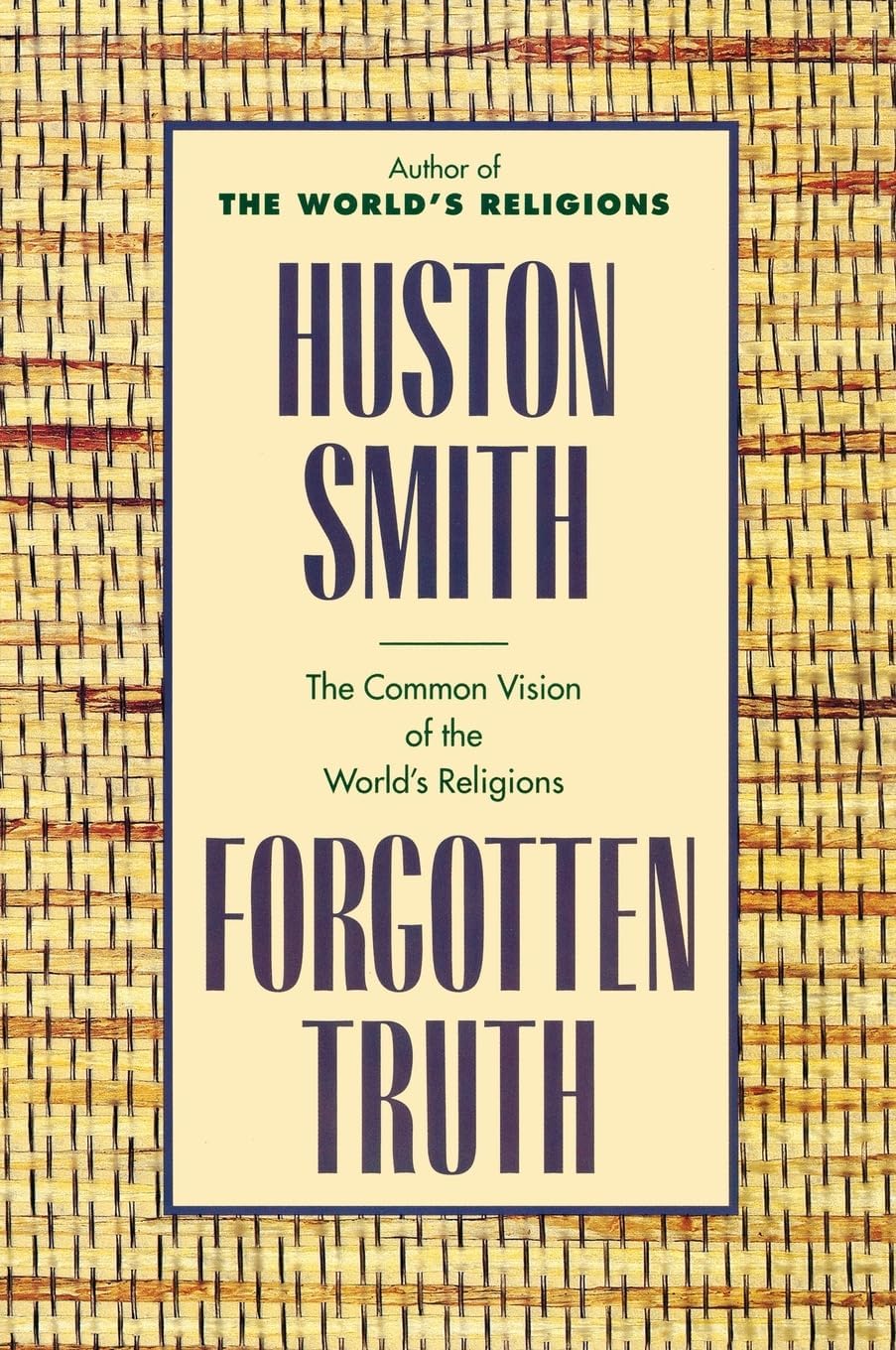
Forgotten Truth: The Common Vision of the World's Religions – The Classic Companion to the Unity Underlying World Religions
Product ID: 25726109
🌐Universal religious unity
📚Concise yet profound insight
🕊️Timeless spiritual wisdom
Desertcart purchases this item on your behalf and handles shipping, customs, and support to USA.
🌟 Discover the timeless truth behind every faith — your gateway to global wisdom!
Forgotten Truth is a concise, highly regarded companion book revealing the profound unity underlying the world's major religions. It offers an accessible introduction to the esoteric and metaphysical assumptions shared across diverse spiritual traditions, making it an essential read for those seeking to understand the perennial philosophy and the spiritual foundations of both Western and Eastern civilizations.
| Best Sellers Rank | #461,078 in Books ( See Top 100 in Books ) #510 in Comparative Religion (Books) #628 in Religion & Philosophy (Books) #908 in Religious Philosophy (Books) |
| Customer Reviews | 4.4 out of 5 stars 57 Reviews |
D**R
An excellent introduction to the underlying metaphysical and mythological assumptions of the "primordial religions"
This very small book is simply the best book introduction to the sacred worldview of world religions that exists. If one wants to understand the esoteric wisdom behind the great religions, read this book. If one wants to understand the basis of the perennial philosophy as defined in the twentieth century, read this book. If you wish to grasp the underlying metaphysical and mythological assumptions of Western Civilization until around the 15th century, and the continuing metaphysical-mythological assumptions underlying Eastern Asian philosophy, read this book.
N**P
Quality service and product
This book was purchased for a customer who was very happy to get it when it arrived.
J**R
What You See Is Not ALL There is
Smith's book is a refreshing non-Christian assessment of the irrational consensus stretching across the various segments of American culture, at least as far as I can see it. Over the past 50 years, with greater or lesser intensity, Americans have grown cynical and suspicious of any claims to truth other than that which their senses can validate and their perceptions confirm. This is not an entirely new phenomenon in absolute essence. From the arrival of the Puritans right up throgh the classical enlightenment of Colonial times and extending even, though significantly lessened, through the Romantic 19th century, and certainly in the early Modernist 20th century, Americans have always prided themselves on being "practical." Our approach to religion, politics, art and literature has been influenced, if not conditioned, by the screening grid of "what works?" But within that prevailing practicality Americans had certain values, misplaced perhaps but real, that limited that practicality. Though not a philosophical community, Americans were yet disposed toward the idea of "the beautiful", the pursuit of "quality", the social imperative of the American "Dream", the unquestioned assumption that we had "hit" upon that blend of freedom/responsibility/encouragement which was the key to human development and future prosperity. We were unabashedly evangelistic. Promoting our ways and our ideas, with some success and with too much arrogance, and exporting our institutions throughout the world. In other words, we had a "world view" that formed a central unifying idea. Immigrants were "assimilated" into this view. Cultural distinctives were precious but subordinate. To be "Southern" was to embrace secondary ideas about life in these United States that were never-the-less absolutely subordinate to the higher claim of being an "American." I submit that even the shameful issue of race relations was characterized by this approach and I would submit the evidence of the proud performance of non-white Americans in ALL the wars of the period. But that changed. The common embrace of intangibles dissolved under the influence of vicious political power plays, the dedicated strategy of radical elitist academics and intellectuals, and the rise of "selfish me-ism" sensuality that characterized the masses of the post-1960's populace. Something had to fill the void created by the dismissal of abstract "values." That which was confidently advanced was "scientism" - the belief that the only true "truth" is that which can be established by the principles of formulaic validation and predictive behavior. It showed up across the board. Education theory became the subject of endless, repetitive, and often contradictory "studies." "Studies prove..." became the unquestioned warrant for whatever hare-brained agenda some demagogue wanted to advance. "Prove it" was the underlying demand that opened the door for the idea that everyone's opinion is of equal value no matter what their qualifications on the subject being discussed. Consensus dissolved, intellectual and moral anarchy has prevailed and now, simply, there is no dream. All we have left is the sterile imbecility of moral license and the reductionist straight-jacket of impressionist thinking. In a social structue where in "quality" is not recognized, where "advancement" in personal virtue is not celebrated, and where transcendent goals are not pursued, there is and must be a corresponding despair - the sense that "something is missing" - and the resultant flattening of human existence. Smith is on to something. He is too much a product of those same trends to be able to critique his own observations. He cannot find a measure (scientism) to be able to distinguish, among the commonly held values of the world's various religions, any which are to be elevated as the repository of "truth." He still treats the facts of human religions as the data from which conclusions are to be drawn. But he says and sees many good things. All that is lacking is the insight, that what you "see" is not ALL there is. Among the world religions, only Christianity can claim the priority of "truth." That statement is not proved by the data of the Christian religion itself... it is furnished by the inward testimony of the Holy Spirit... a Person who is not contained in human equations nor constrained by human conceptions. He is the validation of all that is transcendent for in Him is beauty, peace, joy, life and truth.
M**R
Wise and Eloquent
Forgotten Truth is among the 10 best books I have ever read on spiritual wisdom. The contemporary philosopher Ken Wilber alerted me to the book, recommending it highly. I’m now reading it for the second time (after a decade's gap) and again delighting in its insights and in the eloquence of Smith’s prose.
N**E
For "seekers" this is a good read. Huston Smith has an open mind when ...
For "seekers" this is a good read. Huston Smith has an open mind when it comes to the world's religions. He'll make you think if you're ready to take religious blinders down.
L**R
Exellcent.
I was replacing a lost copy. Great to have it again.
A**E
Universal spiritual wisdom...
Universal spiritual wisdom...
E**L
Not What It Would Seem, but of Absolute Importance.
If one is wishing for a list of comparative shared beliefs, especially those at the surface, or simple dogmatic ideas among the current world's religions, this book will not live up to their expectations. However, it does something quite well that Doctor Smith has been arguing for years; why science and religion cannot explain one another, with the profound and timely explanation that when attempted, this will corrupt not only science, but religion as well. It is important to understand that Doctor Smith has taught for years at MIT. Therefore, the audience of most concern is that of the scientific community and its' extremist self-congratulatory idea of some that science is the only answer, other tools of contemplation are not only unnecessary, but irrelevant. The problem of extreme "Scientific" incursion into religion, with the formers' necessary concern only with the quantitative methods and the latter with qualitative, can only result with science corrupted to the point of becoming a religion itself. What is strongly implied, but not addressed as much (and which is a serious problem that is getting worse) is the problem of self descried "Christians" so-called "religious" incursion into science, with disastrous results. Because of Smith's years at MIT, dealing with what is essentially the corruption of science into the religion of scientism, the opposite problem is not thoroughly examined, nor seen as dangerous a situation. At that time this may not have alarmed Doctor Smith; however, the rise of a Neo-Christian Nationalism with the unscientific belief that science can "prove" the error of evolution, with the alternative of "Creationism" or its updated denotation of "Intelligent Design", has resulted in the fact of thousands if not millions of young adults and school-aged children, not being taught true science; in fact, taught science without any explanation of its actual definition, the use and process of the Scientific Method. Wi scientists such as Dawkins, with his "Scientism" book, The God Delusion do contribute in making the problem worse, the divisive fundamentalist vow that one cannot be a Christian and "Believe" the evolutionary process, together with the egregious disruption of the United States public education, seems much more serious. Doctor Smith explains the problem of science and religious potential, and actual destruction so that we can understand that this knowledge is essential in any question, examination, etc. of either of the two. The examination of the core principles of all religions must go quite deep and is not for one seeking an easy explanation. Refreshingly, Dr. Smith grants us the respect of allowing that each of use wish to delve not into superficial dogma, but to ideas that require much understanding and thought on the notion of faith. Although the book is quite thin, one (at least one such as myself) will find that much time will be used by the contemplation of faith in ways in which we may not be previously familiar. Thus, a short book, becomes a time-consuming, but rewarding read.
K**.
Five Stars
Forgotten Truth came on time and was as expected.
E**S
Five Stars
It illuminates the modern mentality.
D**S
Five Stars
Excellent
Trustpilot
1 month ago
3 weeks ago