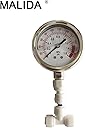
💧 Gauge your flow, own your system — pressure perfection at your fingertips!
The Malida Stainless Steel Water Pressure Gauge offers precise 0-1.6MPa (0-220psi) measurement with quickfit 1/4" connections, designed specifically for reverse osmosis, aquarium, and water filtration systems. Its corrosion-resistant stainless steel construction ensures durability, while easy installation and reliable accuracy empower users to monitor and optimize water pressure, preventing system failures and enhancing performance.
| ASIN | B0124FAV6Q |
| Batteries Included | No |
| Customer Reviews | 4.4 4.4 out of 5 stars (1,123) |
| Date First Available | 20 July 2015 |
| Item Weight | 204 g |
| Item model number | ABCD |
| Product Dimensions | 8.89 x 8.13 x 3.3 cm; 204.12 g |
| Quantity | 1 |
| Size | 1 Count (Pack of 1) |
| batteries required | No |
B**3
order two of these to monitor water pressure before and after my softener\filters. I tested the gauges and they were within 1-2psi of a known accurate gauge. some reviewers complained about these leaking at the connector. I did not have this issue. over-tightening of plastic connector is a common mistake for most DYI`ers. as with ANY plumbing connection. over-tightening will NOT stop a leak. in fact it will make it worse and even break the connection. connectors like the included one should be hand tightened and then just another 1/4 turn with a small wrench. what I did with this connector is to just put a small O-ring into the connector (it should have included one but unfortunately does not). I then used RectorThread #5 pipe thread sealant instead of PTFE tape. PTFE tape is technically not meant to SEAL pipe threads. it is meant to lubricate NPT threads for assembly. some sealing occurs as an after-effect but it is not its primary function. doing this sealed the connector properly and i have NO leaks. other users complained that the gauge is is not fully filled with Glycerin. this is by design. all of these types of gauges have a small air bubble in them. some of the top of the line high pressure fuel gauges i use in my race car have this bubble. now, if it all leaks out or is only half full then it is defective and should be returned. in any case, these gauges look great and perform perfectly.
T**.
I installed a booster pump on my reverse osmosis system and I was unsure what the actual pressure of the system was, other than just checking the faucet water flow - which was higher but I was unsure if it was at full potential. With the addition of this gauge I was able to monitor the pressure on the gauge and increase the upper limit on my high pressure switch to get more water flow without over-pressurizing the system. The quality seems real good and worked real well for this application.
E**O
This water pressure gauge has worked fine for me; there was some leakage from the thread/connector. I fixed the leakage using the provided o-ring and also used teflon tape. I wrapped the male thread 5 times (360 degrees each time). I hand-tightened it until it couldn't turn anymore, then I used a wrench and tightened it 1/4 turn. This was the solution to the leakage. I increased/decreased my booster pump's pressure all the way up to 120 PSI, ran it for 30 minutes on a misting system kit and there was no leakage. The mist was almost like fog by the way (I didn't get soaked in water).
S**E
These meters are high quality all-stainless steel, glycerin-filled, and come with the PEX fittings and a small piece if 1/4" PEX tubing required to connect them to a reverse osmosis filter system. They are cheaper than buying the meter without the fittings other places I have found them! Pros: High quality Glycerin filled Accurate Easy to read Include adapters to connect the 1/2" NPT meter head to 1/4" lines for use with an RO filter system Cons: Minor assembly required Relatively heavy Weight necessitates creative mounting solution I use these meters on my entire water filtration system in my house - before main feed particulate filter, post acid neutralizer and softener/pre-UV filter, post UV filter, pre-RO system, and RO system bladder tank pressure. I needed to have an RO bladder tank meter to adjust and monitor the pressure setting of the RO bladder tank boost pump pressure cutout switch, and to monitor for leaks in the RO system since I have it plumbed to refrigerators and dispensers throughout my home. All of the meters are leak-free, and have super-smooth needle motion. The key to preventing leaks is proper assembly of the meter head to the included 1/2" NPT to 1/4" line fitting. Use Teflon tape if needed, but I just tightened the fitting to the meter head very firmly and had no issues. Three of the meters I did not need to use any of the included adapters on since they are connected to the main water lines in pre-existing 1/2" NPT fittings. I am very pleased with these meters and the price point. Notes regarding glycerin-filled meters: There is an air bubble in the glycerin that you can see, and it is there by design. If there is no bubble, the meter is faulty. There are various reasons for the bubble, the main one being compensation for any pressure differential between the inside and outside of the meter itself. The glycerin smooths out the motion of the needle reducing wear on the needle mechanism, as well as lubricating the needle mechanism, eliminates condensation inside the meter glass, and enhances the viewability of the meter. There is no need to cut the rubber plug on the top of the meter as that will open the meter to possible infiltration of particulate contaminants and moisture, as well as allow the glycerin to leak out.
D**.
These are great for checking your pressure on a Reverse Osmosis System. The actual Reverse Osmosis filter needs more water pressure than most wells supply, so this helps accurately see how much pressure your filter is getting. Less connections on any water system is better, but its worth putting these on your lines to see how well your system is operating. I have one before my booster pump, and one right before the reverse osmosis filter.
Trustpilot
1 month ago
3 days ago