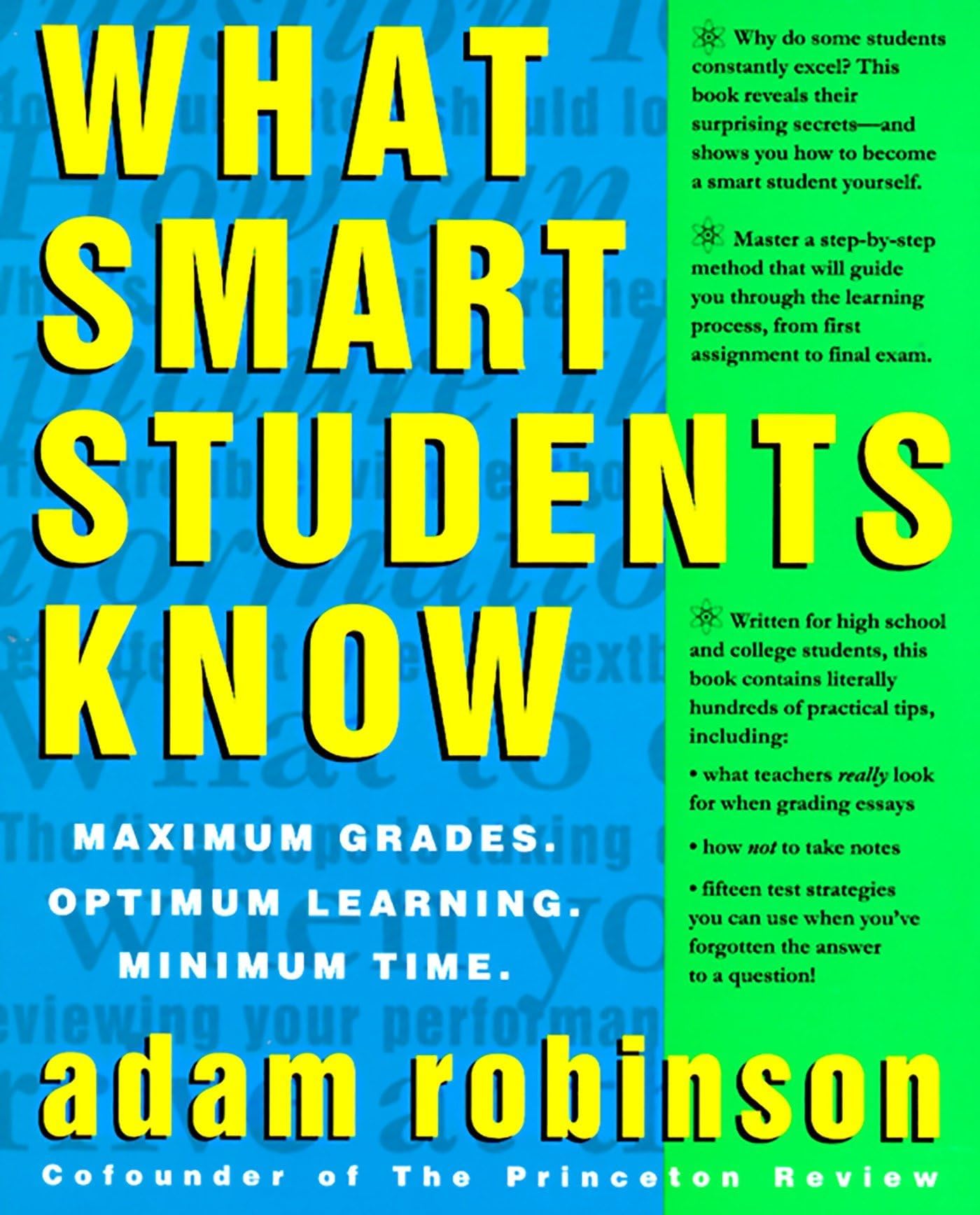
What Smart Students Know: Maximum Grades. Optimum Learning. Minimum Time.
Product ID: 2509677
Desertcart purchases this item on your behalf and handles shipping, customs, and support to USA.
Successful students are not necessarily smarter than their less successful peers, they have simply mastered the art of efficient learning. Adam Robinson introduces high school and college students to an innovative approach that can help them achieve top grades while discovering the joy of true learning. Review: 4.0 GPA SHOULD BE NO SWEAT - This is a great book! I was skeptical and embarrassed to buy a book that is titled, "what smart students know". Surely, if any students catch you reading this book they will think you are a retard. The reason is there is a fad going on now. The fad is summarized by the following: "I spend the least amount of time studying and I get all A's. I don't spend the whole night studying! Heck I don't even study, I don't come to class. I'm just naturally brilliant." Many, many college students are emulating this fad. Everyone wants to say they don't study, because let's face it studying is nerdy. And the worst part is they tell average students like you not to study hard, which confuses you even more and makes you think I don't belong in a Engineering program. The fact is, they do study or have picked up books like this so they can maximize understanding and minimize study time. No one will admit it! There is nothing in this book that you couln't have figured out for yourself, but it may take years and years to figure everything out. By that time you'll be ready to pass that info on to your son! Here is a quick collection of logical steps that will turn any C student into a "B+" student at the least. Great book! Down side is the author used the phrase, "smart students" in every paragraph, making it sound like they are god-like! There are some repititious sentences and redundant material but this only makes up 5% of the book. The Cyberlearning procedure can be used for any major from underwater basket weaving to Engineering. This book is 30% for the high school kid and 70% for the college kid. Any student, or just about any average joe who wants to sharpen his reading, thinking, analytical, problem solving skills can benefit from this book. Now you too can take part in the fad and pretend like you don't really spend time studying and yet you get A's. Man are you smart, pat yourself in the back. This book is well priced! For $12, and 274 pages, this is steal! Review: Excellent Guide to Learning - The core ideas in this book aren't dissimilar from those of older books, such as "How to Study" by Swain or "How to Read a Book" by Adler and Van Doren. The essence of the learning techniques isn't very different. This book places the techniques in a specific context, though: school, where the ultimate goal is to get good grades. It presents a strategy for implementing the techniques in a school setting with the joint goals of "maximum grades, optimum learning, minimum time." I've seen some people complain that the techniques are too time-consuming. The author specifically addresses this problem: "This process is going to take us much longer to follow along than the actual thinking-involved took." In other words, once you practice and get used to the techniques, you won't need to do them explicitly...they will become automatic. In fact, I don't think it's possible to learn _at all_ if you aren't asking many of the questions that Robinson discusses. If you think it's too time-consuming, then you're basically admitting that learning is too time-consuming, at which point you should stop reading and reevaluate your priorities. I was a senior in college when I picked up this book. I had survived my former years by mainly using techniques from Cal Newport's material, but reading this book, along with the books I mentioned earlier, provided me with a much clearer understanding of what learning is. Newport's books are definitely useful, being more immediately practical. But this book was more challenging and addressed the core problem of learning more directly. If you want to learn how to learn, especially in a school setting, this book is a great guide. Taking the time to work through the book and struggling to apply the principles to your studies will pay off big time. It will start slow, but persistence will pay off as the material is internalized and becomes second nature. Then you will become an unstoppable learning machine. I can't recommend this book enough for students.
| Best Sellers Rank | #199,341 in Books ( See Top 100 in Books ) #210 in Study & Test-Taking Skills (Books) #1,287 in Study Guides (Books) #2,986 in Education Workbooks (Books) |
| Customer Reviews | 4.5 out of 5 stars 300 Reviews |
D**E
4.0 GPA SHOULD BE NO SWEAT
This is a great book! I was skeptical and embarrassed to buy a book that is titled, "what smart students know". Surely, if any students catch you reading this book they will think you are a retard. The reason is there is a fad going on now. The fad is summarized by the following: "I spend the least amount of time studying and I get all A's. I don't spend the whole night studying! Heck I don't even study, I don't come to class. I'm just naturally brilliant." Many, many college students are emulating this fad. Everyone wants to say they don't study, because let's face it studying is nerdy. And the worst part is they tell average students like you not to study hard, which confuses you even more and makes you think I don't belong in a Engineering program. The fact is, they do study or have picked up books like this so they can maximize understanding and minimize study time. No one will admit it! There is nothing in this book that you couln't have figured out for yourself, but it may take years and years to figure everything out. By that time you'll be ready to pass that info on to your son! Here is a quick collection of logical steps that will turn any C student into a "B+" student at the least. Great book! Down side is the author used the phrase, "smart students" in every paragraph, making it sound like they are god-like! There are some repititious sentences and redundant material but this only makes up 5% of the book. The Cyberlearning procedure can be used for any major from underwater basket weaving to Engineering. This book is 30% for the high school kid and 70% for the college kid. Any student, or just about any average joe who wants to sharpen his reading, thinking, analytical, problem solving skills can benefit from this book. Now you too can take part in the fad and pretend like you don't really spend time studying and yet you get A's. Man are you smart, pat yourself in the back. This book is well priced! For $12, and 274 pages, this is steal!
C**T
Excellent Guide to Learning
The core ideas in this book aren't dissimilar from those of older books, such as "How to Study" by Swain or "How to Read a Book" by Adler and Van Doren. The essence of the learning techniques isn't very different. This book places the techniques in a specific context, though: school, where the ultimate goal is to get good grades. It presents a strategy for implementing the techniques in a school setting with the joint goals of "maximum grades, optimum learning, minimum time." I've seen some people complain that the techniques are too time-consuming. The author specifically addresses this problem: "This process is going to take us much longer to follow along than the actual thinking-involved took." In other words, once you practice and get used to the techniques, you won't need to do them explicitly...they will become automatic. In fact, I don't think it's possible to learn _at all_ if you aren't asking many of the questions that Robinson discusses. If you think it's too time-consuming, then you're basically admitting that learning is too time-consuming, at which point you should stop reading and reevaluate your priorities. I was a senior in college when I picked up this book. I had survived my former years by mainly using techniques from Cal Newport's material, but reading this book, along with the books I mentioned earlier, provided me with a much clearer understanding of what learning is. Newport's books are definitely useful, being more immediately practical. But this book was more challenging and addressed the core problem of learning more directly. If you want to learn how to learn, especially in a school setting, this book is a great guide. Taking the time to work through the book and struggling to apply the principles to your studies will pay off big time. It will start slow, but persistence will pay off as the material is internalized and becomes second nature. Then you will become an unstoppable learning machine. I can't recommend this book enough for students.
S**E
Helped Me Extensively
I really like this book because not only did it provide various study tips, it also gave great examples of how to teach yourself. How to teach yourself multiple concepts, ranging from specific subjects to how to take notes from lectures v.s textbooks, etc. I feel my school did not focus on teaching students how to actually ask questions and search for the answers, but more on passing tests and searching for information that the teacher or school wanted to know. With the help of this book, I realized that you can't really understand or attempt to remember the purpose of the information if you don't know why it's relevant or important to know. After struggling my first semester in college simply because I didn't know how to teach myself, I decided I wasn't going to rack up thousands of dollars in student loans just to struggle and get average grades. So I gave this book a try because of the positive reviews and was really happy with my purchase. I use multiple study strategy or tip books as well in conjunction with this book and developed my own working methods. However, the majority of my most effective practices came from this book and I did benefit the most from it. Another thing I enjoyed about this read was it provided suggestions for improving your overall attitude about school and tips to help yourself actually enjoy it and whatever specific subject or task you don't like. If you find specific subjects boring this book can help you find ways to make them fun. If you don't want to put in the effort to be successful, you won't be! The narrator has a practical and frankly, blunt way of stating facts and explains the concepts clearly with a mildly humorous attitude. There are multiple, easy quizzes and exercises that I truly did find helpful, especially if you remain open minded and actually try your best. If you are really struggling with retaining information, reading dry textbooks (or highlighting every other word), having a hard time paying attention in class, or have other issues with school I highly recommend this product.
W**R
4 stars for organization/structured presentation and successful old-school study strategies. But it could be better.
Bought this, along with The Straight-A Conspiracy, and The Everything Guide to Study Skills because my daughter has a different learning style than mine. Modern middle-school and high-school educators incorporate tech-based teaching methods into their curriculum, which no longer makes students read textbooks like the way they taught us back in the late 1980s & early 1990s. So I got these books in attempt to learn how to communicate better with modern tech-savvy teens and deliver some old-school studying strategies to my daughter and her friends. Out of all 3 books, I like how the info is organized and presented in What Smart Students Know the most. However, there are Pros and Cons to this book's presentation. Pros: 1) All 12 steps/questions are old-school. They are the same strategies I learned back in my early high school days, before the publication of this book. They do work, i.e. once your mind adapts to the pacing. 2) The presentation is very structured & organized. But the structure is not necessarily fun to read for the more creative and emotionally-inclined xxFP personality types. 3) Each chapter has enough good examples to illustrate each step, especially in demonstrating the chapter-section-headlines to body to summaries. Using the geology/rock formation excerpts is great as an example of boring textbook reading (so boring that even I almost fell asleep and skipped the passages altogether). But it is the perfect demonstration for my daughter on how to extract info on a boring subject. 4) It is mostly good for science classes or any subject in which massive textbook reading is required. Scanning table of contents, chapter/section titles and headlines, and skimming are the most efficient way of reading. 5) The overall tone is positive and encouraging. Cons: 1) It is too old-school and did not take students with different learning styles into consideration. Throughout the book, the author keeps conveying the general tone of "just follow all of these steps, don't skip anything and it will work." Taking notes from lectures and reading (unless there are colorful pics, graphs, pie charts, etc) are better for Aural learners, not so much for Visual or Kinesthetic learners. So I'd recommend first testing yourself to see what type of learner you are before buying/reading this book. 2) The summaries of all 12 steps are listed on pages 36 & 37. There is no need to expand each step into a whole chapter. Expanding them into an allegory just to demonstrate scanning-headlines-skimming-summaries really beats the point to death. This makes it a chore for most teens to read. 3) Not every step/question is necessary for every subject. Many steps don't apply to English classes, especially reading classical literatures and writing literature analysis essays. Following all 12 steps and not skipping anything as the author recommended can be very tedious and too time-consuming. 4) Instead of the expanded chapters on each step, which just repeated things in a lot more words, the author could have included a self-test on learning styles at the beginning, more memorization strategies for AP science/history classes and SAT vocabs, and a chapter/section on essay writing and literature analysis for AP Lang/AP Lit classes. But then again, why give so much details all in one book when studying tips can be split up into several books and make more money?
J**S
Robinson knows what he is talking about
"What Smart Students Know" is a five star book because it is a ground breaking book. Robinson has two remarkable qualities as a writer and thinker: he knows how things REALLY work, and is NOT AFRAID to tell you. He used theses two abilities to crack open the SAT in his book "Cracking the SAT", and now he has blown wide open our educational system in "What Smart Students Know". I have been through the educational system, from high school through graduate school, and can only say that Robinson has it all nailed down. From the personal biases of teachers to the incorrect model of learning that all schools embrace. It may be controversial, it may be upsetting, but Robinson is going to tell you how schools really work and how you can use this knowledge to take control of your education and succeed. Through my years of schooling I saw over and over and over again examples of the author's discoveries. Many times after seeing something crazy or hearing something hard to believe (like a student that a teacher liked begin given an "A" after getting half the questions wrong) I would think "Wow, Robinson mentioned that kind of bias in his book!". As a side note, there is another wonderful book out there that helped me as much as Adam Robinson's in terms of learning and getting good grades. It is Tony Buzan's book "Use Both Sides of Your Brain". It is equally groundbreaking, but it concentrates more on how we understand and process information. It is a fun, slim book that will change your life. To conclude, Adam Robinson should be in charge of overhauling our education system. He is THAT good. When he speaks, our educational system must listen.
N**9
Worth a read, but make your own distilled notes on it.
This book could use another round of editing to make it more concise and impactful. The basic method to improve your studies is to learn how to ask questions of the material: What is the purpose of me reading this; for a test, to write a paper, for class discussion? What is the big picture? How can I summarize the most important elements? The author presents "12 Questions" including these to ask of the material. I feel like there is a great opportunity to streamline this book. Might be worth a quick skim to pull out a few tips. I also feel like there was no or little attention paid to how to practice free retrieval or spaced review, or how to create good mnemonics. *Reread this book to make sure I was not missing anything. It is worth a read, but I do recommend distilling it down to your own legible notes. The cluttered format of the book detracts from its message. Much of the clutter is extra quotes and tips in the side column that only serves to increase cognitive load. My favorite part is on page 86 - tips to get the most out of a lecture. If there is any advice on spacing and interleaving in this book I missed it.
A**R
Wished I had this back in the early 1970's when I was in school!
The author of this book DID A PERFECT JOB explaining how to learn (for all personality types). You can be a C- or an A+ student and still learn something from this book. I hated school as it was almost always rote and writing everything down over 60 times (catholic private school) and it quickly got old (despite the nuns using the ruler to spank my hands.... laughing now!). This book makes you take charge and TEACH YOURSELF the subjects you need to learn. It's almost modeled after the Socratic Method that they use in law school but it helps you (if you use it right) how to get A+ grades! If you have a student (child or adolescent or in college) who needs better grades... GET THIS BOOK FOR THEM! It will teach them how to take notes, understand the material clearly, and make those boring subjects come alive! It even shows you how to learn from history and math classes (and EASILY RECALL) what they taught you. How do I know all of this? Because I used the book exactly how they told me and I now can recall MUCH MORE than I ever did before... Try this for your calculus, history, or boring philosophy class! HIGHLY, HIGHLY, HIGHLY RECOMMENDED!
S**M
Too much work, but I guess it helps
I came open minded to this book and tried most of the techniques that were making sense to my major. I didn't really asked questions while I was reading since all my material is like Chinese and you don't really have anything to ask since most of the information is usually new (metabolism/physiology/neurobiology). I did summarize the book which is a good technique to save time before exams and be less in stress, but it takes a great amount of time. I'm still not sure if it's better to read the book twice or summarize it like suggested since it takes the same amount of time to do each. Some techniques didn't really work for, like writing all the material on one sheet of paper before exams - good luck with that when you have zillion things to memorize, especially pathways (and usually you need to apply them and understand the concepts). So don't stick to the book by 100%, see what is working for you and proceed from there. Give a chance for everything though, and do it early in the semester or whatever you are on since it would be difficult to figure out what is working for you as the semester (and the workload) proceeds.
A**R
You want to really learn - then get this
Yes - the bloke who has written this book looks like a preppy type and the way he writes tends to suggest that he was probably a bit of a creepy crawly around the teachers when he was at school. However, there is no doubt about his techniques for structuring your study so that you fully understand the subject that you are studying. This is NOT about memorising. This is about learning - and then building upon that knowledge. This is not a magic button technique - you have to work hard at the process. You have to study. But like with most techniques, once you've got used to the process, you will simply 'get this' and then the studying won't feel like a chore. Basically it is the way you should have always done things, but you've got into bad habits. This book breaks those habits and asks you to embrace new ones. It won't be easy, at first, but once you're into it, knowledge gathering and storing will become a pleasure.
C**I
Maravilhoso!
Aqui tem material para um curso inteiro!
S**N
Imparare ad apprendere
Titolo datato ma il materiale è completamente attuale e di taglio pratico. Consigliato a studenti delle scuole medie o superiori e anche per universitari. Il metodo cyber learning è unico e in più include il segreto per il successo dell’approccio the mind shift. Senza cambiare modo di pensare, il nostro abito mentale è difficile migliorare drasticamente. Di più recente pubblicazione ma sulla stessa linea di pensiero sono i testi di Barbara Oakley: learning how to learn e mindshift. Non è mai troppo presto imparare a utilizzare la nostra mente che ci viene fornita senza istruzioni d’uso
P**K
Love it, great format and nice content
I would recommend this book to any body who want to understand how school works. I have read this book after attempting to University (in Canada) and I can tell you that most of what is written is right. I think it can be hard to follow everything but the heart of the concept is something that I have been witness. 5/5, good read for anyone who want to improve how to learn, even if it's not in school.
R**Y
Good to Great
Must have for all students
Trustpilot
2 weeks ago
2 weeks ago