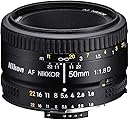
📸 Elevate your frame with Nikon’s legendary 50mm clarity!
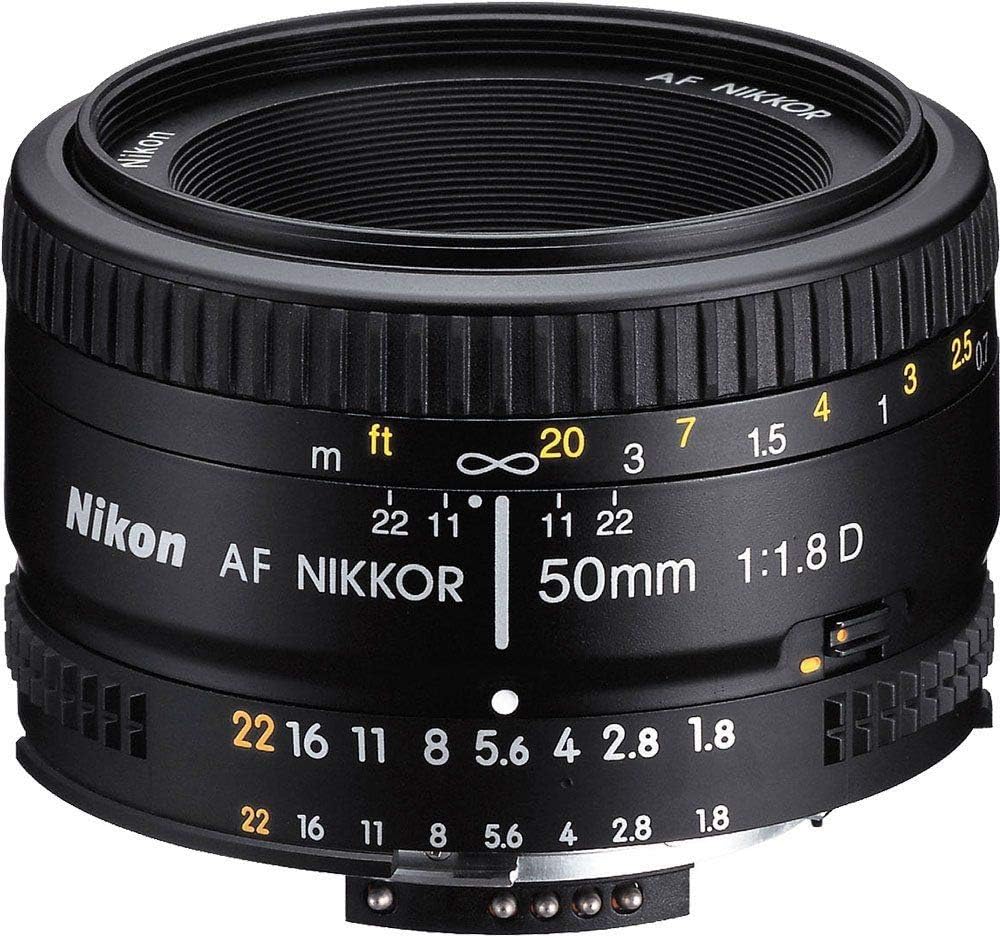
The Nikon 2137 AF Nikkor 50mm f/1.8D lens is a lightweight, compact prime lens designed for DSLR cameras. Featuring a fast f/1.8 aperture for exceptional low-light performance and Nikon’s Silent Wave Motor for quick, quiet autofocus, it’s a versatile staple for portrait and everyday photography. Weighing only 155g, it’s an ideal travel companion and a highly recommended lens for beginners and professionals alike.


| ASIN | B00005LEN4 |
| Best Sellers Rank | #38,851 in Electronics ( See Top 100 in Electronics ) #215 in SLR Camera Lenses |
| Brand | Nikon |
| Built-In Media | Front Cap, Lens, Rear Cap |
| Camera Lens | Standard Prime Lens With Fast F/1.8 Maximum Aperture |
| Color | Black |
| Compatible Camera Models | Nikon F-mount cameras |
| Compatible Camera Mount | Nikon F |
| Compatible Devices | Nikon cameras |
| Customer Reviews | 4.5 4.5 out of 5 stars (6,417) |
| Exposure Control Type | Automatic, Manual |
| File Format | JPEG |
| Focal Length Description | 50 millimeters |
| Focus Type | Auto Focus, Manual Focus |
| Global Trade Identification Number | 00018208021376, 04960759023254 |
| Has Self-Timer | No |
| Image stabilization | no image stabilization |
| Item Part Number | JAA009AD, JAA013DA |
| Item Weight | 155 Grams |
| Lens | Standard |
| Lens Coating Description | Super integration coating |
| Lens Design | Prime |
| Lens Fixed Focal Length | 50 Millimeters |
| Lens Mount | Nikon F |
| Manufacturer | Nikon |
| Manufacturer Part Number | 2137 |
| Maximum Aperture | 1.8 Millimeters |
| Maximum Focal Length | 50 Millimeters |
| Maximum Shutter Speed | Nikon F-Bayonet Seconds |
| Media Type | Product Image |
| Minimum Aperture | 22 |
| Minimum Focal Length | 50 Millimeters |
| Model Name | 2137 |
| Model Number | 2137 |
| Number of Diaphragm Blades | 7 |
| Photo Filter Size | 52 Millimeters |
| Real Angle Of View | 46 Degrees |
| Screen Size | 2.47 Inches |
| Shooting Modes | Auto, Manual, Sports, Portrait, Landscape |
| UPC | 018208021376 |
| Unit Count | 1.0 Count |
| Viewfinder Type | LCD screen |
| Warranty Description | 1 year manufacturer warranty |
| Water Resistance Level | Not Water Resistant |
| Zoom Ratio | 1 |
S**N
Value For Money
Even though its an old model it works. Not very smooth to handle like while fixing in the camera or fine tune the focus. Still I'm satisfied with this product according to what I spend. Recommended for beginners. ( I'm a beginner )
F**Z
A flagship!
This is a great lens. Can’t setup a gear without one of these!
C**S
Top quality
Nice product
J**E
Happy
Purchased from uniholdings. Great product and service
H**Y
Like it
Good product
A**L
A Good 50 mm starter prime lens
Very good quality, though manually operated... but at least there's no jitter when filming... good to practice my focusing.
A**O
This lens is lightweight, perfect for Travel, portraits and macro photography. It’s traditional 52 mm attachment size is most suited with my existing accessories, plus the optics is bright with f/1.4 great for night shots with higher shutter speeds.
N**O
Let's get this out of the way first. Your max aperture is simply a mathematical ratio describing the len's ability to gather light entering the front element. It does not measure the amount of light where it's important -- light exiting the rear element on to the film or sensor. That's always LESS than the max-ap because the glass and surface-to-air planes absorb light. The amount of light that hits the sensor (or film plane) is known as a t-stop and it's what cinematorgraphers use. The max f-stop and t-stop readings can be off by a surprising amount. As measured by the tech website DXOmark, the vaunted Canon 1.2 has a t-stop of 1.5. Guess what DXOmarks measures this Nikon's t-stop rating as? 1.5. Same as the Canon. This is the best max aperture to t-stop ratio I'm aware of. 1.4 max aperture, 1.5 t-stop. Same as the Canon 1.2 -- see for yourself. Now, on to the review. This is a lens for those who appreciate a classic standard focal length prime that uses the timeless seven element in six groups planar optical formulation. Every major manufacturer from Zeiss, to Olympus, to Yashica (RIP), to Pentax, to Minolta to Canon, to Sigma has made nearly an identical lens using the same classic configuration. They're basically the same lens (sorry Nikon but you know it's true...) It's a simple lens compared to modern lenses -- no fancy coatings, few elements and groups, no vibration reduction, no exotic glass, no aspherical elements. None of that stuff. As a result, this lens will vignette a little and be a bit softer at wider apertures, especially in the corners. You will always get some barrel distortion that will look terrible on "internet lens testing sites" but will hardly be noticeable in the field. It will be more susceptible to flare at wider apertures. Newsflash -- f1.4 is not a "working aperture", really. Working apertures for this lens are f 2 to f 8. Let's go through -- f 1.4 is "in case of emergency". If you need every photon available for available darkness shooting -- it's there. Also, use it to squeeze every bit of bokeh possible out of the lens for creative effect , playing and experimentation. F 2 -- 2.8, used to provide subject isolation. Great for environmental portraiture, ambient light shooting, or natural light still lifes. You'll get very good to excellent center sharpness, corners will be acceptable, and you'll get nice bokeh while losing a good bit of the chromatic aberrations and vignetting associated with shooting wide open. F 4 -- now were starting to get some serious sharpness in the center, corners improving dramatically, vignetting gone. F 5.6. BAM! If you're after max sharpness especially in the center with good depth of focus and some subject isolation (depending on focus distance) this is your aperture. You will be hard-pressed to find a sharper optic at any price. Center sharpness is off the charts, almost literally. Good daylight, flash, outdoors, that's your aperture. Whenever you're looking for optimal sharpness. Or? F 8. This will give you excellent corner sharpness at the expense of some center sharpness (which is still excellent) but no "bokeh" everything pert much in focus. F 11 -- image quality now visibly degrading due to diffraction. Still quite usable. Kinda the reverse of f1.4 except now you're going for max depth of focus. F 16 -- not a working aperture imo. Too much image degradation from diffraction but it's there if you need it for some reason. So. Why this lens? Why is it still relevant after 20 years of production? Why is it still made? A number of reasons. Modern FX cameras are pretty heavy. My "little" D600 weighs 2 lbs (I think). Now, slap a lens on it that easily adds another pound (or more) and it becomes a drag lugging this kit around and there's a good chance you leave it home and not use it at all, Your big, pricey FX camera is not doing any good setting on the shelf. This is the smallest and lightest f1.4 lens Nikon makes. It's great for "lug management". Not only that? It is very bright and is capable of completely professional results. Some of the greatest photographers shot solely with a 50 taking brilliant images with them. Since my camera has a built-in focus motor, I prefer to use that. (It's also purportedly faster on this lens...). I think the tiny motors built-in to the newer lenses will eventually wear out. I think this guy is simply more durable. Finally, I use two sites when choosing a lens: DXOMark and Flickr. DXO rates lenses objectively using an indexing scale and you can match lens performance to you camera body. There was one modern 50 by a 3rd party manufacturer that topped this one by a bit -- but it's a big, heavy, expensive behemoth. I can make just as good "ART" without lugging that thing around. No thanks. This lens was tied for 2nd among standard non-specialty "everyday" focal lengths. (Scrolling way down the list you start getting to your pricey pro zooms...) It was also a good bit cheaper (especially used and they're plentiful), smaller, and lighter. Then I went on Flickr -- some talented folks taking some amazing images with this lens. That comes as no surprise. This is a better lens than I am a photographer. Henry Cartier Bresson, Ralph Gibson, and others mostly shot a 50mm 1.4 their entire careers. Sold!
S**U
中古とのことですが、外観もレンズも見た目問題ありませんでした。 実際に使ってみると、ボケ方がやはりすごいですね。ただ、若干ボケはうるさい感じはしますが、イイレンズだと思います。
G**S
Es difícil imaginar un lente que te de tanto por tan poco dinero. Tiene un tamaño reducido, anillo de diafragma y una gran apertura. La calidad de imagen es buena y su distancia focal de 50mm lo hacen el único lente que podrías tener. Soy usuario de diversas marcas y cuando veo lentes 50mm 1.4 que valen 10 o 20 veces más que éste, son más grandes - y por ende estorbosos y pesados - me pregunto que tanto vale la pena esa calidad extra de imagen que pudieran tener. Este lente tiene un poco más de distorsión que el 50 1.8D, el cual es aún más pequeño y barato! Pero en mi caso, prefiero tener esa apertura mayor y corregir esa pequeña distorsión en el software de edición. Por lo anteriormente dicho, este lente me gustó mucho. Compré toda la serie D que había disponible: 24, 28 (este lo vendí después porque no me gustó), 35, 50 y 85 y un zoom. Si tuviera que elegir solo uno, sin duda sería el 50mm 1.4D. Un ganador!
S**R
If you have a camera with a built-in autofocus-motor (D90, etc...), then you need this lens. Everyone should have a 50mm f/1.8 (or faster) lens. This lens is just too inexpensive and too good to pass up. You buy this lens for two reasons: to shoot in low light without flash or to get great depth of field control. With a wide aperture of f/1.8 you are guaranteed to get great natural light pictures indoors or other low light situations while maintaining a relatively low ISO. The other advantage to large apertures is of course the great isolation of your subject by limiting depth of field. The sample images posted by reviewers show how well this lens works on both accounts. I see reviews complaining about the sharpness of this lens. Forget about it. Sharpness is rarely a result of the lens. I've taken incredibly sharp pictures with this lens and very fuzzy pictures. Every fuzzy picture was because of something I did "wrong", for example... Depth of Field: With f/1.8 at 50mm if you're framing a close subject that is only 2 feet away, your depth of field (amount of subject in focus) is only .38 inches (< 1 cm). That is what is referred to as "paper thin" depth of field. Naturally with such a small amount of the subject in focus much of the image will be "unsharp". This is expected and called bokeh. Be sure to understand how depth of field works, or make sure to shoot all your subjects from very far away (not recommended). If this is your first prime lens, then consider the 35mm f/1.8 which has a much more forgiving DOF (.8 inches at 2 feet when wide open). Subject Motion: With such a limited depth of field, when shooting at the larger apertures, even a small bit of subject motion can cause one of two things to happen. The first is that the part of the subject you wanted to be in focus moved and is now out of focus. The second is that the shutter speed wasn't fast enough to freeze the subject and motion blur occurs. Make sure to shoot moving subjects with an appropriately high shutter speed. Here is where your Nikon beats all other DSLRs: you can customize this using Auto ISO in your camera menu. Camera Shake: If you let your camera decide everything for you then eventually your shutter speed is going to drop to a value where you can no longer hold the camera steady enough to get a clear shot without a tripod. You need to always shoot at a speed that you can hold the camera steady at. Customize Auto ISO here as well based on your capabilities. Focus Errors: With paper thin depth of field at the wider apertures it's even easier for a focus error to ruin a picture. If you're taking a close-up picture of someone's face, and your camera selects the nearest object to focus on, then their nose will be in focus but their eyes slightly blurry. That will ruin your picture. Even being slightly off will wreck a great picture. Be very careful with your choice of focus method. If you're shooting at the wider apertures, but not at the nearest object, you may want to use selective auto-focus. Try to focus on the eyes if you're taking pictures of people. It's easy to see how the challenges of shooting at wide apertures have more to do with the sharpness of pictures than any optical quality of the lens. It is challenging, but the great pictures you get are well worth the effort. After the first year I owned this lens my photography education was greatly accelerated. I was immediately challenged to understand and master depth of field, shutter speed, ISO, and auto-focus. Without it, I would have continued to do the same dumb things that resulted in mediocre and blurred pictures. I would have continued to blame the tools (camera, lens, flash, etc...) instead of taking control for myself. If you're afraid to walk, then don't get this lens. The only way you're going to get proper depth of field and good framing is by walking closer to or farther away from your subject. If you don't have a camera with a built in autofocus-motor (D40, D40X, D60, D3000, D3100, or D5000), then you will either need to get the more expensive 50mm f/1.4 with the autofocus-motor or, if this is your first prime lens and you want a lower price, go ahead and start with the more forgiving 35mm f/1.8 .
Trustpilot
1 month ago
1 month ago