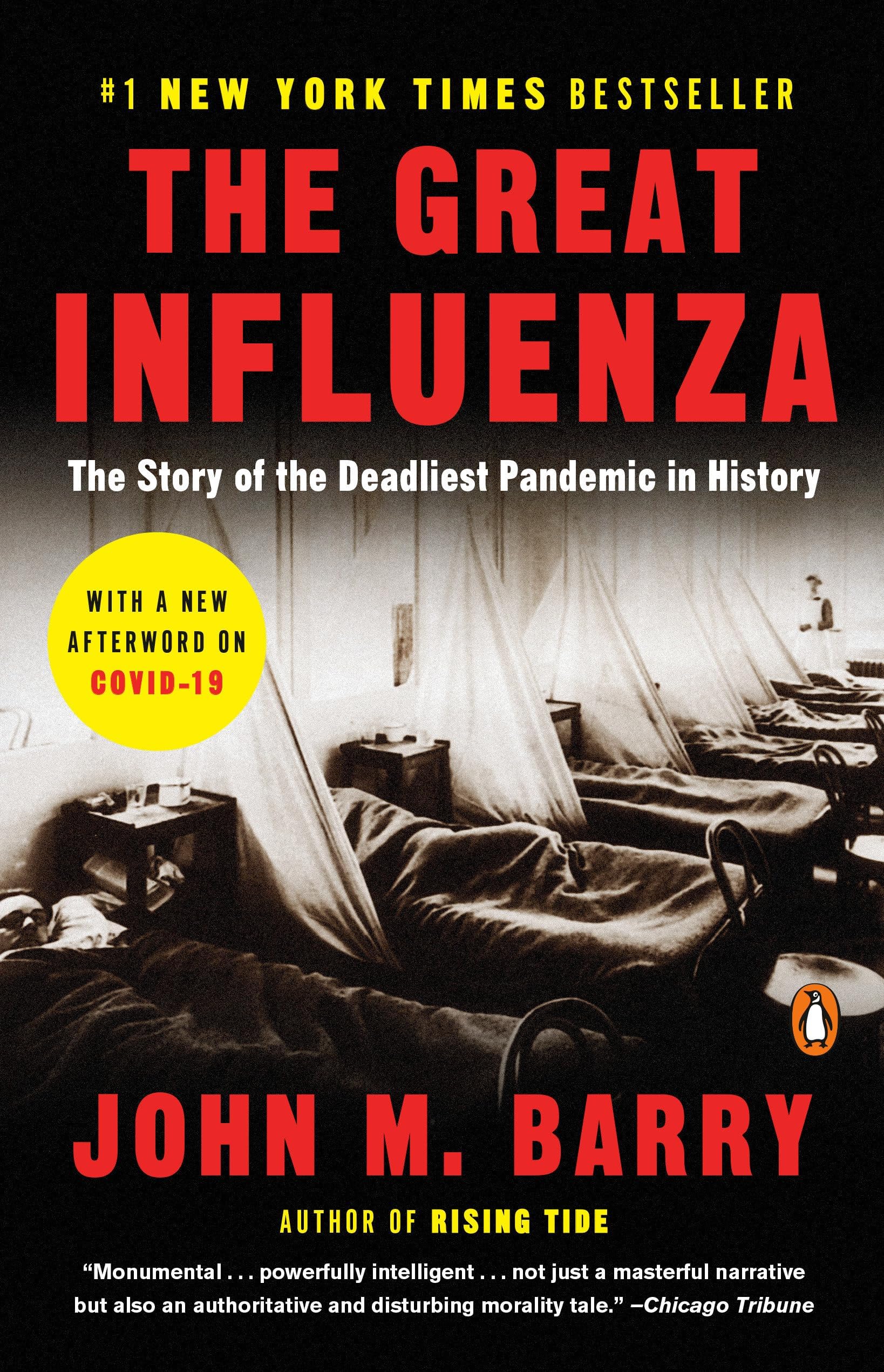
The Great Influenza: The Story of the Deadliest Pandemic in History
Product ID: 237760
Desertcart purchases this item on your behalf and handles shipping, customs, and support to USA.
#1 New York Times bestseller “Barry will teach you almost everything you need to know about one of the deadliest outbreaks in human history.” —Bill Gates "Monumental... an authoritative and disturbing morality tale."— Chicago Tribune The strongest weapon against pandemic is the truth. Read why in the definitive account of the 1918 Flu Epidemic. Magisterial in its breadth of perspective and depth of research, The Great Influenza provides us with a precise and sobering model as we confront the epidemics looming on our own horizon. As Barry concludes, "The final lesson of 1918, a simple one yet one most difficult to execute, is that...those in authority must retain the public's trust. The way to do that is to distort nothing, to put the best face on nothing, to try to manipulate no one. Lincoln said that first, and best. A leader must make whatever horror exists concrete. Only then will people be able to break it apart." At the height of World War I, history’s most lethal influenza virus erupted in an army camp in Kansas, moved east with American troops, then exploded, killing as many as 100 million people worldwide. It killed more people in twenty-four months than AIDS killed in twenty-four years, more in a year than the Black Death killed in a century. But this was not the Middle Ages, and 1918 marked the first collision of science and epidemic disease. Review: Death Rides a Pale Horse - “Influenza killed more people in [1918] than the Black Death of the Middle Ages killed in a century; it killed more people in 24-weeks than AIDS has killed in 24-years.” Those are some pretty sobering statistics. John Barry takes an oddly forgotten moment in world history and makes it comes to life in this thorough, fast-paced and sharply written history of the great Spanish Influenza pandemic that struck the globe at the end of the First World War. Barry begins his narrative with a terrific overview of the history of medical science. The Warriors highlights the critical role played by Johns Hopkins University and Hospital in reforming and advancing the cause. The amazing thing is how stunted medical science remained for so long, essentially unaltered from the time of Hippocrates and Galens to the mid-nineteenth century. Indeed, medicine was “the withered arm of science.” This backwardness can be attributed to the failure to ask two basic questions: “What can I know? How can I know it?” For centuries – actually millennia – medicine was a basic exercise in observation, not probing experimentation. It was treated like Newton under the apple tree, unlocking the secrets of physics by observing the world around you. Only the world of biological science isn’t so neat and uniform; it’s chaotic. Thus, the use of bleeding (venestration), the most notorious practice of pre-modern medicine, was entirely logical from an observational perspective (e.g. “people with fevers are flushed; after bleeding they are pale.”). Logic and observation failed because neither tested hypotheses rigorously. As a result, medicine was long considered a “low science” and not much respected. When Hopkins was born in 1876 it was a deliberate break from the American university model of conveying the known, to a new, largely German model of methodically explaining the unknown. It wasn’t until 1891 that a major disease – diphtheria – was cured. Suddenly, there was a flood of research dollars into medicine. In 1890, there was $18M in national university endowments supporting American theological schools and just $500K supporting American medical schools. As late as 1904 most medical schools had no affiliation with either a university or a hospital, no admission criteria of any kind, and a staff that was paid purely from tuition receipts. A blistering study, the Flexner Report, on the state of American medical education in 1910 was a watershed moment, according to the author. Medical education was about to be reinvented, and re-built largely on the Hopkins example. Over the next decade 100 medical schools – about two-thirds of those then in existence – either went under or merged. In 1904, there were 28K American medical school students; by 1920 the number had been fully cut in half. The guiding light in this benevolent revolution was the first head of the Hopkins hospital, William Welch. Known for his judgment and inspiration, Welch “exuded confidence without arrogance, smugness, or pomposity.” He was “the glue that cemented together the entire American medical establishment.” A medical graduate of Yale, “a typical good American medical school, with no requirements for admission and no grades in any course,” he presided over the emergence of American medical science as a world leader in just over a generation. Part two, The Swarm, provides an introduction to virology and the astounding resiliency and adaptability of the influenza virus in particular. Barry describes the invasion and take over at the molecular level in arresting language. “An infection,” he writes, “is an act of violence; it is an invasion, a rape, and the body reacts violently.” Even today in the United States, about 36K people are killed by the flu every year, essentially the same that are killed by auto accidents or gun violence (including suicide). Part three, The Tinderbox, the author introduces a stridently hostile view of American mobilization leading up to World War I, skewering President Wilson and his extended administration at every turn. In short, the H1N1 flu virus of 1918 was unusually virulent, but what turned it into one of the greatest killers of all time was a potent mix of massive manpower mobilization combined with press censorship. Millions of young men, from both city and country, were shunted to over crowded barracks, and forced to share beds, utensils and air. “Never before in American history – and possibly never before in any country’s history – had so many men been brought together in such a way,” Barry claims. Meanwhile, the US government had virtual control over the flow of information and were aggressively on guard to squelch any news that smacked of defeatism or could damage morale, both military and civilian. Part four, It Begins, describes how the initial version of the flu that spread quickly out of the Kansas army camps and then across the Atlantic from February 1918 to April, reaching Australia by September 1918, was generally mild and not too disconcerting to public health officials. Owing to strict censorship the disease became known as the Spanish Influenza simply because neutral Spain had an open press and was the only country that freely reported on the illness. “Those in control of the war’s propaganda machine wanted nothing printed that could hurt morale,” the authors says again and again. Most health officials presumed the flu had come and gone. But instead, “It had gone underground, like a forest fire left burning in the roots, swarming and mutating, adapting, honing itself, watching and waiting, waiting to burst into flame.” Part five, Explosion, chronicles the rapid spread of the flu from Camp Devins, an army installation in Massachusetts, to the rest of the eastern seaboard and port cities in early autumn. The commanding officer at Camp Grant in Illinois committed suicide when the flu decimated his troops after he blocked the strict quarantine recommendations of camp physicians. Barry pays special attention to the city of Philadelphia where a massive Liberty Parade went ahead despite clear evidence that the deadly flu had arrived. “Within seventy-two hours after the parade," he writes, "every single bed in each of the city’s thirty-one hospitals was filled. And people began dying.” But still the government snuffed out true reporting on the extent and danger of the virus. “…Free speech trembled indeed,” Barry states emphatically. Part six, The Pestilence, describes the chilling effects of the Spanish Flu. Up to 20% of all flu cases developed a severe form of pneumonia; roughly 10% experienced bleeding from the ears, eyes and nose, just like Ebola; nearly 50% of all deaths in the U.S. during the pandemic were flu-related; the hardest hit demographic was young adults (suggesting that the flu was a strain of a more mild flu from decades before); the flu killed so viciously that it shaved a full ten years off of the national U.S. life expectancy. The hallmark of this flu was the virulence of the pneumonia it caused. The lungs were so destroyed that victims literally turned blue for lack of oxygen. “Intense cyanosis was a striking phenomenon," a contemporary witness reported. "The ears, lips, nose, cheeks, conjunctivae, fingers, and sometimes the entire body partook of a dusky, leaden hue." Part seven, The Race, explores the race to find the pathogen of the flu. “What caused this disease?” That was the question on the minds of America's leading researchers. From the very start the primary suspect was the so-called Pfeiffer bacillus, the pathogen from the 1890 pandemic isolated by German scientists. It was difficult to grow in the laboratory. The doctors battling the disease, especially Canadian-American Oswald Avery, the un-sung hero of the story according to Barry, proceeded carefully and deliberately to identify the pathogen despite the tremendous pressure to move faster. Part eight, The Tolling of the Bell, is a further indictment of the Wilson administration’s insistence on prosecuting war mobilization in the face of the flu pandemic right up until the German armistice. Tightly packed troop ships were sent to Europe despite the robust objections of public health officials and army doctors. Barry concedes that nothing could have stopped the spread of the flu, but argues that more intense efforts could have slowed down its merciless march. By the second week of October, Philadelphia was in complete crisis. On an average day the city witnessed 500 deaths from all causes (natural, accidents, homicides, suicides); now over 750 were dying from the flu alone. The week of October 16th nearly 5,000 perished. At least half-a-million were ill. The city ceased to function; no volunteers answered the call for assistance; social services ceased. All the while, reporting on the true nature of the disease was suppressed. Lack of reliable information, Barry writes, only made things worse. “Uncertainty follows distrust, fear follows uncertainty, and, under conditions such as these, terror follows fear.” “The war was over there. The epidemic is here. The war ended. The epidemic continued. Fear settled over the nation like a frozen blanket.” Part nine, Lingerer, covers the long tail of the disease. Just as quickly as the second wave struck, it ended. The flu tore through the potential population at an alarming rate. After this second wave finished the flu became more benign for two key reasons. First, even with antigen drift, those that survived the first or second wave of the flu developed immunity to the disease. Second, the virus itself continued to mutate, and as it mutated it became more average and thus less deadly. It is startling just how different various strains of the virus could be. For instance, at one army cantonment 35% of those with flu contracted pneumonia, and of those with pneumonia the death rate was 61%. A few weeks later another cantonment experienced only 7% pneumonia with a mortality rate of 18%. In other words, the cantonment with the virulent strain saw 21 men die for every 100 with the flu; a few weeks later it was less than 1 in a 100. In the end, the death toll was conservatively estimated at 21 million globally. The author suggests that 50-100 million is probably closer to the mark. In a 12-week period in the fall of 1918 approximately 5% of the world’s population died. That would be 350 million people at today’s global population numbers. In New York City alone the disease created 21K orphans. Part ten, Endgame, tells the sobering story of the results of medical inquiry on the disease. Despite tremendous gains in medical science and research, and tireless effort to identify the flu’s pathogen and to disrupt the spread of the disease, very little was known. Oswald Avery spent the rest of his life searching for the pathogen. The author describes it as an incredibly laborious and frustrating experience as the scientist eliminated, one-by-one, like Thomas Edison with the incandescent light bulb, every possible element. But in the process Avery made a startling discovery: DNA carried genetic information. His 1944 paper would launch other researchers, like James Watson, on his groundbreaking work. Barry claims that Avery’s research into the 1918 flu and its associated pneumonia led directly to the opening of an entirely new field: molecular biology. In closing, "The Great Influenza" is a terrific read on a fascinating, terrible, and reoccurring human experience. Review: The Seven Billion Dollar book… - Way, way back in 2005, President George W. Bush read John Barry’s book, a copy of which was given to him by HHS Secretary Leavitt. Came to work a few days later and asked his staff what plans America had for combating the next pandemic. Nada. Bush might not have learned anything from the Vietnam War he strove to miss, when he decided to charge into Iraq, but he SURE seems to have learned something from history, thanks to Barry, and insisted the United States be prepared for the next pandemic. Wags in the West Wing started calling Barry’s book by the subject line, since that is how much the overall plan would cost. Dr. Fauci, just last Sunday, said on “Face the Nation” that he would be “astounded” if there was not an “autopsy” on America’s appalling response to the COVID Pandemic. Certainly, a good starting point would be what happened to the seven-billion-dollar plan. This is such an impressive book and is the one essential book that we all should read, now almost two years into the latest pandemic. The thesaurus of superlatives is quickly exhausted in describing this book. Barry says that it took him seven years to write this. There are 60 pages of references at the end. Few authors have that unique ability to meld the science and the human drama. His style is crisp and lucid. It is one thing to write a biography; Barry did the research for seven to ten. He then distilled that knowledge into concise and lively portraits, with the quirks, rivalries, and warts of the leading medical people who would confront the pandemic. I had heard of none of these individuals, apparently due to my wandering in the wilderness too long. There is William Henry Welsh, the one man who largely transformed how medicine was practiced in America, trying to get the practitioners educated and the snake oil off the shelves. Oswald T. Avery, a private in the Army during WWI, would do brilliant work at the Rockefeller Institute. William Park, Anna Wessel Williams and Rufus Cole made substantial contributions. There is the brilliant and troubled Paul Lewis, whose story may have helped inspire portions of Sinclair Lewis’ (no relation) “Arrowsmith.” Paul Lewis would die in Brazil, in 1929. Barry posits: “And whether his death was a suicide or a true accident, his failure to win what he loved killed him. One could consider Lewis, in a way meaningful to him, the last victim of the 1918 pandemic.” Philadelphia was particularly hard hit by the influenza outbreak. Barry provides an excellent account of all the relevant factors and the role of the Edwin Vare’s political machine, and how, when the “terror” of the flu took hold, the ol’ Blue Bloods, the Wartons, Biddles had to take charge. Wilson was hell-bent on getting the Doughboys over There, to Europe, with devastating effects on military bases in the USA, due in particular to overcrowding. Barry relates what happened at Camp Devin in MA., in detail. With pitch-perfect tone, Barry uses the ironic refrain throughout the book: “It’s just the flu.” As Barry relates, it was not until the late 20’s, that Lewis’ protégé, Richard Shope proved that it was a virus, and not a bacterium that had killed something like 50 million people. The book was originally issued in 2004; Barry did an Afterword in 2018, just before all hell broke loose on what we did NOT learn. In the Afterword, hauntingly, in light of what has transpired, he said: “So, the problems presented by a pandemic are, obviously, immense. But the biggest problem lies in the relationship between governments and the truth…But as horrific as the disease itself was, public officials and the media helped create that terror- not by exaggerating the disease but by minimizing it, by trying to reassure. A specialty among public relations consultants has evolved in recent decades called ‘risk communication’. I don’t much care for the term. For if there is a single dominant lesson from 1918, it’s that governments need to tell the truth in a crisis. Risk communications implies managing the truth. You don’t manage the truth. You tell the truth.” Amen, from that eponymous corner. I live in New Mexico, which, thanks to our Governor, has imposed some of the more restrictive measures to control the spread of the disease and I am all in favor of that. Nonetheless, several of our major hospitals have imposed “crisis standards of care,” a fancy phrase for that dreadful French word: triage. It is required to wear masks indoors, and I do, though I think it only improves my changes of not contracting COVID by 10-20% as compared to no mask. Therefore, I found Barry’s quite dismissive rejection of the efficacy of masks in preventing COVID supportive of my own beliefs. In fact, looks like Barry would consider 10-20% far too generous: “Surgical masks are next to useless except in very limited circumstances, chiefly in the home” (P. 477). “The masks worn by millions were useless as designed and could not prevent influenza. Only preventing exposure to the virus could” (P. 358-59). In my idiosyncratic rating system, for books or movies I really like, I provide a 6-star rating, sometimes adding a “plus” for the truly great ones. For the 7-billion-dollar book that took 7 years to write, and is written so well, on such a complex subject and is so relevant for our lives today, I am providing it my very first 7-star rating.
| Best Sellers Rank | #28,892 in Books ( See Top 100 in Books ) #2 in Viral Diseases (Books) #2 in Communicable Diseases (Books) #8 in History of Medicine (Books) |
| Customer Reviews | 4.6 out of 5 stars 11,578 Reviews |
T**I
Death Rides a Pale Horse
“Influenza killed more people in [1918] than the Black Death of the Middle Ages killed in a century; it killed more people in 24-weeks than AIDS has killed in 24-years.” Those are some pretty sobering statistics. John Barry takes an oddly forgotten moment in world history and makes it comes to life in this thorough, fast-paced and sharply written history of the great Spanish Influenza pandemic that struck the globe at the end of the First World War. Barry begins his narrative with a terrific overview of the history of medical science. The Warriors highlights the critical role played by Johns Hopkins University and Hospital in reforming and advancing the cause. The amazing thing is how stunted medical science remained for so long, essentially unaltered from the time of Hippocrates and Galens to the mid-nineteenth century. Indeed, medicine was “the withered arm of science.” This backwardness can be attributed to the failure to ask two basic questions: “What can I know? How can I know it?” For centuries – actually millennia – medicine was a basic exercise in observation, not probing experimentation. It was treated like Newton under the apple tree, unlocking the secrets of physics by observing the world around you. Only the world of biological science isn’t so neat and uniform; it’s chaotic. Thus, the use of bleeding (venestration), the most notorious practice of pre-modern medicine, was entirely logical from an observational perspective (e.g. “people with fevers are flushed; after bleeding they are pale.”). Logic and observation failed because neither tested hypotheses rigorously. As a result, medicine was long considered a “low science” and not much respected. When Hopkins was born in 1876 it was a deliberate break from the American university model of conveying the known, to a new, largely German model of methodically explaining the unknown. It wasn’t until 1891 that a major disease – diphtheria – was cured. Suddenly, there was a flood of research dollars into medicine. In 1890, there was $18M in national university endowments supporting American theological schools and just $500K supporting American medical schools. As late as 1904 most medical schools had no affiliation with either a university or a hospital, no admission criteria of any kind, and a staff that was paid purely from tuition receipts. A blistering study, the Flexner Report, on the state of American medical education in 1910 was a watershed moment, according to the author. Medical education was about to be reinvented, and re-built largely on the Hopkins example. Over the next decade 100 medical schools – about two-thirds of those then in existence – either went under or merged. In 1904, there were 28K American medical school students; by 1920 the number had been fully cut in half. The guiding light in this benevolent revolution was the first head of the Hopkins hospital, William Welch. Known for his judgment and inspiration, Welch “exuded confidence without arrogance, smugness, or pomposity.” He was “the glue that cemented together the entire American medical establishment.” A medical graduate of Yale, “a typical good American medical school, with no requirements for admission and no grades in any course,” he presided over the emergence of American medical science as a world leader in just over a generation. Part two, The Swarm, provides an introduction to virology and the astounding resiliency and adaptability of the influenza virus in particular. Barry describes the invasion and take over at the molecular level in arresting language. “An infection,” he writes, “is an act of violence; it is an invasion, a rape, and the body reacts violently.” Even today in the United States, about 36K people are killed by the flu every year, essentially the same that are killed by auto accidents or gun violence (including suicide). Part three, The Tinderbox, the author introduces a stridently hostile view of American mobilization leading up to World War I, skewering President Wilson and his extended administration at every turn. In short, the H1N1 flu virus of 1918 was unusually virulent, but what turned it into one of the greatest killers of all time was a potent mix of massive manpower mobilization combined with press censorship. Millions of young men, from both city and country, were shunted to over crowded barracks, and forced to share beds, utensils and air. “Never before in American history – and possibly never before in any country’s history – had so many men been brought together in such a way,” Barry claims. Meanwhile, the US government had virtual control over the flow of information and were aggressively on guard to squelch any news that smacked of defeatism or could damage morale, both military and civilian. Part four, It Begins, describes how the initial version of the flu that spread quickly out of the Kansas army camps and then across the Atlantic from February 1918 to April, reaching Australia by September 1918, was generally mild and not too disconcerting to public health officials. Owing to strict censorship the disease became known as the Spanish Influenza simply because neutral Spain had an open press and was the only country that freely reported on the illness. “Those in control of the war’s propaganda machine wanted nothing printed that could hurt morale,” the authors says again and again. Most health officials presumed the flu had come and gone. But instead, “It had gone underground, like a forest fire left burning in the roots, swarming and mutating, adapting, honing itself, watching and waiting, waiting to burst into flame.” Part five, Explosion, chronicles the rapid spread of the flu from Camp Devins, an army installation in Massachusetts, to the rest of the eastern seaboard and port cities in early autumn. The commanding officer at Camp Grant in Illinois committed suicide when the flu decimated his troops after he blocked the strict quarantine recommendations of camp physicians. Barry pays special attention to the city of Philadelphia where a massive Liberty Parade went ahead despite clear evidence that the deadly flu had arrived. “Within seventy-two hours after the parade," he writes, "every single bed in each of the city’s thirty-one hospitals was filled. And people began dying.” But still the government snuffed out true reporting on the extent and danger of the virus. “…Free speech trembled indeed,” Barry states emphatically. Part six, The Pestilence, describes the chilling effects of the Spanish Flu. Up to 20% of all flu cases developed a severe form of pneumonia; roughly 10% experienced bleeding from the ears, eyes and nose, just like Ebola; nearly 50% of all deaths in the U.S. during the pandemic were flu-related; the hardest hit demographic was young adults (suggesting that the flu was a strain of a more mild flu from decades before); the flu killed so viciously that it shaved a full ten years off of the national U.S. life expectancy. The hallmark of this flu was the virulence of the pneumonia it caused. The lungs were so destroyed that victims literally turned blue for lack of oxygen. “Intense cyanosis was a striking phenomenon," a contemporary witness reported. "The ears, lips, nose, cheeks, conjunctivae, fingers, and sometimes the entire body partook of a dusky, leaden hue." Part seven, The Race, explores the race to find the pathogen of the flu. “What caused this disease?” That was the question on the minds of America's leading researchers. From the very start the primary suspect was the so-called Pfeiffer bacillus, the pathogen from the 1890 pandemic isolated by German scientists. It was difficult to grow in the laboratory. The doctors battling the disease, especially Canadian-American Oswald Avery, the un-sung hero of the story according to Barry, proceeded carefully and deliberately to identify the pathogen despite the tremendous pressure to move faster. Part eight, The Tolling of the Bell, is a further indictment of the Wilson administration’s insistence on prosecuting war mobilization in the face of the flu pandemic right up until the German armistice. Tightly packed troop ships were sent to Europe despite the robust objections of public health officials and army doctors. Barry concedes that nothing could have stopped the spread of the flu, but argues that more intense efforts could have slowed down its merciless march. By the second week of October, Philadelphia was in complete crisis. On an average day the city witnessed 500 deaths from all causes (natural, accidents, homicides, suicides); now over 750 were dying from the flu alone. The week of October 16th nearly 5,000 perished. At least half-a-million were ill. The city ceased to function; no volunteers answered the call for assistance; social services ceased. All the while, reporting on the true nature of the disease was suppressed. Lack of reliable information, Barry writes, only made things worse. “Uncertainty follows distrust, fear follows uncertainty, and, under conditions such as these, terror follows fear.” “The war was over there. The epidemic is here. The war ended. The epidemic continued. Fear settled over the nation like a frozen blanket.” Part nine, Lingerer, covers the long tail of the disease. Just as quickly as the second wave struck, it ended. The flu tore through the potential population at an alarming rate. After this second wave finished the flu became more benign for two key reasons. First, even with antigen drift, those that survived the first or second wave of the flu developed immunity to the disease. Second, the virus itself continued to mutate, and as it mutated it became more average and thus less deadly. It is startling just how different various strains of the virus could be. For instance, at one army cantonment 35% of those with flu contracted pneumonia, and of those with pneumonia the death rate was 61%. A few weeks later another cantonment experienced only 7% pneumonia with a mortality rate of 18%. In other words, the cantonment with the virulent strain saw 21 men die for every 100 with the flu; a few weeks later it was less than 1 in a 100. In the end, the death toll was conservatively estimated at 21 million globally. The author suggests that 50-100 million is probably closer to the mark. In a 12-week period in the fall of 1918 approximately 5% of the world’s population died. That would be 350 million people at today’s global population numbers. In New York City alone the disease created 21K orphans. Part ten, Endgame, tells the sobering story of the results of medical inquiry on the disease. Despite tremendous gains in medical science and research, and tireless effort to identify the flu’s pathogen and to disrupt the spread of the disease, very little was known. Oswald Avery spent the rest of his life searching for the pathogen. The author describes it as an incredibly laborious and frustrating experience as the scientist eliminated, one-by-one, like Thomas Edison with the incandescent light bulb, every possible element. But in the process Avery made a startling discovery: DNA carried genetic information. His 1944 paper would launch other researchers, like James Watson, on his groundbreaking work. Barry claims that Avery’s research into the 1918 flu and its associated pneumonia led directly to the opening of an entirely new field: molecular biology. In closing, "The Great Influenza" is a terrific read on a fascinating, terrible, and reoccurring human experience.
J**I
The Seven Billion Dollar book…
Way, way back in 2005, President George W. Bush read John Barry’s book, a copy of which was given to him by HHS Secretary Leavitt. Came to work a few days later and asked his staff what plans America had for combating the next pandemic. Nada. Bush might not have learned anything from the Vietnam War he strove to miss, when he decided to charge into Iraq, but he SURE seems to have learned something from history, thanks to Barry, and insisted the United States be prepared for the next pandemic. Wags in the West Wing started calling Barry’s book by the subject line, since that is how much the overall plan would cost. Dr. Fauci, just last Sunday, said on “Face the Nation” that he would be “astounded” if there was not an “autopsy” on America’s appalling response to the COVID Pandemic. Certainly, a good starting point would be what happened to the seven-billion-dollar plan. This is such an impressive book and is the one essential book that we all should read, now almost two years into the latest pandemic. The thesaurus of superlatives is quickly exhausted in describing this book. Barry says that it took him seven years to write this. There are 60 pages of references at the end. Few authors have that unique ability to meld the science and the human drama. His style is crisp and lucid. It is one thing to write a biography; Barry did the research for seven to ten. He then distilled that knowledge into concise and lively portraits, with the quirks, rivalries, and warts of the leading medical people who would confront the pandemic. I had heard of none of these individuals, apparently due to my wandering in the wilderness too long. There is William Henry Welsh, the one man who largely transformed how medicine was practiced in America, trying to get the practitioners educated and the snake oil off the shelves. Oswald T. Avery, a private in the Army during WWI, would do brilliant work at the Rockefeller Institute. William Park, Anna Wessel Williams and Rufus Cole made substantial contributions. There is the brilliant and troubled Paul Lewis, whose story may have helped inspire portions of Sinclair Lewis’ (no relation) “Arrowsmith.” Paul Lewis would die in Brazil, in 1929. Barry posits: “And whether his death was a suicide or a true accident, his failure to win what he loved killed him. One could consider Lewis, in a way meaningful to him, the last victim of the 1918 pandemic.” Philadelphia was particularly hard hit by the influenza outbreak. Barry provides an excellent account of all the relevant factors and the role of the Edwin Vare’s political machine, and how, when the “terror” of the flu took hold, the ol’ Blue Bloods, the Wartons, Biddles had to take charge. Wilson was hell-bent on getting the Doughboys over There, to Europe, with devastating effects on military bases in the USA, due in particular to overcrowding. Barry relates what happened at Camp Devin in MA., in detail. With pitch-perfect tone, Barry uses the ironic refrain throughout the book: “It’s just the flu.” As Barry relates, it was not until the late 20’s, that Lewis’ protégé, Richard Shope proved that it was a virus, and not a bacterium that had killed something like 50 million people. The book was originally issued in 2004; Barry did an Afterword in 2018, just before all hell broke loose on what we did NOT learn. In the Afterword, hauntingly, in light of what has transpired, he said: “So, the problems presented by a pandemic are, obviously, immense. But the biggest problem lies in the relationship between governments and the truth…But as horrific as the disease itself was, public officials and the media helped create that terror- not by exaggerating the disease but by minimizing it, by trying to reassure. A specialty among public relations consultants has evolved in recent decades called ‘risk communication’. I don’t much care for the term. For if there is a single dominant lesson from 1918, it’s that governments need to tell the truth in a crisis. Risk communications implies managing the truth. You don’t manage the truth. You tell the truth.” Amen, from that eponymous corner. I live in New Mexico, which, thanks to our Governor, has imposed some of the more restrictive measures to control the spread of the disease and I am all in favor of that. Nonetheless, several of our major hospitals have imposed “crisis standards of care,” a fancy phrase for that dreadful French word: triage. It is required to wear masks indoors, and I do, though I think it only improves my changes of not contracting COVID by 10-20% as compared to no mask. Therefore, I found Barry’s quite dismissive rejection of the efficacy of masks in preventing COVID supportive of my own beliefs. In fact, looks like Barry would consider 10-20% far too generous: “Surgical masks are next to useless except in very limited circumstances, chiefly in the home” (P. 477). “The masks worn by millions were useless as designed and could not prevent influenza. Only preventing exposure to the virus could” (P. 358-59). In my idiosyncratic rating system, for books or movies I really like, I provide a 6-star rating, sometimes adding a “plus” for the truly great ones. For the 7-billion-dollar book that took 7 years to write, and is written so well, on such a complex subject and is so relevant for our lives today, I am providing it my very first 7-star rating.
D**Y
An Important Book
John Barry's book on the influenza pandemic of 1918 is an incredibly researched and well written account on the influenza virus that claimed millions of lives around the globe. The estimates vary from as "low" as 20 million to as high as 100 million. Those numbers today would almost be unimaginable. In this country alone Barry states that around 675,000 people died. In addition to the deadly virus itself, Barry discusses the state of medical science in this country at the time and how it developed, the leaders who pushed for this movement and those who tried to combat the influenza virus, and the lessons learned from this deadly pandemic and how to be better prepared in the future. This book I'm sure has and will attract a wide range of readers, as a history major I can relate to that aspect of the book more so than the scientific and medical aspect, but even that part is still very accessible, even for those of us who aren't as well versed in all the terminology. The first part of the book begins with some of the emerging figures as well as emerging institutions like the Johns Hopkins University and the Rockefeller Institute that would change and enhance the state of medical science in this country, which at the time lacked the leaders and institutions found in parts of Europe. Many leading figures are ably discussed by Barry, people like Welch, Cole, Park and Williams, Avery, Lewis, Army Surgeon Gorgas and many others who worked valiantly to combat the deadly effects of this particular strand of influenza. He also discusses those who saw the dangers and did little or nothing to alert others or work to combat the virus, including big city bureaucrats, the Wilson Administration and the newspapers. Indeed, he is quite condemning of the nation's newspapers who tried to reassure people that everything wasn't as bad as some were saying. This was all part of an effort to promote Wilson's idea that the nation needed to be focused on the war effort and preserving morale. Barry even concludes by saying that the coverup by the major newspapers even contributed to the fear and death toll the influenza was exacting. Maybe that's a little too strong, but I'm sure many people in various leadership positions from the local level to the top certainly didn't help matters. Barry's narrative is at its best in describing the spread of the influenza from camp to camp, city to city, and the horrible toll is was exacting on the population. Cities like Philadelphia where bodies had to wait on porches to be picked up, homes identified by markings in which a family member was either sick with or had died from the influenza. He is also good in describing the valiant efforts of those who worked hard to combat this deadly virus, many I mentioned in the previous paragraph. Many of the stories are heartbreaking where some families lost so many of their own or in populations like the Eskimos and others whose immune systems were extremely vulnerable to this kind of virus and as a result suffered higher mortality rates. People in my age group (20-30) suffered higher mortality rates than the elderly, which at first seems to us as contrary to most other death rate statistics. There's a lot I'm leaving out, but this book is worth reading. For me some areas are better written than others, but overall it is very well researched and because of its subject matter sure to make you think, what if something like that influenza outbreak of 1918 or some other disease or some type of bioterrorist attack hit today? Would we be prepared? Barry discusses this in his conclusion and it's sure to make you pause and think.
R**N
The Great Influenza: The American Experience
In The Great Influenza, John Barry has produced a massive and exhaustively researched description of one of the greatest disasters of human history. At least, from the American point of view. While there are a few glancing references to what was going on in the rest of the world, there is no serious discussion of any attempts to deal with the pandemic in other countries, even in other industrialized countries. On the other hand, Barry has chosen a very specific point of view: the transition of American medicine and medical training from folk wisdom to science. It's a compelling point on which to balance a long and exhaustive (there's that word again) study of how America and, specifically, American medicine confronted an epidemic in which people were dying faster than the technology of the time could handle, an epidemic in which society itself was nearly overwhelmed by death. As other reviewers have noted, the book's weakness is a tendency towards melodrama, as in the far-too-often repeated tag line "This was influenza. Only influenza." After a while, you think to yourself, "Yes, we get it. Give it a rest." On the other hand, the book has one of those quirky displays of real brilliance in the last two chapters in which Barry deals with how science is done well (in the case of Oswald Avery) or done poorly (in the case of Paul A. Lewis). These two chapters are so strong that they could stand on their own, and what they have to say about the process of scientific thought itself is fascinating. Avery's story is that of a man who was just relentessly focused, who kept digging deeper and deeper into a single issue until he discovered the source of heredity itself. Lewis's story, on the other hand, is that of a man who simply lost his way. Distracted by the need to administer an institute, the need constantly to raise money, to deal with the politics of science, the need to socialize and just plain hustle to support the work of others, Lewis lost the focus that Avery had and ending up flailing in a sea of theories and methodologies. In fact, if you don't read any other part of this book, read these two chapters. There is no question about The Great Influenza being a monumental work. It's so good that you just have to overlook the bits of melodrama that pop up from time to time. The research is, well I obviously can't use "exhaustive" again, so let's say nearly encyclodedic. In fact, there's so much research, and so much documentation that Barry has used an odd method of footnoting. Instead of using footnote numbers that refer to the notes section at the end of the book, you have to turn to the notes section and find the specific page and text being referenced. Unfortunately, as a result you don't know while you're reading which bits have footnotes and which don't. I'd prefer actual footnote numbers. Ah, well. I'm sure it seemed like a good idea at the time. In any case, Barry has produced a massive and important work of epidemiological history which is, at the same time, as readable as a thriller. In writing this review, I kept wavering between giving it four stars or five stars and finally decided on five based on the scope, the thoroughness, and what Aristotle would call the "point of attack," that is, the point at which the story really begins, which is, in this case, the birth of truly scientific medical education in America. All in all, it's a truly fascinating and immensely readable piece of history.
S**U
Reads like a medical thriller.
I loved this book. I loved it because it is a work of non-fiction, yet reads like fiction. This is the story of a deadly virus that killed over 100 million people worldwide in 1918. But like Hollywood horror movies, the evil entity somehow survives at the end of the movie. The influenza virus is still with us, and it can strike back at any time. We already had a taste of its deadly force. The recent SARS and avian flu epidemics that were stopped in time were just a reminder of the risk we are in of another influenza pandemic similar to that of 1918. If the influenza pandemic of 1918 killed at least 100 million people (and some estimates go more than 200 million people) when the population was merely 2 billion, today a similar pandemic will kill over 600 million people worldwide! (Note: The influenza epidemic of 1918 is more precisely called a pandemic because it affected populations throughout the world). The author does a great job tracing the rise of medical practice in the United States. In the late 1800s and early 1900s, doctors were still trained by the Hippocratic and other old medical practices. The body was said to be out of balance when a person was ill, and the doctor's job was to bring the body back in balance, or harmony. Homeopathy was widespread, but ineffective. There was widespread use of bleeding to get rid of the impurities in the body. Viruses were still unknown. But medical science was slowly progressing. The need for medical research was a hot subject in the early 1900s before the influenza outbreak. Great men founded great medical research institutions, such as the Mayo Clinic, the John Hopkins institute, and the Rockefeller foundation. When the influenza pandemic finally hit in 1918, there were well trained men ready to confront this deadly disease. Interestingly, when the John Hopkins research institute was founded, the speech given at the inauguration did not mention God. God was no longer viewed as the cause of and healer of disease. Man was solely responsible for healing himself. Man was the healer, not God. The message the speech was giving is that old thoughts needed to change. According to the author, it is precisely this very change in thought that prepared great medical researchers to confront the influenza pandemic of 1918. Doctors and nurses trained after 1911 were much better qualified and knowledgeable about the treatment of disease than did their predecessors. There is debate as to where the influenza pandemic first started. Some believe that it started in Spain, and for that reason it is sometimes called the Spanish Influenza. Indeed the influenza virus did hit Spain, but in a mild form. It became "Spanish Flu" because Spanish newspapers reported honestly about its effects while wartime censorship in England, France, Germany, and America caused the press to lie about its severity. It is highly likely that the lethal influenza virus first erupted in an army camp in Kansas, and then moved east to Europe with American troops during World War I. The author explains in detail what it was like for American troops to be stuck on ships infected with the virus. Ships arriving back to the United States were quarantined, and most sailors died on the ships. Many of the American troops died on their journey to Europe from the influenza virus. Living in such close proximity to each other, the virus spread quickly on a ship. At some point, it was feared that more American troops were dying of the virus than in the trenches of Europe. I found it very interesting how rats were dealt with in the trenches. According to the author, rats were eating the dead bodies of the soldiers. This was viewed as good by the generals of both sides, for the bodies of the dead soldiers did not need to be removed from the battle field, thus putting more soldiers at risk from enemy fire. Also, the time that would have been spent burying the dead was better used on the frontline. Rats of course spread the virus, and when this was brought up to the attention of the generals, nothing was done. Bodies were still left for rats to eat. Because so many troops were dying of the virus, the army decided to take all the newly trained nurses and doctors. Most joined the army, leaving only a handful of doctors and nurses for civilians, and these were mostly over the age of 45 and trained before 1911 with the old teachings of Hippocrates. They were therefore not qualified to attend to patients inflicted with the influenza virus. As a result, civilians suffered heavy casualties from this deadly disease. Many mistakes were made that helped spread the virus. Even though it was known that close proximity spread the virus, troops were still being sent to Europe. Many were infected by the virus by the time the ships arrived in Europe. Many arrived dead. The US government also downplayed the severity of the pandemic, claiming that there was no pandemic. Newspapers were not allowed to talk about the pandemic, or mention the word pandemic. We saw this today in China during the SARS and bird flu epidemic, where China hid those cases from the rest of the world. If the virus was able to mutate and spread from person to person, we would have had today a pandemic that would have dwarfed that of 1918. By not telling the world of the reported cases, China left the world unprepared to deal with the pandemic, and above all, for the world to place quarantines to stop the spread of the virus. It seems the same mistakes of 1918 will be repeated during the next influenza outbreak. History indeed repeats itself! At very conservative estimates, the influenza pandemic of 1918 killed more than 100 million worldwide. It killed more people in twenty-four weeks than AIDS has killed in twenty-four years (estimates are at around 25 million), and more in a year than the Black Death killed in a century. How many will die today should the bird influenza succeed in mutating and spreading from person to person? The author goes in detail through the trials and errors medical researchers went through in order to find and isolate the virus in order to find a cure against it. For example, many researchers believed that the virus responsible for the pandemic was not the flu virus, but a brand new virus. Those sections of the book read like a medical thriller. I really recommend this book. Some of the negative feedback by other reviewers: "Given that American medical research was in its infancy in 1918, there were obviously dozens of physicians and scientists in England, Germany, France, and elsewhere who were similarly involved in the frantic search for a cure. Their stories and identities are not mentioned, even briefly, in this book. Perhaps the book should have been subtitled, "The American Response to the Plague." "It was quite obvious in the beginning of his book that he attributes the medical innovations of the last century to a separation of God and institutionalized curriculum. In short, he tries to show that when people began thinking for themselves and not relying upon God, medical breakthroughs flourished. As a Christian, I disagreed with his conclusion but was able to look beyond this."
G**3
An Important Book for Today
"For if there is a single dominant lesson from 1918, it's that governments need to tell the truth in a crisis. Risk communication implies managing the truth. You don't manage the truth. You tell the truth.... A leader must make whatever horror exist concrete. Only then will people be able to break it apart." - Afterward, pp. 460 and 461. This outstanding book from John Barry carries lessons relevant to anyone wanting to understand the human condition in times of crisis. Barry does a great job explaining the factual evidence of the times, including the necessary background information necessary to help the reader understand the conditions of the day. His writing style keeps the reader engaged and frequently revisits important points to help foster memorization. The reader will learn about the depths of the influenza pandemic in 1918 and be informed of many different circumstances that lead to the many deaths of the time period. He is honest in his approach - the reader will walk away "refreshed" at the honesty of such a comprehensive work. Barry isn't the only author to write about the 1918 influenza pandemic that literally put the world on hold. Others, such as Alfred Crosby's "America's Forgotten Pandemic," provide detailed information and account for what happened during that time. But where Barry separates himself, in my opinion, is how he "connects the dots" at how decisions led to actions across the globe. Barry, from my perspective, doesn't concern himself with political correctness. He is, literally, quite honest about the political struggles and damaging consequences human pride and ego can take on, especially during a crisis. If you are a reader looking into learning about the 1918 influenza pandemic, this is definitely a source you should explore. But don't expect to learn about the flu and only the flu. You will learn about the field of medicine and how the 1918 pandemic forced incredible changes within the scientific community. You will learn about the unfortunate reality of human power and ego, two forces that could be argued to "cause" additional deaths during that period. You will learn about the importance of living a life of integrity than one of lies. And, similar to our grade school days, you will be reminded of the power of truth - only this time, it will be more refreshing, meaningful, and purposeful.
M**"
An exceptional book provides great insights into our current pandemic.
This book is dense, definitely not something that you can casually skim, but if you want a better perspective concerning our current pandemic and how it's impacting our society, read this book. Even though the 1918 influenza epidemic was far more devastating (50-100 million people are estimated to have died, with 650,000 deaths in the United States out of a population of 103 million) I think you'll quickly see that in many instances, we are walking over ground which has already been trod. In many instances, our current responses (and failures) are virtually mirror images of the nation's response in 1918 and the ensuing years until the influenza faded away. Here are some takeaways from the book: -Although there were many scientists and institutions worked diligently to abate the pandemic, much of their research was hampered by a general acceptance that it was caused by a bacteria associated with pneumonia rather than a virus. -The research efforts initiated during the pandemic eventually led to the knowledge that DNA was the fundamental building block for transmitting genetic information. On a sad note, the researcher (Oswald Avery) who first identified this connection, after many years of intensive research, was not widely recognized for his discovery. -The 1918 influenza virus also apparently caused some lingering and serious after-effects, many of them neurological, that impacted survivors for the rest of their lives. -President Woodrow Wilson was himself stricken with influenza while he was negotiating the post-war peace settlements in Paris in 1919, and was apparently debilitated by it until his death in 1924. -The 1918 influenza occurred in multiple waves, and was unique in that it killed as many or more young people as older people. The author offers some theories to this end, as well as describing a concept (“reversion towards the mean,” although only briefly discussed) which likely explains why the influenza became less lethal in subsequent waves, and likely also explains similar mutations in COVID-19. “The Great Influenza” is exceptionally well written and offers profound insights. It describes the 1918 pandemic from multiple perspectives. Some of the vignettes are truly heart wrenching. The author describes how entire families might start their day in seemingly good health, and all be dead before the day ended. He describes how troops were jammed onto ships to be rushed to Europe, and how they died by the hundreds over the course of just a few days. He points out that the fact that thousands of children became orphans as a result of the pandemic. The lessons in this book are invaluable to understanding our current crisis, and I cannot recommend it highly enough.
A**R
Good material, lousy editing job
In "The Great Influenza: The Story of the Deadliest Pandemic in History," author John M. Barry pieces together eye-witness accounts and writings concerning the causes of the so-called "Spanish flu" that decimated the world beginning in 1918. Barry begins his tale with the state of 19th and 20th century medicine (which I felt lay the groundwork nicely for why the U.S. was so unprepared for symptoms of influenza when they struck). He then spends time on the contagion factors, the biological factors, and how science and medical researchers raced to isolate the causes and to (hopefully) find a treatment. There was a lot to like about this book. Unlike other reviewers, I didn't have a problem with a focus on William Henry Welch; it was Welch's methods and beliefs that helped create the new "medical men" (and women) that tried to find the cause of the flu. I felt he devoted the appropriate amount of time to that, though he could have easily whittled down the first third of the book and still gotten his point across. I was also impressed with a lot of the information presented -- the author moves back and forth between an objective viewpoint (when discussing how viruses take over cells) to a more emotional type of prose (when discussing, for example, the decimating effects of influenza on the population of Philadelphia). He balances these two tones nicely, though I will say I did get tired of the phrase "It was only influenza." I see where he was going with it from a literary standpoint, but there is such a thing as overuse. I also liked the context in which he put the pandemic. Barry outlined what was going on with the United States as it pertained to World War I, and how those happenings helped drive the influenza into epidemic and pandemic proportions. What I longed for in this book, however, was better flow. There was too much jumping around, and it became annoying. I'd be reading about the impact of the flu on the Great Lakes Naval Air Station -- then would be dragged into a discussion about how a germ multiplies with no transition. From there, I'd be catapulted into a Liberty Bonds parade in Philadelphia. Then the next section would focus on how a virus takes over cells in the human body. Also, several reviewers mentioned repetition in the book -- and yes, there was plenty of it. I think the repetition would have been a lot less had the book's structure been more solid. I'm an editor, and it made me wonder who actually edited this book. If it had come across my desk (or my computer), I would have done some wholesale red penciling on the manuscript. Finally, I was somewhat stunned by Chapter 34 -- after using facts and sources to prove much of his point throughout the book, Barry blamed an alleged case of influenza for Woodrow Wilson's mental decline during the peace talks; an assumption that had absolutely no basis in fact. His comments were purely speculative. What's worse is he even admits that he's speculating, noting that biographies of Wilson mention a slight stroke (rather than influenza) as the cause of Wilson's mental deficiencies while he was in France. Yet Barry ignores these proven sources. Instead, he links an anecdotal occurrence (Wilson allegedly contracting the flu) to the rise of Nazism in Europe. This is the worst kind of hack writing and has absolutely no place in this book. Again, if I'd been the editor, I would have challenged Barry to come up with a specific, CITED source that there was a link between Wilson's declining mental faculties and his allegedly contracting influenza, rather than just letting him blather away on speculation. In short, poor editing took away from this book. The information is all there and Barry clearly did his research (except in Chapter 34). But the lack of a solid structure and flow took away from what Barry was trying to do.
L**Y
A great book for anyone how wants all the facts
This book is chalked full of the facts and figures about the great pandemic of 1918. It covers everything from the very first outbreak which was in a small town in the US to the end which was in 1922 - 1923. The book also covers alot about future outbreaks of other influenza like the one in 1997 and 2003 which is all related to the one in 1918. What I found really interesting is that the flu didn't start in Europe and come over here (which is what I had been taught) and I found that how the American government - Especially Wilson's action during the war and the pandemic crisis to be less then heroic. He made fear and ignorance rule and that just breeds death.
F**D
The Great Influenza: The Story of the Deadliest Pandemic in History
Libro in inglese. Stupendo! Ci ricorda la storia della scienza medica in ogni singola pagina ed approfondisce gli aspetti sociali della pandemia piu` devastante della storia. Insegna molto
A**R
Great book, very detailed
I bought this one based on Gates Notes recommendations. The book is a great, very detailed and a truly historic account of the medical profession and scientific community in the US. It also provides an accurate account of the 1918-20 Influenza Pandemic and its intertwining with the relevant historic events of those years. It is a bit too detailed and repetitive throughout and somewhat lacks sistematization which would make it easier to follow at times. Nonetheless it is a good book but it is worth to consider if your interest in the subject truly justifies such a detailed, long book.
L**9
passionnant et terrifiant
Plongée historique et scientifique passionnante dans la naissance, la diffusion et les tentatives de traitement de la fameuse "grippe espagnole". L'écriture est dynamique et le propos particulièrement sérieux. Enfin, l'hommage rendu aux scientifiques et personnel médical est particulièrement touchant.
N**I
A must-read in 2021!
A chilling account of the 1918 pandemic with a lot of lessons that can be applied to the situation that we find ourselves in today. This is a book that does get very technical but also has some take-home value for every reader. Barry however took over 100 pages to actually get into the pandemic! I would recommend this book as a must-read for those that are betting that the world will be out of the COVID-19 pandemic in 2021 (think again!). Great historical account also on the founding of John’s Hopkins Medical School, the role of the Rockefeller Medical Institute and how America came to being at the forefront of medical research. It did give me some satisfaction reading a recent WSJ article on how much the book impacted President George W. Bush and how he began to create the systems needed to handle the next pandemic.
Trustpilot
2 days ago
2 weeks ago