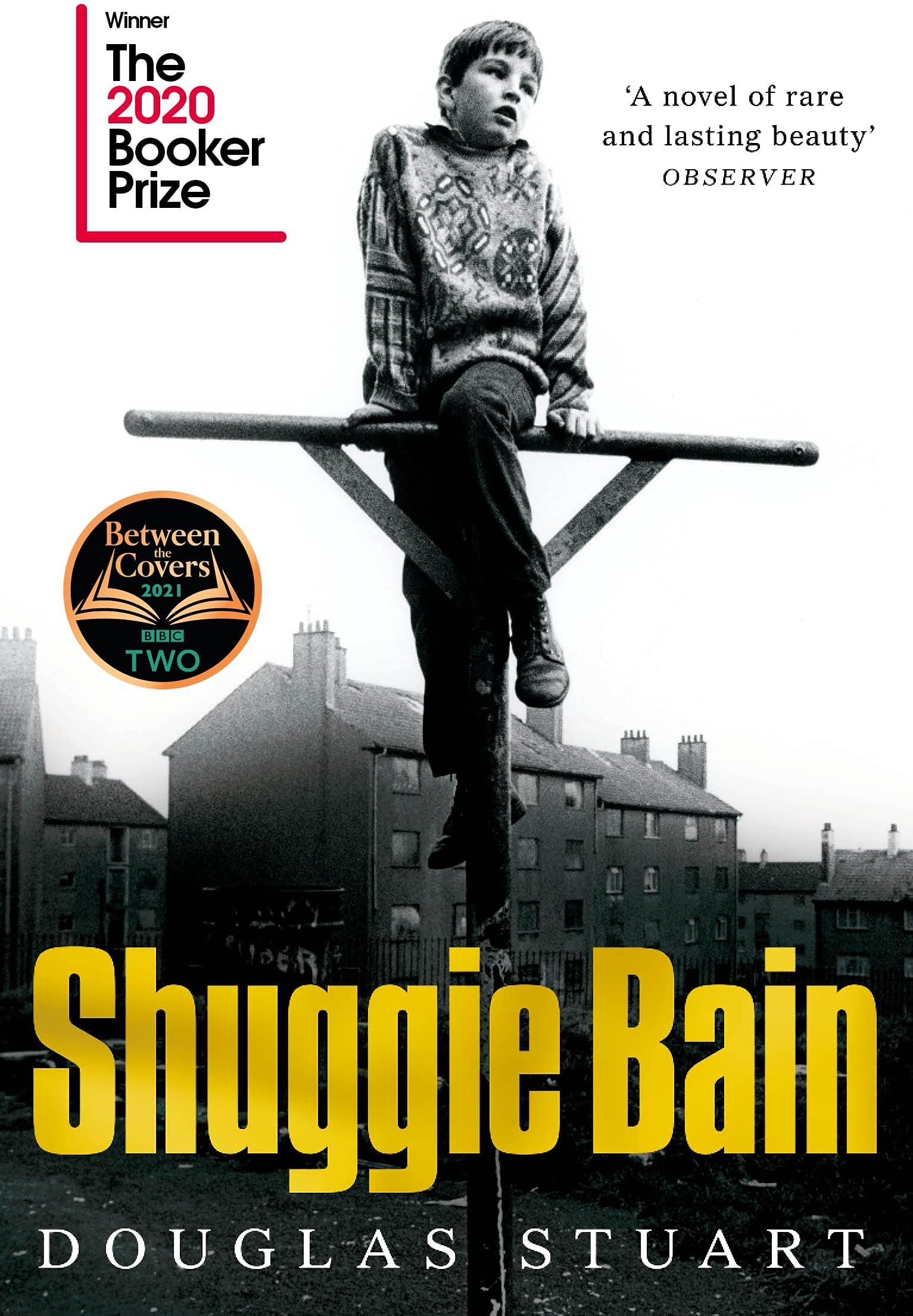
Shuggie Bain: The Million-Copy Bestseller & Winner of the Booker Prize
Product ID: 230879670
🌍Set in 1980s Glasgow
🏆Booker Prize Winner
📚Million-Copy Bestseller
Desertcart purchases this item on your behalf and handles shipping, customs, and support to USA.
📖 Dive into the Booker Prize-winning story everyone’s talking about — don’t miss out on this literary phenomenon!
Shuggie Bain is a Booker Prize-winning novel and million-copy bestseller that delivers a heart-wrenching, compassionate portrait of a boy’s struggle to save his alcoholic mother in 1980s Glasgow. Celebrated for its raw depiction of poverty, addiction, and love, this critically acclaimed work has become a cultural touchstone for readers seeking powerful, socially conscious literature.


| Best Sellers Rank | 2,003 in Books ( See Top 100 in Books ) 8 in Drug & Chemical Abuse Addiction & Recovery 148 in Literary Fiction (Books) 230 in Contemporary Fiction (Books) |
| Customer Reviews | 4.5 out of 5 stars 51,816 Reviews |
L**L
Heart wrenching, shocking, dreadful but also filled with love, humour and resilience.
I resisted reading this for the longest time, as I mistakenly thought Stuart’s Booker prize winner would be in the same ball-park as another, earlier Booker prize winner inhabiting the same ball-park of family breakdown and the devastating effects of alcoholism, which I found was unremitting and unvarying in its laying out of the destruction and degradation which inhabits the world of addiction. What elevates Shuggie Bain for me, even though Stuart pulls no punches, is the absolute love shown between Agnes and her children. Love which of course is often crashed and smashed and eviscerated bu drink. Stuart writes from the place of compassion and love – and also, from a place of healthy societal awareness and rage. The real villain here is far far wider than an individual. Rather, the legacy of Thatcher’s ‘there’s no such thing as society’ Britain. That mind-set of self-interest, survival of the fittest, class war, people as expendable, union-bashing. Stuart lays clear the fall out for communities where their industries have gone. Communities which had formed around mining, The legacy of the 1980’s, the creation of new towns, haphazardly and cheaply done. Shuggie Bain is a novel, but it comes formed by Stuart’s own life. A gifted boy, child of a mother who struggled with alcoholism, a boy discovering himself as gay, one with an older brother and sister. The foundation of this book – and clearly, the heart and love within difficult family relationships, are Stuart’s own, though specific characters and events are the novelist’s craft: this is not an autobiography or straight ‘memoir’ It is also, despite (or perhaps because of) the harrowing, at times joyous, feisty, and full of life. Stuart works to awaken the compassionate and tender heart in his readers, to feel WITH his characters in their weighty struggles, not to despise or dismiss them.
S**E
The Grit Of Poverty.
This superb story is essentially in three parts. In the first and final parts we encounter Shuggie after he has physically escaped the events of the lengthy middle portion. I thought the first part was too long and caused a wrench when the book stepped back ten years, moving into the second section, taking Shuggie back to his childhood, especially as the reader really needed some knowledge of the main events in order to process this first section. This is a minor complaint; the author picks us up and carries us along once we meet Shuggie's family. The bulk of the main story concerns Shuggie's mother, Agnes, an alcoholic struggling - and struggling is the word - to control her alcoholism, bring up three children, experience some sort of life, realise her hopes and ambitions, and negotiate the people around her. Her love for her kids is manifest but she and they are doomed by drink, feckless lovers, vicious neighbours and an absence of any true friends. She meets a man she likes but even he - actually one of the more decent characters - betrays her in the most convincing and destructive manner. Agnes herself is superbly drawn - her alcoholism-cycle of drink, stupor, guilt, drink again, and her changes in character from sweet and loving, through drunken rage and spite to hungover regret are utterly true to life: one alcoholic possesses several conflicting personalities. The author has set the novel in eighties Scotland and hints at the damage done by Margaret Thatcher's government to Agnes' neighbourhood, employment prospects and class, but doesn't ram Thatcher down the reader's throat. This is just as well because it is one component of the social environment in which Shuggie's family try to live. Agnes' ambitions to rise out of her poverty and degradation are thwarted time and again by her alcoholism, uncaring - even absent- local and national governments, and by a cold society isolating and degrading her and her family. Logically, this vile environment did not just spring up with the new government; it had been festering for years. Agnes didn't have a chance. In the middle of this mess we find Shuggie, a decent, seemingly doomed boy striving to cope with and care for his loving but incapable and deteriorating mother as well as negotiate both his emerging sexuality and the pitfalls of simply growing up. The warmth of his mother, and her guilt over his plight, the convincingly well masked affection of his brother, are clearly drawn in description as well as appropriately gritty language. I felt I was listening to the authentic voice of deprived and struggling Glaswegians. The landscape and emotional life of the book are stark and bleak but the superb quality of the prose carries the reader through to the final section. This is a narrative novel not a trite story with a message. It does, I think, have a kernel of redemptive seed to it. Three quarters through, Shuggie goes to cash a benefit book for his mother. The regulation-spouting cashier considers refusing to oblige but eventually pays up when the queue becomes impatient. As she does so, she dispenses a few words of wisdom representing the only real hope Shuggie ,or any of us, really has. It's a crucial scene, all the more poignant because the cashier - however distantly - represents callous officialdom. Towards the end there is a tragicomic development when an acquaintance invites Shuggie along to makeup numbers on a date (of sorts!) A beam of hope under a louring Glasgow sky. Is the hope realised? I won't spoil it. Shuggie Bain deserves its place in the short list. I wish it well for the award.
A**T
Tragic, well written, worth reading BUT with a few reservations...
This is one grim read. There's so much detailed description of misogyny and the abuse of women that it's hard to get beyond the first quarter and keep on reading. If it hadn't had the Booker listing, I would certainly have given up on it. There's also the clichéd image of working-class Glasgow, a place of squalor, abuse and relentless violence. Here we go again: Sighthill a working-class hell, where it's pretty much inevitable that men beat up and rape their wives (and any other women they get a chance at grabbing), women are grimly accepting of this fate, even while they're furious and trying to fight back, unless they're on the drink or drugs, and kids had better stay out of the way. Boys had better be boys, too, or else – Shuggie as a boy is gradually becoming aware of his sexuality, and that he disgusts most other boys and men with this 'unnatural' behaviour, and his father is ashamed of him. You have to look a long way to find a smidgeon of kindness or support or anything a little more positive. It's a case of slogging all the way through almost to the end. As an evocation of a miserable and thankless life in which an isolated boy has to care for his mother who is completely lost to alcoholism, it's convincing and thorough and, in the end, quite moving. But don't read this one for fun...
R**F
An incredibly moving and emotionally challenging book
Shuggie Bain is an incredibly moving and emotionally challenging book. The story folows Hugh 'Shuggie' Bain and his mother, an alcoholic and the victim of an abusive marriage. It is harrowing at times but it isn't a book that leaves you feeling completely despondent. Douglas Stuart weaves so much humanity into his characters that you do feel, ultimately, that there is something to feel hopeful about. The novel tells the story of Shuggie's mother, Agnes, and his father, Shug. Shuggie is named for his father, Agnes' second husband. Shug is sadistic and manipulative. Having seduced Agnes away from her first, safe but boring, husband, he almost immediately loses interest and pursues a campaign of physical, sexual and emotional abuse. He neglects and abuses Shuggie and his half brother and sister. Eventually, he dumps Agnes and the children in a tiny house in a community gutted by the Thatcher government. As well as misogyny, alcoholism is the book's second recurring antagonist. Agnes struggles with alocohol addiction despite her sincere attempts to stop drinking. As Shuggie gets older, he increasingly takes on responsibility for her care. Those responsibilities are always beyond his years and unsurprisingly his social and educational opportunities suffer as a result. There is a battle throughout this book for the status of protagonist. Shug's emotional dominance over Agnes is reflected in his son and (by association) the book being named after him. His shadow hangs over everything that follows. Agnes is a supporting character in the book's title and in the opening sections thanks to Shug and his control over her. Then, after Shug abandons them, her life is always secondary to her need for drink. In turn, Shuggie's story is always relegated below that of his mother and her addiction. His attempts to assert himself and prioritise himself are always thwarted. The politics of Shuggie Bain is both subtle and important enough to feel authentic. The characters are beautifully and convincingly developed. You feel every moment and grapple with every hopeless scenario. This is a book that stays with you for days and weeks afterwards.
A**E
Darkly gritty
If there was ever a book to break your heart, it will be this one. This is dark, gritty and raw and despite everything, I couldn't help but feel not just for Shuggie, but for Agnes as well. She is her own worst enemy, a slave to the drink and a poor mother to all her children. So it is Shuggie, the child caught up in trying to take care of his own mother, who you feel for most in all this. And having grown up with an alcoholic mother, it was easy to become angry with Agnes. But it is also impossible not to see the deep love that Shuggie feels for his mother and to pity her, even if it was sometimes difficult to like her. This is a stark and bleak look at the undeniable damage alcoholism can do to a family; the hurt it causes, the tattered childhood it leaves in its wake. The responsibilities it passes to those too young to bear them. The guilt left in those who have tried to pick up the pieces; that they weren't enough, that perhaps they should have been able to fix it. Shuggie is the youngest in his family, and as Agnes slowly but surely drives everyone else away from her, he is the only one left. He is the one trying to keep her from the bottle, trying to make the stamp money last the week so they have food to live on, trying to keep the meters running when his mother has all but given up. It's a story of desolation and of broken families, let in the backdrop of Thatcherite Scotland where the mines were closing. Men left without jobs, families left without fathers. A bleak, cold and depressing landscape where the money is never enough to pay the bills, much less so when you piss it away on lager and vodka. But there are sparks of hope within the dismal landscape, even when you know the inevitable will soon occur and the cycle will begin again. Shuggie's love for his mother is one of those bright sparks and his hope that one day she will manage to climb back on the wagon is both heart-wrenching and heart-warming. Douglas Stuart creates characters that leap off the page, for all their faults and all the cracks and splinters that they leave in their wake. Even fairly minor characters like Agnes's parents somehow managed to worm their way into my heart. It felt like I was reading about real people, leading real lives with all the ugly flaws and day-to-day tragedies that occur within them. As a child, I was unbearably embarrassed by my mother. My shame led to rage and a deep-set anger that took many years to shake off. As an adult I pity her and love her in the same awkwardly mingled breath. And that is how Agnes made me feel in part. For all her flaws and her weaknesses, she is a deeply unhappy woman, broken in part by her own actions but also by events she had little control over once they were set in motion. And her son deserved better. It doesn't surprise me to learn that this book, although not biographical, was inspired by the author's own childhood. There is too much truth in the pages for it not to have been. Too deep an understanding not just of the devastation alcohol addition leaves in its wake, but also of the historical period and the hopeless devastation that Thatcher's policies left in the north of the United Kingdom.
A**R
A modern tragic tale
Incredible, I'm so glad I picked it up. Heart wrenching, painful and acerbic. I kept hoping for a happy ending...
M**E
A well-written but painful read
I wonder why this novel won the Booker Prize? It was compelling but surely not of the superlative quality that such a win would suggest. It's as much a portrait of the alcoholic Agnes Bain as it is that of her son Shuggie, a young carer struggling with his sexual identity. There is an incredible amount of vivid detail with characters and townscapes that fill the story with almost unremitting misery. I used to spend a lot of time in Glasgow and love the city but now I realise how sheltered I was in my aunts' handsome middle-class homes in the 'nicer' parts of town. But ALL working-class women can't be so utterly dreadful as those within these pages. It is an unbalanced and bitter view. I gather the novel contains a lot of autobiographical material and my heart goes out to the author for having suffered during his own childhood, but as interesting and moving that this work is it is not in my opinion a truly great novel.
S**.
Grippingly raw and emotional.
In this book we meet Shuggie a young boy from a dysfunctional family. We first meet him in present day in the nineties as a teenager and then we are taken back to when he is a young child and what life was like for him growing up. This isn’t an easy read. Shuggie isn’t like most boys of which has him picked on and bullied at school as well as by neighbouring children. He is particularly close to his mum for what good it does him. It was heartbreaking to see him craving for attention and for her to be how a mother is supposed to be. Seeing things on the opposite foot with the child looking after the well fare of his mum it broke my heart reading of Shuggie’s childhood basically being stolen from him. Through Agnes his mother, we see what addiction can do to someone. I was torn with my feelings for this woman. On one hand she has been dealt a rough hand in life and does what she needs to do to try and keep a roof over her and her children’s heads but as with any addict, putting her own needs before those of her children left me infuriated and I wanted to give her a good hard shake. Shuggie Bain is set in the eighties when poverty and job losses were at an all time high due to closures of the coal mines. Whilst this is the back drop of the novel, the main focus is on a young boy trying to work through his feelings of who he is as well as wanting the best for him and his mum. It shows the pressures on children who live with an addict and it’s something that no child should have to deal with. Grippingly raw and emotional with a boy whose story will stay with me.
A**R
This is a well deserved Booker Prize Winner
As someone who lived and worked in Glasgow a long time ago I was attracted to this book straight away, and it didn't disappoint. It took me back to the city at a time when I was young and working there. The language is perfectly captured and the story is an accurate reflection of how many Glaswegians lived at the time, with alcohol being at the centre of almost everything for many folks. It is a blend of sadness, happiness, disappointment, alcoholism and infidelity and the hard fact that being different, as Shuggie was, made it tough for him growing up in that time. This is a book I would recommend wholeheartedly and it's hard to put it down when you start on Shuggie’s journey with him. I could hear Glasgow loud and clear in the use of the language but don't let that put you off, it's written beautifully and easily understood, even if you have never been to Glasgow before. Well done Douglas Stuart, it is a triumph and a classic already.
S**A
Beautifully written
The story even so it’s dark yet it so sweet I didn’t think I’d love it this much one of the best books I read this year
N**.
Ausgezeichnet!
Ein tolles Buch! Zu empfehlen!
M**N
gripping
Van begin tot eind word de lezer meegenomen in een onbekende wereld. De personages zijn levensecht. Ergens hoop ik op een vervolg. Je blijft hopen op betere tijden.
N**N
Unordinary and Unforgettable!
Shuggie Bain is a masterpiece, an astounding debut which will make your soul desperate and heart ache. Set in the 1981-1992 Glasgow, Stuart's debut novel is a fascinating reading experience, story of a 14 yr old Shuggie Bain and his mother Agnes Bain, so dark and intense, which brilliantly portrays a broken childhood and hopeless love. It includes multiple themes- poverty, abuse, addiction, gender inequality, religion etc. Shuggie Bain is not a feel good read; it's more like a gothic fiction. The writing style will make you want more of Stuart's works as it's charming, Glasgow dialect and the subtle descriptions of each incident will never fail to take you to the unordinary and unforgettable life of Shuggie. Shuggie and his love...he loved Agnes so much that the only thing he wanted was to make her normal, to live a normal life with her. And her alcoholism, the author is not directly sharing the physical and mental conditions of an alcoholic, but we can feel the depth of darkness inside her and she considered alcohol as an escape from the physical and mental abuse and her unfulfilled dreams. This novel is a rare one with all it's memorable characters and outspoken realities. It was a highly disturbing, yet heartbreakingly-good read, Shuggie and his unusual, painful life will always stay with you!!
Trustpilot
1 month ago
1 day ago