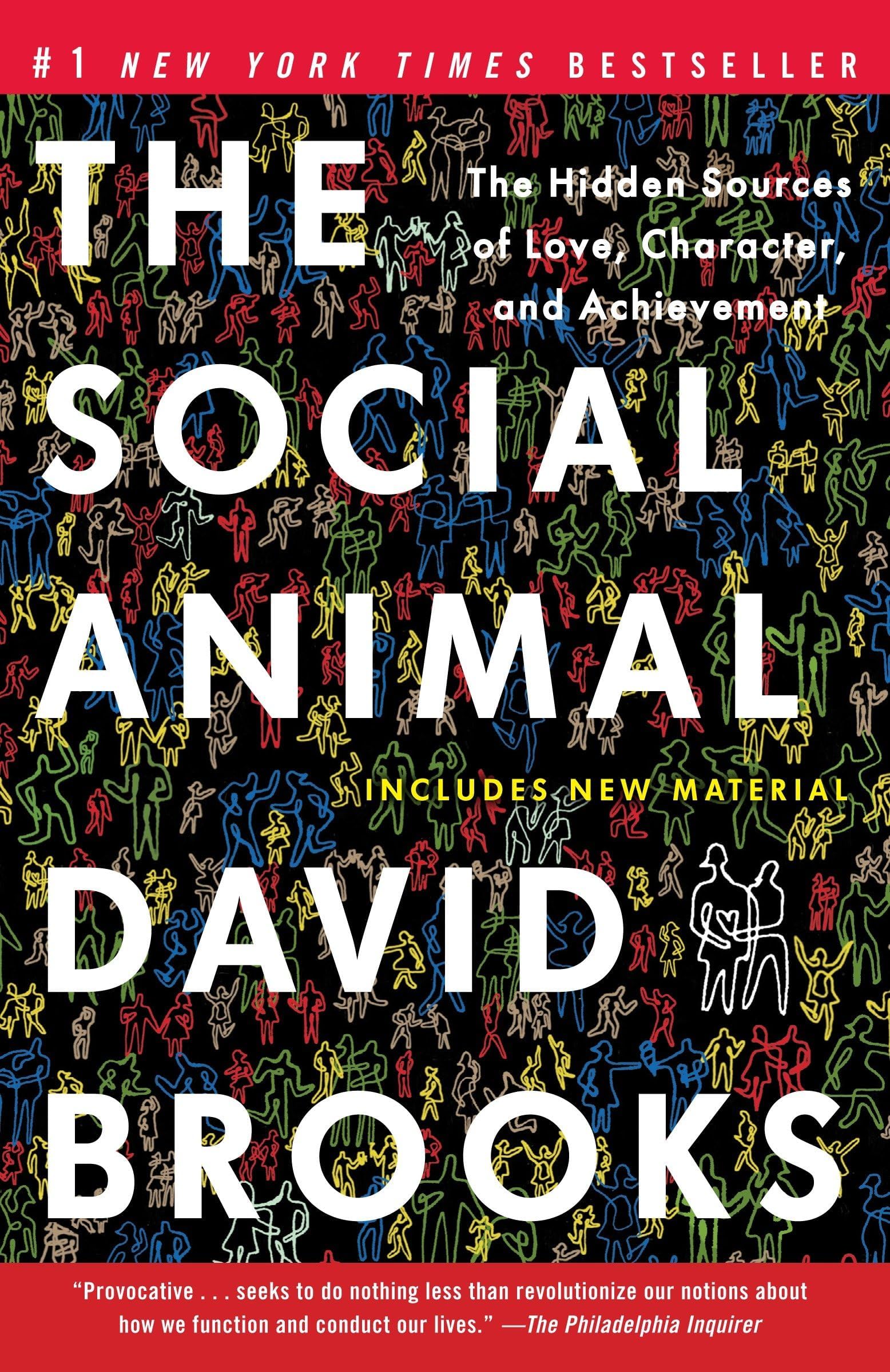
The Social Animal: The Hidden Sources of Love, Character, and Achievement
Product ID: 221580
Desertcart purchases this item on your behalf and handles shipping, customs, and support to USA.
#1 NEW YORK TIMES BESTSELLER With unequaled insight and brio, New York Times columnist David Brooks has long explored and explained the way we live. Now Brooks turns to the building blocks of human flourishing in a multilayered, profoundly illuminating work grounded in everyday life. This is the story of how success happens, told through the lives of one composite American couple, Harold and Erica. Drawing on a wealth of current research from numerous disciplines, Brooks takes Harold and Erica from infancy to old age, illustrating a fundamental new understanding of human nature along the way: The unconscious mind, it turns out, is not a dark, vestigial place, but a creative one, where most of the brain’s work gets done. This is the realm where character is formed and where our most important life decisions are made—the natural habitat of The Social Animal . Brooks reveals the deeply social aspect of our minds and exposes the bias in modern culture that overemphasizes rationalism, individualism, and IQ. He demolishes conventional definitions of success and looks toward a culture based on trust and humility. The Social Animal is a moving intellectual adventure, a story of achievement and a defense of progress. It is an essential book for our time—one that will have broad social impact and will change the way we see ourselves and the world. Review: surprisingly entertaining and informative - I must be the ideal audience for this book because I found it to be a wonderful mix of great writing, new ideas, and interesting information. The goals of Brooks' book are "to synthesize [recent scientific] findings into one narrative... to describe how this research influences the way we understand human nature... to draw out the social, political, and moral implications of these findings." He achieves the goal of aggregating the research admirably. I don't consider myself well read on brain and cognitive sciences but I read several science blogs and had encountered many of the info-bites he introduces, many of which are extremely recent. A random sampling of research results he mentions: "six-month-old babies can spot the different facial features of different monkeyse, even though, to adults, [the monkeys] all look the same." "Anthropologists tell us that all cultures distinguish colors. When they do, all cultures begin with words for white and black. If the culture adds a word for a third color, it is always red." Brookes uses a device of narrating the lives of 2 invented people, Erica and Harold. For example, to illustrate ideas on decision making, he introduces Erica's coworker Raymond whose "knowledge of his own shortcomings was encyclopedic. He knew he had trouble comparing more than two options at a time... so he would build brackets and move from one binary comparison to the next. He knew he liked hearing evidence that confirmed his opinions, so he asked Erica and others to give him the counterevidence first," etc. After describing a situation within the context of the narrative, Brooks jumps in to elaborate with more information. I feared this tactic would be too forced and would thereby fall on its face but he actually pulls it off! He binds up all the ideas in a cohesive story that has surprisingly sympathetic characters and a completely unexpectedly interesting character-driven plot. Brooks uses his characters' lives and personalities to illustrate his ideas. One theme that arises is that rational thought is far from the dominant component of human reality: "Unaware of what is going on deep down inside, the conscious mind assigns itself the starring role... people are still blind to the way unconscious affections and aversions shape daily life." Underestimating the importance of culture in forming the subconscious and thus human behaviors causes the government to misdirect their energies, focusing on "money and guns" rather than community. Brooks argues for a more paternalistic government that shapes culture: "You can pump money into poor areas, but without cultures that foster self-control, you won't get social mobility... You can establish elections but without responsible citizens, democracy won't flourish... it was not enough to secure a village; they had to hold it so that people could feel safe, they had to build schools, medical facilites, courts, and irrigation ditches; they had to reconvene town councils... the hardest political activity- warfare- depended on the softest social skills- listening, understanding, and building trust." Brooks' characteristic writing style is funny, engaging, and smart, but sometimes sarcastic and intentionally provokative/offensive. Example: "Like most upper- amd upper-middle-class children, these kids are really good at obscure sports. Centuries ago, members of the educated class discovered that they could no longer compete in football, baseball, and basketball, so they stole lacrosse from the American Indians to give them something to dominate." I'd seen this style of soft science writing before, most recently in a book called Spent: Sex, Evolution, and Consumer Behavior . Brooks manages to keep his punchiness sparse enough that I don't tire of it but if that style doesn't appeal to you, you may want to steer clear. At times Brooks writes beautifully, surprising me with his poetic phrasing, so for me this book also holds artistic value. In writing about the human mind, he explores happiness and the meaning of life, pulling from sources ranging from Walt Whitman to Poincare. Describing Harold's impending death, he writes, "his wife and his nurses served him with a care, patience, and devotion that surpassed all expectation. Their efforts were more dear to him because he knew that he could never repay them... It was hard at first to simply fall backward into their love." This book is great for someone who's interested in the human mind and wants an incomplete overview of recent developments in that area. It's also great for people who are interested in a unique perspective on how human nature relates to society and politics. Keep in mind Brooks is not a scientist- he's a journalist interested in culture and he uses various studies to inform his view but does not analyze the science. This book does not offer deep analysis of studies, nor does it come close to being exhaustive in its depiction of all the research done in this field. Review: A well written, informative book on a topic relevant to all - I find that some of the most enlightening and enjoyable books come when an intelligent author that I trust studies a topic extensively and delivers facts, thoughts, and practical applications. That is what this book is to me. If you have interest in the topic of how the subconscious and conscious mind combine to create the perceptions and thoughts that define your world and how people behave in it, then this book may be for you. I personally came into this book with relatively little knowledge on the topic, though it is something that I have recently been thinking about quite a bit. It seems as if this is a topic that Brooks has spent many years studying and pondering. Whatever you may think of David Brooks or his politics, you would be hard pressed to describe him as anything short of a very intelligent man and, as much as one can trust a writer from merely reading their work and watching their commentary, I trust Brooks as an honest and forthright man so, though I cannot speak to the accuracy of his interpretations of the research, I am inclined to trust it. If you are an expert in this field, maybe you would find significant misinterpretations or omissions in Brooks use of technical aspects of this book, but that is not something that I, as a layman, can determine. Unless I read any specific complaints from an expert, I am willing to highly recommend this book to both friends and the desertcart community. Let me make one point to ensure you are getting what you expect: This book contains the life stories of two fictional characters, but that part of the book only exists as a method for Brooks to deliver his message. This book is not about the characters but rather it is about what Brooks has learned from his study of research on the human brain. Thought I think this format allows Brooks to reach a broader audience, I didn't find the fiction to be the strength of the book. You shouldn't be buying this book for the value or quality of the fictional aspects. This book is though provoking, and I genuinely feel that it changed my view of how my own mind works. I expect that I will consider things that this book introduced me to on a regular basis and sometimes in practical aspects of my life. When a book is an interesting read and genuinely changes ones view of themselves and how their body and mind function, then how can one give it less than 5 stars?

| Best Sellers Rank | #64,398 in Books ( See Top 100 in Books ) #78 in Sociology of Class #274 in Popular Social Psychology & Interactions #300 in Cognitive Psychology (Books) |
| Customer Reviews | 4.4 out of 5 stars 1,335 Reviews |
N**A
surprisingly entertaining and informative
I must be the ideal audience for this book because I found it to be a wonderful mix of great writing, new ideas, and interesting information. The goals of Brooks' book are "to synthesize [recent scientific] findings into one narrative... to describe how this research influences the way we understand human nature... to draw out the social, political, and moral implications of these findings." He achieves the goal of aggregating the research admirably. I don't consider myself well read on brain and cognitive sciences but I read several science blogs and had encountered many of the info-bites he introduces, many of which are extremely recent. A random sampling of research results he mentions: "six-month-old babies can spot the different facial features of different monkeyse, even though, to adults, [the monkeys] all look the same." "Anthropologists tell us that all cultures distinguish colors. When they do, all cultures begin with words for white and black. If the culture adds a word for a third color, it is always red." Brookes uses a device of narrating the lives of 2 invented people, Erica and Harold. For example, to illustrate ideas on decision making, he introduces Erica's coworker Raymond whose "knowledge of his own shortcomings was encyclopedic. He knew he had trouble comparing more than two options at a time... so he would build brackets and move from one binary comparison to the next. He knew he liked hearing evidence that confirmed his opinions, so he asked Erica and others to give him the counterevidence first," etc. After describing a situation within the context of the narrative, Brooks jumps in to elaborate with more information. I feared this tactic would be too forced and would thereby fall on its face but he actually pulls it off! He binds up all the ideas in a cohesive story that has surprisingly sympathetic characters and a completely unexpectedly interesting character-driven plot. Brooks uses his characters' lives and personalities to illustrate his ideas. One theme that arises is that rational thought is far from the dominant component of human reality: "Unaware of what is going on deep down inside, the conscious mind assigns itself the starring role... people are still blind to the way unconscious affections and aversions shape daily life." Underestimating the importance of culture in forming the subconscious and thus human behaviors causes the government to misdirect their energies, focusing on "money and guns" rather than community. Brooks argues for a more paternalistic government that shapes culture: "You can pump money into poor areas, but without cultures that foster self-control, you won't get social mobility... You can establish elections but without responsible citizens, democracy won't flourish... it was not enough to secure a village; they had to hold it so that people could feel safe, they had to build schools, medical facilites, courts, and irrigation ditches; they had to reconvene town councils... the hardest political activity- warfare- depended on the softest social skills- listening, understanding, and building trust." Brooks' characteristic writing style is funny, engaging, and smart, but sometimes sarcastic and intentionally provokative/offensive. Example: "Like most upper- amd upper-middle-class children, these kids are really good at obscure sports. Centuries ago, members of the educated class discovered that they could no longer compete in football, baseball, and basketball, so they stole lacrosse from the American Indians to give them something to dominate." I'd seen this style of soft science writing before, most recently in a book called Spent: Sex, Evolution, and Consumer Behavior . Brooks manages to keep his punchiness sparse enough that I don't tire of it but if that style doesn't appeal to you, you may want to steer clear. At times Brooks writes beautifully, surprising me with his poetic phrasing, so for me this book also holds artistic value. In writing about the human mind, he explores happiness and the meaning of life, pulling from sources ranging from Walt Whitman to Poincare. Describing Harold's impending death, he writes, "his wife and his nurses served him with a care, patience, and devotion that surpassed all expectation. Their efforts were more dear to him because he knew that he could never repay them... It was hard at first to simply fall backward into their love." This book is great for someone who's interested in the human mind and wants an incomplete overview of recent developments in that area. It's also great for people who are interested in a unique perspective on how human nature relates to society and politics. Keep in mind Brooks is not a scientist- he's a journalist interested in culture and he uses various studies to inform his view but does not analyze the science. This book does not offer deep analysis of studies, nor does it come close to being exhaustive in its depiction of all the research done in this field.
M**N
A well written, informative book on a topic relevant to all
I find that some of the most enlightening and enjoyable books come when an intelligent author that I trust studies a topic extensively and delivers facts, thoughts, and practical applications. That is what this book is to me. If you have interest in the topic of how the subconscious and conscious mind combine to create the perceptions and thoughts that define your world and how people behave in it, then this book may be for you. I personally came into this book with relatively little knowledge on the topic, though it is something that I have recently been thinking about quite a bit. It seems as if this is a topic that Brooks has spent many years studying and pondering. Whatever you may think of David Brooks or his politics, you would be hard pressed to describe him as anything short of a very intelligent man and, as much as one can trust a writer from merely reading their work and watching their commentary, I trust Brooks as an honest and forthright man so, though I cannot speak to the accuracy of his interpretations of the research, I am inclined to trust it. If you are an expert in this field, maybe you would find significant misinterpretations or omissions in Brooks use of technical aspects of this book, but that is not something that I, as a layman, can determine. Unless I read any specific complaints from an expert, I am willing to highly recommend this book to both friends and the Amazon community. Let me make one point to ensure you are getting what you expect: This book contains the life stories of two fictional characters, but that part of the book only exists as a method for Brooks to deliver his message. This book is not about the characters but rather it is about what Brooks has learned from his study of research on the human brain. Thought I think this format allows Brooks to reach a broader audience, I didn't find the fiction to be the strength of the book. You shouldn't be buying this book for the value or quality of the fictional aspects. This book is though provoking, and I genuinely feel that it changed my view of how my own mind works. I expect that I will consider things that this book introduced me to on a regular basis and sometimes in practical aspects of my life. When a book is an interesting read and genuinely changes ones view of themselves and how their body and mind function, then how can one give it less than 5 stars?
J**N
Uneven but Still Worth the Read
There are many reasons to like "The Social Animal." First, there's Brooks' trademark graceful, humorous, engaging writer. Second, there's that engaging narrative, much of it autobiographical or biographical. Third and most important, Brooks has combed through books on neuroscience, psychology, management, politics, sociology, philosophy, and economics to present to us partly what we know about the human condition, but mainly what we don't know. But while there are many reasons to like this book, there's one good reason to not like this book -- it doesn't really tie well together, certainly not the way that "Bobos in Paradise" ties so well together. I am a big fan of Brooks' writing, and agree with just about everything he says. I've always thought of him as our modern-day Edmund Burke, so ever distrustful of rationalists and speculators, so ever faithful to tradition and communal bonds. At the end of the book, when I discovered we also had another common hero -- Alexander Hamilton -- I was both surprised and thrilled. But I am not a fan of how he haphazardly slips in references to this or that book he's read. It was very hard to maintain focus and interest when he kept on doing that. The value of the book is if you're an avid reader of fiction, but you don't read non-fiction then Brooks, with this book, explains to you how the best fiction writers are also the very neuroscientists, and how neuroscience is only confirming what fiction writers have been informing us for centuries: that we are social creatures of feeling and habit, and that is a good thing. Of course, if you are an avid reader of both fiction and non-fiction, then this book doesn't offer any new insights. It's very little new information, but a lot of validation -- which is, as Brooks keeps on telling us, what we humans want first and foremost anyway.
M**.
Excellent
Perfect. Arrived on time and was as described by merchant... and typical of Brook's series.
T**Y
Read it for the facts not the conclusions
About the book The social animal is a book about the recent scientific discoveries about the operation of the human mind. It is written as a story about a couple Harold and Erica. It's not my favorite style to read about science but it works fine as illustrations of the ideas. How we learn, think, act and bond is documented with a wealth of references. One nice thing about the social Animal is that it put on display how marvelous creatures we are. Just to give you a taste for the book I'll give a few examples of interesting sections: Emotions are used to measure the value of something. Without emotions we are unable to make choices. This was documented by research on people with specific brain damages. "He was incapable of assigning value to different options. "His decision-making landscape was hopelessly flat" The feeling of pleasure is caused by the removal of some tension like when we grasp some situation or master a task. The surge of happiness is not caused by living in harmony but by erasing the tension. One very important implication of this is that you have to be the creator of your own happiness. Another point made is that self control (or character triumphs IQ as determinant of success in life. "People with self control and self-discipline develop habits and strategies that trigger the unconscious processes that enable them to perceive the world in productive and farseeing ways." Another good point is the need for heroes as role models. "Highly ambitious people often have met someone like themselves who achieved great success" Economic considerations The economic implications are discussed and concepts as emergent systems are explained. This is a well know concept in Austrian economics. Independent actions by individuals result in structures which is more complicated and intricate than the individuals are aware of. An example is individual settlers over time creating an advanced city. Another example is knowledge. People may over generations learn how to build boats which are far more advanced than the builders are aware of. Other examples are language and trade patterns. "Out of the actions and relationships of millions of individuals, certain regularities do emerge" Another economic point made is that humans are to complex creatures to be measured, quantified and fit into mathematical models. "Erica was taught by economists and political scientists who assumed that human beings are pretty much the same. This assumption makes social science a science" But mental character varies to a large degree: "The tendency to collect information before making up one's mind, the tendency to seek various points of view before coming to a conclusion, the disposition to think extensively about a problem before responding, the tendency to calibrate the degree of strength of one's opinions to the degree of evidence available, the tendency to think about future consequences before taking action, the tendency to explicitly weight pluses and minuses of a situation before making a decision and the tendency to seek nuance and avoid absolutism" David Brooks is not an economist, but I must comment that these points are in line with the Austrian view on economics: The concept of "perfect competition" entails among others perfect information. But we certainly has widely different information. Austrian economist Murray Rothbart states "it is never any possibility of measuring increases or decreases in happiness or satisfaction. This makes any scientific handling of "externalities" impossible. Similarly elasticity curves are useful to understand the usual direction of economic processes. If the price rice people will typically buy more and the demand for some products are more sensitive to price changes than others. But each curve is really unique to the situation (persons, time, place, product etc.) Morality and Politics I'll conclude this review with what I did not like about the book and that was the author's moral and political conclusions of the presented material. Here is a statement showing his view on morality: "Many scientist believe that the ability to unconsciously share another's pain is a building block of empathy and through that emotion morality" Brooks presents a camera metaphor for morality. A camera has automatic and manual settings. The automatic settings are fast and efficient but not very flexible. So sometimes you override the automatic settings by switching to manual. In the same way the mind has automatic moral concerns. But in crucial moments, they can be overridden by the slower process of conscious reflection. What is presumed here is that the well being of this other person has moral value whereas my well being has not. But upon reflection; If life has moral value why has all human beings moral value except me? The only logical conclusion is that my actions promoting my life has moral value too. In a way he is a victim of the consequences of the structure of his own mind and the culture he grew up in. As ha states: "We're born into cultures, nations and languages that we didn't choose. We're born with certain brain chemicals and genetic predispositions that we can't control. We're sometimes thrust into social conditions that we detest. But among all the things we don't control, we do have some control over our stories. We do have a conscious say in selecting the narratives we will use to organize perceptions. At another place he states: Learning consists of taking things that are strange and unnatural and absorbing them so steadily they become automatic. Automaticity is achieved through repetition. The idea that your life has no moral value has sneaked into the authors mind through repetition in his culture. He makes another error concerning politics. Here is another statement: If you ask Americans to describe their values, they will give you the most individualistic answers of any nation on the planet. Yet if you actually watch how Americans behave, you see they trust one another instinctively and form groups with alacrity. WOW!! Much of the books is about how individuals bonds and relates. In the face of all this how can the author be surprised that securing each man's right to life, property and the pursuit of happiness should prevent people to form groups? I seems like some perverted vision of individualism has somehow sneaked into Brooks mind. Something like a false alternative between the government organizing the bonding or everybody will just stay alone. Another place he states "One of the most enduring lessons of social psychology is that behavior change often precedes changes in attitude and feelings. " If your body impersonates an attitude long enough then the mind begins to adopt it" Well then in an individualistic society where the life and property of each man is consistently protected and all infringements are checked then maybe people finally ends up respecting and trusting each other? How can Brooks get so lost when it comes to morality and politics? Again the answer is found in the book: "We spend much of the first halves of our lives trying to build internal models that fit the world and much of the last halves trying to adjust the world so it fits the inner models." I recommend reading this books for all the interesting facts. But be careful with adopting the authors conclusions. Better use you conscious mind to evaluate the facts and integrate them with your own mental structures.
B**L
Cavorting With The Carnivore of Curiosity!!!
Cavorting With The Carnivore of Curiosity!!! What Can I Say! WOW! I Needed That! Admittedly, I'm a fan of David Brooks mind. I don't agree with everything he writes in his op-eds for the NY times. Yet, I have developed an appreciation for the carnivore-like appetite he has for exploring a wide range of subjects - particularly those breakthroughs on the forefront of science. In this book, Brooks creates some fictional characters and allows us to walk along with them on their journey through life - integrating science, philosophy and his own interpretation of the aforementioned - and weaving this into the story line. It works! Brooks begins with this poignant insight: "We are living in the middle of a revolution in consciousness. Over the past few years, geneticists, neuroscientists, psychologists, sociologists, economists, anthropologists, and others have made great strides in understanding the building blocks of human flourishing. And a core finding of their work is that we are not primarily the products of our conscious thinking. We are primarily the products of thinking that happens below the level of awareness." p..x. Anyone whose has watched The Brain Series on Charlie Rose simply must read this book. Yet, it's more than that. This book will be terribly interesting to an audience will be deep and wide. For me, some of the most delicious items in the book included some of the following excerpts: "You are the spiritual entity that emerges out of the material networks in your head." (p 49). "The ability to construct templates about the future is vitally important to future success." (p.328). "Epistemological modesty is an attitude toward life. This attitude is built on the awareness that we don't know ourselves. Most of what we think and believe is unavailable to conscious review. We are our own deepest mystery." (Pp.245-6). Brooks writes: "Sounds and syllables come together and produce a story that has an emotional power that is irreducible to its constituent parts." (P.109). Well, he proved just that in this book. Outtakes and excerpts just won't produce the delicious meal this fare delivers to the reader. Buy it. Devour it! One of my favorites YTD in 2011.
B**N
A Magnificent Accomplishment
Mr Brooks is an Op-Ed columnist for the NYTimes, I read his work regularly and enjoy his efforts. He writes about public policy in his columns and some may see him as the token conservative for the Op-Ed group, but I think he is more of a middle road thinker between liberal and conservative. Have lived in Southern California my adult life and have completed careers as a Police Captain, Marine Corps Officer and Mayor. Have a PhD, two Masters and a Law Degree. To see what the book is, I think we need to review the author's objective. He states that for many years during his writings of public policy he has been interested in the studies relating to the brain and psychology. The author says that he is borrowing a technique from Rousseau to create personalities to bring life to the ideas he discusses. I think there is a connection with being concerned about public policy and the brains that create public policy. Also in general I think we are interested in why we and others act the way we do and how we function mentally. In addition, we get a cross section of the economic and social levels in the United States, and visit inner large cities, Aspen and Davos. The objective is a tall order. Some other commentators have mentioned a comparison of the outstanding work of Malcom Gladwell, who is quoted several times in this book. I believe a more apt comparison is with James Michener, who placed an even grander task before himself and created large sweeping novels. The criticisms of Mr Brooks book match those of Mr Michener as far as literary depth is concerned. All three authors in this paragraph are bringing us a huge amount of quality information extremely well written in an interesting manner with references for further study. After you finish this very important book, please take some time to reflect on how many significant studies have been used to create this work, and how adept, enjoyable, compelling and memorable the author's efforts are.
W**G
The Social Animal and Critical Thought
Ordering America: Fulfilling the Ideals of Western Civilization David Brooks makes an impressive case for the role of the unconscious and moral intuition in man's judgments. Brooks argues that we are not rationalists, in which conscious reason and logic control our decisions, the view of the French Enlightenment. We are largely social, sentimental creatures, the view of the British Enlightenment. Unfortunately, the unconscious and the moral imagination have become the basis for societal decisions that also require reason and logic--critical thought. David Hume, a leader of the British (Scottish) Enlightenment, identified the imagination as the active mental power that fashions a specifically human world within nature. He recognized that the imagination enables man to create connections between the perceived elements of both the physical and the moral world. But Hume also held that man's actions "were grounded in psychological realities, and hence were not to be disavowed lightly in the name of any specious transcendental value system, abstract metaphysics or utopian visions." Our college-educated social animals consider that their views are the products of uniquely creative intelligence, intuition, and imagination--and are thus morally superior. But for other than the technical professions (such as natural science, medicine, engineering, and finance), college since the 1960s has inculcated postmodern thinking in its graduates. Postmodern thinking dismisses the "rationalistic" mentality associated with scientific mechanism and materialism, what Theodore Roszak derided as "objective consciousness." The elite moral imagination reflects the postmodern social construction of reality (or illusion), dismissing the need for evidence. The sustainability ideology now dominant among elites illustrates the results of such thinking. Contrary to Hume, sustainability includes apocalyptic environmentalism, an egalitarian utopian vision, and a Gnostic-like transcendental value system--sustainable development. Edmund Burke called this the use of the "idyllic" imagination rather than the moral imagination. And many elements of sustainability require objective understanding and use of mathematics and assessment of risk, for which, as Brooks notes, the unconscious is unequipped. For matters of public policy, critical thought, not just personal or collective moral intuition, must be an essential element of judgment. In conscious thinking, as William James advised, intuition and logic must operate in partnership; the challenge of the rational mind is to sort and organize the interchange between the two. Moreover, the mind must use quality information and methods stored in memory to properly develop and apply both reason and the moral imagination. Are our elite social animals wholly capable of conducting such critical thinking in combination with their intuition? As first revealed by A Nation at Risk (1983), over decades many elites as well as others in Generations X and Y have received mediocre educations. Such elites lack the hard knowledge, experience, and vocabulary--as well as historical understanding--to fully inform their intuition, imagination, or reason. College graduates, increasingly educated in popular culture, are weakest in reasoning skills such as the ability to infer knowledge that is not explicitly stated and to assess the validity of evidence or the logic of arguments. Many elites are semiliterate, innumerate, and lack the critical thinking skills necessary to overcome the prejudices of human nature (Francis Bacon's "idols"): availability biases, conspiracy theories, false beliefs, and moral obsessions and crusades often based on fantasy rather than imagination. David Brooks need not be concerned that our elites are unduly rationalistic. For public matters, such as the efficacy of the sustainability ideology, many of those elites--in other than their technical professions--would seem largely unprepared to draw responsible rather than moralistic conclusions. Rather than accepting the unconscious as the basis for their thinking, our elites should examine how critical thought can be applied along with the moral imagination--perhaps by the proper use of objective technical professionals rather than only social animals.
S**R
Very good
This book is so very good. I was looking for inspiration to pick me up and return me to my cheerful go getter mode, and this book made me feel good and focused. I read books to clear my mind and gain perspective. This book provided that in abundance.
A**Y
Great read, good humor!
Great read, story and psychologically interesting and entertaining. I haven't even finished but have already given it as a gift.
M**R
Brilliant, Educational, and quite deep!
I bought this after hearing that policy makers were clambering as it gave such insight into "the human condition", so I was expecting a popular science type book along the lines of Freakonomics, Tipping Point etc. This book was so much more, the narrative of Harold and Erica gave real substance to the facts provided and the arguments made. Every page is crammed full of fascinating facts from the number of physical contacts Brits make compared to South Americans while having coffee to how the brain works. It's also a kind of a manifesto for the sub-conscious, if we are the sum of our experiences then you could look at the sub-conscious as our soul - deep stuff.... I really enjoyed the book and have made a page of facts to use in presentations and another page of books to read from the bibliography! Well worth buying
S**E
Best Book I've Read
Devoured this book in just a few days. An interesting look at life. Could not put it down and immediatly ordered more David Brooks books after finishing this one. A fabulous read for a student of sociology or of life, for that matter.
V**R
Thought provoking. Beautifully written.
It will teach you a lot about how a modern, evolved human beings are still similar in many ways to chimps found in jungles. How after a million years of evolution our animal part of brain is still running the show. How our instincts and reactions have all the control.
Trustpilot
4 days ago
2 weeks ago