Buy anything from 5,000+ international stores. One checkout price. No surprise fees. Join 2M+ shoppers on Desertcart.
Desertcart purchases this item on your behalf and handles shipping, customs, and support to USA.
📡 Stay connected with the cable that means business — without breaking the bank!
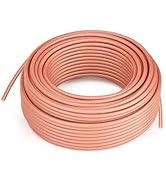
The Eightwood RG400 RF Coax Cable is a 40-foot, double-shielded coaxial cable engineered for high-frequency applications up to 12.4 GHz. Featuring silver-plated copper conductors and a heat-resistant FEP jacket, it delivers near-military-grade performance with excellent signal integrity and durability, making it ideal for professional-grade networking, satellite, and antenna setups.


| ASIN | B07WJG7XF6 |
| Best Sellers Rank | #31,501 in Electronics ( See Top 100 in Electronics ) #153 in Coaxial Cables |
| Brand | Eightwood |
| Brand Name | Eightwood |
| Cable Type | Coaxial |
| Color | pink |
| Compatible Devices | Cable modems, satellite dishes, network routers |
| Connector Gender | Male-to-Male |
| Connector Type | Coaxial |
| Customer Package Type | Long box |
| Customer Reviews | 4.5 out of 5 stars 183 Reviews |
| Frequency | 12400 MHz |
| Indoor Outdoor Usage | Indoor, Outdoor |
| Item Shape | Round |
| Manufacturer | Eightwood |
| Maximum Voltage | 1900 Volts |
| Model | ZRG40040 |
| Number of Items | 1 |
| Number of Pins | 2 |
| Other Special Features of the Product | Braided, Heat Resistant |
| Outer Material | silver plated copper double braid |
| Part Number | ZRG40040 |
| Recommended Uses For Product | Base Station, Antenna extension |
| Special Feature | Braided, Heat Resistant |
| Specification Met | Nom |
| UPC | 790404665768 |
| Unit Count | 1 Count |
M**L
Rg400
Its very good cable. Work out very good with running power. But to see very good swr don't used with mag mount it will be wast of time keep the rg8x.
E**E
Very similar to Mil-spec cable
Being unmarked and at a price of about 1/3 that of Mil-spec RG-400, I was skeptical but decided to give this a try for a non-critical application -- and I was pleasantly surprised. I measured the 40 foot length with a professional grade vector network analyzer (VNA) and compared it to a length of Mil-spec cable I'd previously purchased from a reliable source. Velocity factor and characteristic impedance (Z0) of the two cables were virtually identical. Also, the Z0 of this cable was at least as constant along the 40 foot length as that of the Mil-spec cable, indicating that the physical construction is uniform with no anomalies. The shields appear to be as tightly wound as those of the Mil-spec cable. The only difference I could detect was a slightly higher loss. I measured the loss only between 3 and 200 MHz which was the range where I'll be using it. The loss of this cable was about 6% greater at 3 MHz, and 1 to 2 percent greater at 10 - 200 MHz. These could indicate that the silver plating on this cable isn't as thick, or might be some other material. This small difference in loss itself would be insignificant in just about any application, but if due to a plating difference it might mean that the cable would deteriorate in a shorter period than the Mil-spec counterpart, if exposed to the environment for a long time. At least as far as I'm able to determine, this cable will be useful for a lot of applications calling for RG-400/U, at greatly reduced expense.
D**N
RF Choke Application Caution
RG400 is frequently used for constructing RF Chokes for transmitting antennas. It works well for me even though this is not a premium quality coax. In this application it is important to not wrap the coax too tight on the toroid core (typically an FT240-43 or FT240-31 core) because a tight wrap will exceed the minimum bend radius for RG400 coax (i.e. 0.5", or a 1" diameter loop). The reason for this is that the PTFE center insulation material will fail under use as the center conductor pulls through the PTFE like a hot wire knife. When used as an RF choke, the wire will heat up as RF current flows through the device. Keep the loops wrapped no smaller than 1" diameter and you should be OK.
F**N
Great jumpers and feed line mobile or base application
This is good quality coax and made great 3 ft and 6 ft jumpers for my radio equipment setup 50 Ohm 50 Ohm cable is primarily used in communications applications. C.B. , HAM , RADIO can be used as your main feed line as well all you need to know on how to install good quality pl259 Amphenol ends or Messi and Paoloni pl259 ends
T**.
Not bad coax for the price
I was actually surprised that it was double shield. Also the center conducter is Teflon insulated.
S**N
Flexible, insulation doesn't melt when soldering.
Great for making jumpers and winding chokes. Would buy again.
T**B
EXPENSIVE
Expensive. Hard to align in tight places.
L**Y
Good coax for jumpers or mobile use
I have used it for jumpers and have it in my mobile. It ohms out fine and haven’t had any issues with it. I have purchased a 100 feet of it different times and its made well and a lot cheaper than the name brand stuff.
D**R
Solid components for a reliable choke balun build
I used the FT240-43 ferrite toroid core together with the TUOLNK UHF SO-239 bulkhead female connector for a DIY balun project, and both components performed exactly as expected. The FT240-43 ferrite core is an excellent choice for HF baluns. The #43 mix provides good broadband performance and helps suppress common-mode currents effectively. It’s easy to wind, even with heavier gauge wire, and delivers stable impedance and low loss across multiple HF bands. SWR improvement was immediately noticeable once installed. The TUOLNK SO-239 bulkhead female connector complements the build nicely. The connector feels solid and well-machined, threads smoothly with PL-259 connectors, and mounts securely through an enclosure wall. Electrical contact is firm, and once tightened, it provides a clean, reliable RF connection with no looseness. It’s a good fit for weather-resistant balun boxes and portable antenna projects. Pros: • FT240-43 ferrite offers excellent HF broadband performance • Ideal for 1:1 current baluns and impedance transformers • SO-239 bulkhead connector is sturdy and easy to mount • Clean threading and reliable coax connection • Together, they make a professional-quality balun build Cons: • Ferrite #43 is best suited for HF (not VHF/UHF) • Connector mounting hardware could benefit from an included gasket for outdoor use Overall, these components work very well together for DIY baluns and antenna feed systems. If you’re building a reliable HF balun for portable or permanent installation, this combination is dependable, easy to work with, and delivers solid on-air results. Highly recommended for ham radio builders.
R**D
Very nice cost-effective alternative to the "real" stuff.
Very nice cost-effective alternative to the "real" stuff. It's unmarked cable however I've tested loss figures, TDR, etc. Just a very tiny (really, very small) more loss than the specs sheet of the marked RG400. They make great jumpers as well.
M**U
Excellent
Acheté pour faire des fils rca custom. Parfait
G**.
Arrived on time as described
Nice feedline for making patch cords and short runs, well shielded.
K**H
Excellent
Nothing to dislike. Great item. Good price.
Trustpilot
1 day ago
1 week ago