

Desertcart purchases this item on your behalf and handles shipping, customs, and support to USA.
📻 Elevate your radio game—hear what others miss!
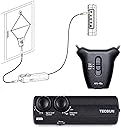
The Tecsun AN-48X is an indoor active loop antenna designed to enhance AM, LW, and SW radio reception across 520-1700 KHz, 120-400 KHz, and 3.5-20 MHz bands. Powered by 2 AAA batteries (not included), it features directional tuning to reduce noise and improve signal clarity. Compatible with most radios and including all necessary cables, it’s ideal for apartment dwellers and radio enthusiasts seeking superior indoor reception without complex outdoor installations.


| ASIN | B08464KCG1 |
| Antenna | Radio |
| AntennaDescription | Radio |
| Best Sellers Rank | #146 in Radio Antennas |
| Brand | TECSUN |
| Color | Black |
| Customer Reviews | 4.0 out of 5 stars 567 Reviews |
| Impedance | 75 Ohms |
| Manufacturer | Tecsun |
| Mfr Part Number | AN-48X |
| Model Number | AN-48X |
| Number of Channels | 3 |
| Number of Items | 1 |
| Unit Count | 1.0 Count |
R**.
Works Great with Crystal and Regenerative Radios
Once when shopping Amazon for a possible shortwave radio purchase, I noticed the Tecsun AN-48X antenna. The fact that it was only a single turn loop intrigued me, along with it’s ability to also cover shortwave and longwave. I didn’t pay too much attention to it as I already have an amplified AM model from another company. The problem with that product is that while it’s terrific when used with standard production radios, for the crystal and regenerative sets I use, its performance is so poor, it’s basically useless. I assume this is due to its lack of a gain control. Eventually I ordered the AN-48X thinking that since it also picks up shortwave, and I’m thinking of eventually buying a shortwave set at some point anyway, why not buy it. The price was reasonable as well. As I’ve experimented with my double-tuned crystal set and regenerative one-tube radio, the results have been encouraging. My first band scan with it was during the day. With the crystal set I netted 6 stations with the best catch being a 1,000 watt station at 30 miles. That’s 2 stations better than any other indoor antenna solution I ever tried. The one-tube regenerative set netted 10 stations. One was a 50,000 watt station at 100 miles and another with the same power at 165 miles. The following week I conducted a nighttime band scan. The crystal set total went down to 3 local stations. That’s not too surprising since, as some of you realize, many stations reduce power at sunset. I was hoping that at least one DX signal would be heard but unfortunately that wasn’t the case. Since loops are directional, I need to try more antenna positions which may improve the situation. The regenerative set was much better. In fact, I lost count around 10 stations. The best catches included a New York station (777 miles) and one from Nashville (570 miles). I can tell you from experience that when using radios like the one’s I’ve described, a passive antenna of substantial size might get a similar or perhaps even better station count. However, any strong local signals are likely to swamp large portions of the mediumwave spectrum. That means you’d have to rely heavily on an antenna tuner and QRM rejector. If you enjoy that challenge, I certainly understand as it’s all part of the fun of experimenting with crystal and regenerative sets. On the other hand, the AN-48X not only allows me to hear DX on my regenerative set, but on both types of sets I discovered it allows them to tune much sharper so strong local stations don’t tend to swamp adjacent, weaker signals. The problem with the AN-48X is that the tuning control is very touchy. A larger, tabletop-type controller box would be a welcome change, with a tuning knob large enough in diameter so that it’s not so easy to miss stations when moving through the band. The current format is obviously the better choice in terms of portability. I did try this on a vintage, budget AM/FM tuner and on an older, high performance portable. The tuner is neither very sensitive or selective, while the high performance portable is just the opposite. I’d say that on better radios this antenna acts similar to my amplified AM antenna and other passive loops I’ve tried, so don’t expect a significant increase in the number of stations you’ll receive. Instead, expect it to primarily boost and clean up what ordinarily would be weak signals. Another thing to be prepared for is the occasional situation where the antenna actually attenuates a signal rather than amplifying or clearing it up. That happened to me just once during testing with one of the above mentioned production receivers. As I recall, I’ve had this happen before, not only with my amplified AM antenna, but with two other passive loops I own. One thing that crops up surrounding antennas like this is the thought that it will not only amplify the signal, but noise as well. Since this antenna is directional, some noise issues might be mitigated by that fact alone. I have a very low level noise issue but it’s related to grounding as it shows up immediately when connecting my sets to the cold water copper pipe system. Although I’m still early in the experimentation process, I’m pleased to report that this antenna adds no additional, audible distortion. I also have yet to experience any negative performance effects related to the cable that runs between the amplifier and the control box. I mention this because it’s thin so I assume it’s not shielded. Mine measured 16 feet, 6 and one-half inches, from tip to tip. Once it’s attached to a window via its included suction cup, this antenna may not appear to be as refined looking as some others, but I believe that aspect can be improved. For example, take a look at the setup presented by Amazon reviewer i700plus from February of 2022. The idea of using a tripod is a great one, especially if you can keep the system assembled and stored somewhere when not in use. That way you avoid any wear and tear or accidental damage from continual setup and removal. So if you’re a crystal or regenerative set builder and like me your living arrangement involves an apartment, or perhaps you live in a condo and you’re scratching your head wondering how to get the most out of such radios, consider trying this antenna. I paid less than half what I did for my amplified AM model that I purchased 3 years ago, and since that one only covers one band, that makes the AN-48X a much better value. Crystal set purists may scoff because of its amplification, but this antenna gives my homemade radios a level of performance that should allow me to better hear the results of any modifications I make. Overall, it’s making my radio hobby efforts a lot more fun! I’ll update this review if I experience any noteworthy reliability or performance issues related to continued use of this antenna, not only with my current radios, but with any new sets I build or buy. Antenna Usage Update—January 2024 I recently took delivery of a new Sangean 909x2 multi-band portable radio. Together with the AN-48X antenna, the combination works great. My first nighttime band scan from my Midwest location netted AM stations from Canada to the Deep South and from West of the Mississippi to the East Coast. Most were not 50,000 watt stations either. Many were stations of considerably lower power whose signals were traveling well beyond their fringe signal range. On shortwave I picked up 23 stations in an area of the spectrum ranging from 4.84 to 9.71MHz. When scanning the AM band with this particular radio, the gain dial wasn’t necessary as any increase seemed likely to cause overload. Instead, I merely used the tuning dial about every 20kHz or so and rotated the antenna to see if that would peak the signal as well. I was able to do this because I followed the example of Amazon reviewer i700plus and mounted mine on a camera tripod. I was blessed to run across a heavy duty, professional tripod at a local thrift store. The camera mounting plate has a threaded stud with a protective cap. I took the cap to the hardware store and had the thread size checked so I could purchase an insert with the same thread type. I had a piece of scrap balsa wood sitting around that measured about 1-1/8 inches square by 36 inches long. I drilled a slightly undersized hole in the center of one end and glued/screwed the threaded insert into the hole. Now all I need to do when I want to begin a listening session is to screw this “spine” onto the tripod and finish assembling the antenna. On the other end of the spine I cut a slot which holds the antenna in place. At the bottom where the loop terminates into the LW/AM/SW switcher, for now I simply make a loop out of a piece of tape and stick it to the back of the switcher and stick that to the balsa spine. That way the lower section of loop isn’t flopping around as I swivel the antenna. A future modification will involve some sort of clip to hold the telescoping spreader bar to the spine. That will stabilize things even more. Keep in mind that this antenna does have limitations. For example, the instruction sheet lists the effective range for shortwave as being from 3,500kHz to 20,000kHz. So if you need wider coverage, you’ll need to look elsewhere. Some people complain that this type of antenna adds noise. That simply isn’t true. Regardless of the antenna type, if there’s a nearby noise source or one between you and the station, that’s basically what you can expect…noise! However, it’s the highly directional characteristic of loops that allows you to be able to tune away from the noise. In fact, you may find that sometimes turning the antenna in a certain direction may cause a reduction in signal strength but because the noise clears up, that station becomes listenable. If rotation in any direction doesn’t allow you to find a point where the signal is free or relatively free of noise, it isn’t the fault of the antenna. The antenna is letting you know that you need to seek a different location. Would it be better to have a loop above your house? Possibly. I say that because there’s more than just signal to be concerned about. Remember, you’ll need a way to turn that loop so that means installing not just the antenna but a rotor as well. Then there’s the installation. Are you going to do it or will you have a local antenna installer handle it? What I’m getting at here is that while I suspect there likely would be some improvement in having an outdoor style loop up high vs. the AN-48X indoors, would the improvement be worth the cost and effort? Since I’m in a house apartment in a reasonably quiet RF environment, for me the answer is no. So from home-built radios to multi-band production receivers, for me, as a space restricted apartment dweller, this antenna works very well.
B**.
Actually works.
I listen to a lot of shortwave radio while chillin' on my back deck, and wasn't expecting much for a cheap $30 loop. Usually I throw a longwire into the trees but since it was cheap, figured I'd take a chance. It says "indoor use only", but unless you're sitting in the rain, or leaving the electronic tuner in the weather all the time, it'll work fine outside - just roll it up when you're done. It's not perfect, and like others say, it's a bit touchy when trying to tune the tuner.. but it's cheap and it works.
J**P
Great antenna.
I bought this because I couldn’t find what I was looking for from a different manufacturer as it has been discontinued. I was surprised at how well this actually works, you have to make fine adjustments and have a little patience, but it really pays off. Comes with radio stand and multiple different adapters. Great quality. Highly recommend.
R**Y
This was great for Shortwave, but not too good for AM radio
I thought it worked well on night time shortwave radio, but I didn't think it worked so well on night time AM radio. I have other antennas I have tried out for that band, and they worked far better, as the power amplifier didn't work well with AM radio. I would personally recommend non-powered antennas for that band unless you live in a dead spot for said band. :-)
A**R
Tecsun A must have to go with your Shortwave in your BOB
Out of the box, this loop was verified, confirmed that I was listening to a station in Burbank California & Jacksonville Florida. Does not include AAA batteries however the unit comes with every connection you need for any radio. It's very compact to fit in with the radio itself. Set up is mere second's & needed for off grid survival & self protection when you need to know.
X**C
Junk
I tried this on several different radios in different configurations. This antenna attenuates the signal. For radios without a built in am antenna it is equivalent of putting a 12' piece of wire. When signal and ground is hooked up, the signal I was hearing vanishes to nothing. Tried it also on an $800 Palstar radio which has no built in antenna and could get one am station, same as 12" wire. The ferrite antenna is useless also. A $25 terk loop passive antenna is a thousand times better than this as works with every radio. Maybe mine is defective but at this price it shouldn't be. Others complain of the same thing, but mine appears worse than touching the antenna terminals with your finger. No kidding.
N**J
Works well
The antenna works quite well depending on placement...It's not terribly effective if it is mounted on a wall inside an apartment. It amplifies RF noise if used this way It works better if it is placed in a window that faces outside in an area not obstructed by buildings, etc It worked best when I mounted it on a wall on my patio, with the connecting wires running through a gap in the door when it is left open an inch or two...this improved AM and Longwave the most (I usually only receive a few longwave beacons...with the antenna I can receive a few Longwave broadcast stations from the UK, Ireland and North Africa...the audio is faint, but I can hear it...the first time I have actually been able to hear longwave stations in all my 45 years listening to sw and lw bands...
L**R
Works but little if any improvement in my location.
I bought this powered antenna for use with my Tecsun PL880 shortwave radio. I set it up in the window of my condo apartment. This is in a city location in a concrete and brick building. I did not think that it improved my reception over a standard long wire antenna. And, it appeared to add some additional noise. Turning the amplifier boost knob to "+" resulted in some improvement to the signal. Turning the antenna tuning knob made very little difference, at least for the stations I was able to pull in. The antenna comes with numerous attachments. The parts are quite small and delicate. I had some trouble keeping the power in the signal amplifier unit connected and had to rotate the batteries in the compartment numerous times to keep it from shutting off. A small red light indicates that it is on. The reel type Tecsun external antenna (which I also have) works as well or better when strung out along the top of my window. Of course, I realize that the powered antenna may work better in a less urban location. The powered antenna comes with an alligator clip attachment that can be clipped directly onto a standard telescoping antenna which most portable radios have. Over the next few months, I will try the antenna on some of my antique shortwave radios (currently in storage) to see if the antenna performs better with those radios.
B**D
PARFAIT
PARFAIT
A**O
Amplia e Qualifica o sinal
Excelente produto. Muito eficiente e bem construído. Qualifica e amplifica o sinal.
U**8
منتج اصلي ومطابق للوصف
انصح بالمنتج لجودته وحسن التفليف والعناية
L**E
Tevreden
Een zeer handige en echt wel effectieve antenne voor KG ontvangst, compact voor veldwerk of op reis. Aanrader
A**E
Tecsun Antenne AN-48X
Einfach Super :-)
Trustpilot
2 weeks ago
1 week ago