

Desertcart purchases this item on your behalf and handles shipping, customs, and support to USA.
🌳 Turn your woods into a self-sufficient sanctuary — don’t just own land, thrive on it!
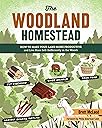
The Woodland Homestead is a practical, in-depth paperback guide that empowers landowners to maximize the productivity of their wooded property. Covering everything from land surveying and tool safety to silvopasture, orchard creation, and sustainable livestock management, this book offers actionable strategies to live more self-sufficiently while preserving and enhancing woodland ecosystems. Highly rated with 4.6 stars from over 600 reviews, it’s a must-have resource for anyone looking to transform their forested land into a productive homestead.
| Best Sellers Rank | #482,517 in Books ( See Top 100 in Books ) #153 in Forests & Forestry (Books) #241 in Sustainable Agriculture (Books) #401 in Vegetable Gardening |
| Customer Reviews | 4.6 out of 5 stars 607 Reviews |
A**A
Paperback is easier to understand, but the whole book is great
I found this when looking for other books in the Backyard Homestead series also published by Storey Publishing. It was intriguing to me because the land my Husband and I plan to build our Homestead on is heavily wooded and we were debating whether or not to clear cut a significant portion of the land- yet here was a book offering us an alternative. So at first I picked it up first for Kindle, but then decided to get it in Paperback form once I saw the information in it. This book really does take you through the basics from beginning- right up to and including information on how to perform your own Land Surveys to determine what's in your woodland and how you can best utilize it. It also has an incredible section on various tools and even the techniques of using them for various needs. Perhaps what I love most about this section is that it even tells you the appropriate way to fell a tree- including a handy illustration showing you where your escape routes are compared to the potential danger zones or "felling area" (the area the tree could fall in if something goes wrong with the cuts the author illustrates). In addition to showing you how to evaluate, get started, and build a farmstead in your woodland, it also gives you a host of ideas for what to do with your trees. These suggestions include everything from making furniture, to charcoal, how to cut and season firewood, how to tap trees for Syrup, basket weaving with barkstrap, and so on. All in all, there is an incredible host of information here... And while my Husband and I have still decided to clear cut some of our land for pasture, we've definitely opted to keep more woodland than initially decided because of this book and I look forward to putting the information here into practice.
L**L
It was good enough to make me reconsider my homesteading location!
I received this book at the start of the weekend and had it finished within a few hours. It's a fast read and I was able to make it through 95% of the book within 3 "nap time" periods with ease. Overall I think it's a great book. There was roughly 5-7% that I thumbed through as it didn't offer me much use at the moment, or interest for that matter. We are currently in the 'burbs' still adjusting to life in a new region of the country. Once established, we are looking to begin rural homesteading within the next 15-36 months. Because of this, while some sections will prove useful in time, right now, it's lost on me. Really, it was mostly chapter 2 that I didn't read in depth. A few paragraphs here and there, but that's it. In this chapter it talks about tools and techniques needed and used on a woodland homestead, building your home from scratch from cord wood, building your own tools, using portable saw mills, etc. The remaining chapters gave me some much needed food for thought. Until reading this book, I have been unable to find sufficient resources that detail how to establish a homestead in the woods. Everything from raising animals, beekeeping, orchards, gardens, etc! I have been trying to find a location that offered enough woods yet enough cleared but has untainted soil and ground water from surrounding industry and ag. Finding this book gave me new things to consider and has opened my eyes to the possibility of "taking to the woods", successfully. In our new home region, woodland lots are available often and usually better priced than semi-cleared lots. If I hadn't read this book, I would continue to overlook the benefits of woodland homesteads. You will find information in here on how to "prune" and harvest firewood from living trees to allow regeneration from existing root stock. I had no idea that could be done! How to introduce livestock to weeds and bramble on your land and get them to begin to prefer these forms of fodder over traditional hay/feed options; allowing up to 25-30% reduction in purchased feed. Again, that's because most in woodland settings wouldn't have the cleared space to turn animals out onto traditional pastures. It gives information about breeds of various animals from chickens, turkey, sheep, cattle, etc that you can consider for a woodland homestead- how they adapt to the climate, fodder, foraging ability, etc. It gives instruction on how to clear a section to literally have an orchard in the middle of the woods. How to integrate vegetables and fruiting bushes into the orchard, and basic orcharding advice. You could take this same advice and use it for a large veggie patch if you were not so interested in orcharding. The author is a fan of community and the community as a "resource". He talks about basic info on how to get neighbors and the community to help you and visa versa for free or bartering. This is something other homesteading books cover as well, but he shows how he did it with orcharding, etc. You'll get handy advice about how to use pigs to remove stumps, how to use all of your animals as a tiller and weed management system, How to use horses and oxen to pull the heavy loads, building the tools to pull the loads, how to build/graft living fences, grafting trees, how to grow in old stumps, look at trees and know if it's disease or woodpecker damage, survey your trees that would pass the grade for lumber, firewood, as well as furniture-grade wood, sugaring, etc. You'll even get a section about basket weaving with some types of "wood" found in some regions of the country (His region- Upstate NY). Although I'm now in the Deep South, I found so many useful tips, techniques, and factoids to help when considering which property we will buy. It was a fast read, knowledgeable read, and in depth enough to get you started in the right direction. There are some things that I'll investigate further but it is nice having strong basics in once place at my fingertips!
C**E
Great resource!
Love this book! It has so much information; more than I even knew I needed to know about homesteading. It’s a simple read and with good illustrations. My only complaint is geographically speaking the information is only relevant to certain areas. (I live in Arizona so there’s a lot that does not work)
C**.
Excellent Book with Lots of Ideas.
I'm currently just a hypothetical woodland homesteader but this book gave me tons of ideas and information for my eventual homestead in the forest. The first 70 pages were a little boring for me, only because I don't really plan on large scale timber farming but some people may be interested in that. I really enjoyed the sections on livestock, orchards, and mushroom cultivation but the most fascinating part was by far the section on growing a hedge! I'm a bit of anglophile so I really like the idea of growing a hedgerow like you'd see in rural areas of the UK. This book is by no means a one stop shop of everything you'll need to know but for someone like me who is just getting started, it was an excellent buy! I now have a much better idea of what I'm getting myself into and what I need/want to research further.
S**H
A wealth of information & inspiration!
This was a fascinating read for a future homesteader like myself. I've been really studying and researching for the past year and a half, and this book opened up a whole different world of possibilities that I had never considered or even come across before! I burned through the book in a few hours because it was so engrossing. Granted, I know little if anything about rural/woodland living, so the material was all very new. I learned a considerable amount about forestry in general, and got some great new ideas for integrating livestock, growing firewood, living fences, and how to incorporate multi-use areas into my future homestead plans. Overall, very inspiring and informative, great illustrations, and surprisingly detailed instructions about a range of different topics. This book is going to be a great asset to my homesteading library, and I can't wait to make my homestead dreams a reality!
P**G
Finally! A homesteading book for Eastern USA. Great homeschool curriculum, too.
Try this for your homeschool. Great for the homesteader in the great North East. My husband is a Natural Resources teacher - he teaches woodland management. This book is a virtual curriculum for woodland use and management. But, no fear, it doesn't read like a school book. It is well written, concise, adequately illustrated with ink/line drawings. The content is extensive and exhaustive. I recommend this for a homeschool curriculum for your homeschooling high schooler interested in forestry. I also recommend it for anyone wanting to develop a woodland homestead. We live in eastern (Appalachian) Ohio. I am thrilled with the content and design of this book.
S**D
This is an excellent book with lots of great information
This is an excellent book with lots of great information. Every topic is covered in a very clear, concise manner that ensures the reader will fully understand the concepts being presented. Personally, I really liked the information dealing with logging, care of the forest floor, and silviopasture. I didn't even know silviopasture was a thing until I read this book! It becomes evident very clearly that Brett McLeod is a very knowledgable man who 'practices what he preaches'. There were a number of times that I thought to myself how great it would be if he could come to my little farm in Tennessee and 'read' the land. This book is definitely worth the money.
S**T
Great book! But lots of rehash and unstructured.
First: I like this book! It's a good summary of what's possible on wooded lots from keeping livestock to planting fruit to harvesting lumber etc. - this book is a SOLID pick for a high-level introduction. In some areas it even gets fairly detailed (animal breeds) in other areas it just skims on the surface and lacks important information (even a high-level overview of fruit/plant diseases would have been helpful). Where the book falls short in my opinion are three areas: 1) REHASH of similar content in the Homestead series by the same publishing company. If you bought any of the other Homestead books then skip this one since there won't be a lot of new information. Different angles for sure, but overall of little value add. 2) The information is UNSTRUCTURED - this makes it hard to look things up in a reference guide manner. It's a great book for reading, with a good narrative and flow but not so good if you want to look up specific things and get right to the information. For example "The Encyclopedia of Country Living" does a good job with the information structuring. This book here is more of a bedtime read to get the creative thoughts flowing. 3) The book seems centered around the MIDWEST or NORTHWEST part of the US - multiple times I thought to myself "Does this apply if I live in the Southwest or PNW?". Not necessarily a big problem with this book but would have been nice to call that out in advance. If this is your FIRST wooded lot homestead book --> go ahead, buy it, it will be a fun read to get your thoughts going! If you have other homestead books (especially from the same publisher) --> skip the rehash, there is better!
R**E
Good Overall Knowledge Book
A good book with expert knowledge about a lot of topics , some topics have all you need to know, some you may need to do more research and the book gives you other resources , internet and list other books to help you look up more. For example one suggested resource was a free university study that was on line which was very helpful. I recently bought 6 acres of woodland far from civilization and this book gave me ideas and knowledge that were very valuable and that I didn't consider. An example is a cheep way to test soil with household products for high acid or ph and how to correct that without buying something. I would recommend this book to anyone who has woodland they might want to develop for food , resources or basic farming. It is not a prepper style book , but it would be helpful , more of a pioneer how to make a woodlot into a homestead. Well written with good information, just know that because it covers so many topics you may have to dig some for more info depending on what you already know. It has helped me and I do recommend it.
J**.
Esta muy bonito
Me gustó mucho la letra, la manera que está ordenado, el tamaño, material y la información en las primeras páginas me está gustando. Al ojearlo se ve que viene información técnica que lo puede ser de utilidad
L**S
Easy to read
super informative with so many ideas for a woodland homestead, easy to read and navigate.
R**9
For someone as a present
This book was a present
A**R
It is a part of our homestead library now!
This book was amazing, an inspiration, very practical information, instructions, best practices, great illustrations. I will be keeping this as a resource for managing our forest. The section on living fences really captured my imagination and will be implementing hedgerows and living fences, the pig-o-tiller and really excited to learn and practice. It opened me up to so many possibilities, like syrup production...who doesn't want to try beech or walnut syrup? Now our forest can be producers for the homestead and community.
Trustpilot
3 weeks ago
2 weeks ago