

Desertcart purchases this item on your behalf and handles shipping, customs, and support to USA.
📚 Elevate your soul’s journey—because true growth happens when you fall upward.
Falling Upward by Richard Rohr is a bestselling spiritual guide that reframes aging and setbacks as essential steps in a transformative journey. With over 5,400 glowing reviews and top rankings in Christian Inspirational and Spiritual Growth categories, this book offers a fresh roadmap for Baby Boomers and beyond to embrace the second half of life with wisdom, resilience, and deeper meaning.

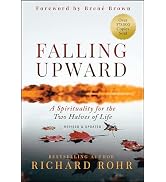


| Best Sellers Rank | #108,572 in Books ( See Top 100 in Books ) #1,959 in Christian Inspirational #1,971 in Christian Spiritual Growth (Books) #2,124 in Christian Self Help |
| Customer Reviews | 4.6 out of 5 stars 5,431 Reviews |
D**W
Sage Advice For the Second Half of Life
FALLING UPWARD: A Spirituality for the Two Halves of Life By Richard Rohr Reviewed by David Bradshaw Every once in a while a new book comes along that speaks to your circumstance so clearly that it has the ability to transform, expand and elevate your worldview for the rest of your life. Falling Upward was such a book for me. A Visionary Book About Growing Up Spiritually A book about growing up spiritually, Falling Upward, is by visionary Franciscan pastor/teacher/author Richard Rohr. It offers a fresh road map to guide Baby Boomers through the next vital rite of passage they face. Rohr offers readers his flashlight to help us find our way out of the dark and into a joyful, bright second half of life. "Falling Upward is fresh way of thinking about spirituality that grows throughout life," says GoodReads.com. "Most of us tend to think of the second half of life as largely about getting old, dealing with health issues, and letting go of life, but the whole thesis of this book is exactly the opposite." Rohr's inclusive writing style is, I suspect, the fruit of his four decades of experience in helping injured souls find healing, feel loved again and acceptance at last - and from this experience becoming free to discover the hidden meaning of the "necessary sufferings" we all face in our lifetimes. His premise is simple: "The way up is the way down." He sees many examples of this axiom everywhere and in every culture - ranging from Greek mythology to "Man of Steel" modern heroes, and especially in Scripture, such as Jesus' Beatitudes, the Parable of the Prodigal Son, and the Apostle Paul's words, "It is when I am weak that I am strong." Like the U-shaped curve seen in all of the natural world, so our lives are formed by a series of fallings, losses and even failures - in preparation for the next rebirth, rising, gains and successes. "The goal," Rohr writes, "is to make the sequences, the tasks, and the direction of the two halves of life clear." "The loss and renewal pattern is so constant and ubiquitous that it should hardly be called a secret at all. Yet it is still a secret, probably because we do not want to see it. We do not want to embark on a further journey if it feels like going down." It is this 'losing our life to find it' that eludes us during the first half of life, but becomes ever clearer in the second half of life. But we all need some help and guidance finding that road less traveled. "You cannot imagine a new space fully until you have been taken there," writes Rohr. Falling Upward serves as a reminder to Baby Boomers that it is our duty and responsibility as elders to cross over into the second half of life to help guide the next generation down their path toward wisdom. "In this book I would like to describe how this message of falling down is, in fact, the most counter-intuitive message in most of the world's religions, including and most especially Christianity," writes Rohr. "We grow spiritually much more by doing it wrong than by doing it right. That might just be the central message of how spiritual growth happens; yet nothing in us wants to believe it." The problem we all face is that our rational mind cannot process suffering or setbacks, so instead we avoid them, deny them or blame someone else for them. What we should do, Rohr explains, is embrace them as part of our journey, our pathway to growth. The Two Halves of Life Explained In the first half of life we move incrementally from utter dependence upon our mother and father toward independence. In the first half of life we search for identity, meaning, significance and support to create a "proper container," Rohr writes. "We all need some successes and positive feedback early in life, or we will spend the rest of our lives demanding it, or bemoaning its lack from others," writes Rohr. How true! In the second half of life we discover the contents that the container was meant to hold and deliver. The old wineskins must be replaced by new, stronger, tested wineskins stretched to meet the changing needs of maturity. True elders must learn patience with "juniors" because they cannot understand what they have not yet experienced. "The 'True Self' is very hard to offend," writes Rohr. "In essentials unity, in non-essentials liberty, and in all things charity," said Pope Paul XXIII, as a reflection of second half of life wisdom. "The first journey is always about externals, formulas, superficial emotions, flags and badges, correct rituals and special clothing, all of which largely substitute for actual spirituality - yet they are all used and needed to create the container," Rohr writes. He sees that if we do not find a way to do the age-appropriate tasks of the two halves of life, both will be unfulfilled. Today we live in a "first-half-of-life culture" largely preoccupied with surviving successfully. But, to quote a Native American aphorism, "No wise person ever wanted to be younger." What does this say about modern American culture, driven to find the elusive fountain of eternal youth? To me it illustrates how desperately our society needs true elders to emerge who have made a conscious choice to live and act like grownups, not like perpetual children who are content living in their first half of life forever. The usual crossover points, writes Rohr, are a kind of "necessary suffering" and "homesickness" which could include the losses of a job, fortune, our reputation or health. This is the falling down which will end up turning into a falling upward if we allow the circumstance to do its inner work on our soul. This second half of life also involves beginning to write our own life script, owning it and paying attention to 'the task within the task' of life. Moving from surviving to thriving. "The familiar and habitual are so falsely reassuring, most of us make our homes in the first-half-of-life permanently," says Rohr. We do not willingly move out of our 'comfort zone' unless circumstances force us to do so. Henry David Thoreau wrote, "If you have built your castles in the air, your work need not be lost. That is where they should be. But, now put foundations under them." Connecting the first and second halves of life together is about seeing the world not as either-or, but rather both-and. Falling Upward presents a fresh vision of wholeness that calls us both upward and downward, for we cannot really understand Up until we have first experienced Down. Regardless of your age, I recommend reading Falling Upward with an open heart, mind and spirit. You will better understand the spiritual aspects of aging and of making a "further journey" to discover your True Self. You will also grow in seeing how to "love thy neighbor as thy self."
G**)
spiritual wisdom for living both halves of life well
Falling Upward tells the story of the spiritual maturation across the life span. The spirituality of the first half of life is about constructing our spiritual container while the second half is concerned with filling it. Put another way, the spirituality of "the first half of life is about writing the text and the second half is writing commentary on that text" (p. 143). While the two halves always occur in order, they are not tied to any specific chronological age range: some people may remain in the first half throughout life while others may progress to the latter at a relatively young age. Since we live in a culture dominated by first half of life issues and that struggles to live with paradox, it is difficult for people to make the transition. The first half of one's spiritual life is dominated by rules and regulations, marked by considerable attentiveness to correct rituals that guide one in the quest to know and do that which is right. The second is far freer, similar to Ricouer's second naïveté. One cannot will one's way forward, but rather finds the way down that path through falling and failing. In short, people tend to "grow spiritually much more by doing it wrong than by doing it right" (p.xxii). In the second half of life, both-and thinking dominates and it becomes possible to understand the richness of multiple meanings. A book about how to progress from the first to the second half of one's spiritual life misses what the journey of faith is all about. Rohr succeeds in his attempt to familiarize those residing on both halves with the relative strengths of their spiritual life stage while also generating awareness of the second stage for those now in the first. Careful not to construct an artificial path joining the two, he instead shows what the terrain is on either end of the path and suggests the path itself is one that must be experienced in full, including many falls and failures. Readers in the first half of their spiritual lives won't find the second attractive, but will gain an awareness for just how different it is. Readers in the second half of their spiritual lives will be reminded of what they already experienced in the first half, encouraged not seek to return to it, and empowered to more fully experience the possibilities of the both-and perspective.
L**I
A Book Worth Reading
Book report on Falling Upward by Richard Rohr, Bjossey-Bass books, 2011 by: L. J. Martini 2015 I put this book in the category of “gain-to-give” self-help spiritual books. Rohr’s premise is that the first half of life requires discipline in order to gain dignity, identity, self-significance (ego), boundaries and direction (p 46). When that is established the second half of life can develop and give back to society. He claims that without at least partial success in the egocentric building of the first half, the second half will not have what I call “confidence” to critique and liberate one towards God. Rohr uses the metaphor of gaining a way “up” for the first half of life and then “falling” through what he calls the suffering in all, whether it be in the original sin of Adam and Eve to each individual not being able to avoid personal sin (Romans 5:12), pp xx-xxi. Other terms he uses include the “way of the wound” (xxiv), the “reconnection” (re-ligio) as in the classic Odyssey story of Odysseus where he has to leave home for the second time and realize the suffered-loss (xxxi-xxxvii), being “wounded” (p 18) by a major dilemma, “how to learn from that very falling” (p 28). In all this Rohr finds the Holy “Spirit hovering over our chaos since the very beginning” of our lives which forces us to find and actually define our spiritual home — which becomes the metaphor for the soul. Chapters 1 and 2 explain Rohr’s Two Halves of Life: first, the need for structure and discipline to establish values and as he writes, “ironically need a very strong ego structure to let go of your ego” (p 26); which second, leads to a hubris that will proceed a lot of impending tragedies. If we have the correct “perennial tradition” then we can “learn how to fall and also how to learn from the very falling.” In Chapter 3 he says this is the idea of learning to fall in order to balance — like riding a bike. “People that don’t learn how to fall are very hard to live with.” What he is really saying is that you can’t love a sinner if you have never sinned, or thought you haven’t sinned. Once the structure, or what he calls “the container,” is established, the “contents” can be dealt with. This he cites from the Art of Loving, by Eric Fromm (p 32). Rohr writes that we need a combination of conditional and unconditional love, and be able to hold that creative tension such that our wounded identities can transcend from a desire to draw sympathy to a desire to serve others (p 34), what I would say “to turn our wounds into gifts.” An example in my mind is: longing for love (the wound) encourages the gaining and giving of love (the gift). Another example that comes to mind is being disciplined and “conditioned” by the formal training as an engineering (learning the specifics of math, science, and physics) and then being able to have “unconditional” freedom to think beyond that. Thinking beyond the boundaries of “conditional” science allowed us engineers to brainstorm and be creative, finding new designs and inventions. As Rohr poses, laws and limits are necessary but it takes a creative tension “to live both law and freedom at the same time” (p 36). When we do this we can deal with loss. That’s what he says moves a “youth” oriented (entitlement) society to a true elderly society that can think for themselves (p 39). This will be a society that is not adverse to risk (p 42), can move from an “ego centric” worldview to a “soul centric” worldview (p 43), can “discharge your loyal soldier” from “merit- badge thinking” to a broader identity (p 44-45), and allow the ego to lose the battle so that faith will allow growth towards God (p 47). This will happen when we “confront love, death, suffering, subtlety, sin, mercy”… to allow the death of the false self, and provoke the birth of the soul (p 49-50). Chapter 4 may be the essence of the book. It deals with the tragic sense of life. Rohr points out that the Greek word for tragedy means “goat story.” This tragic sense of life is the essence of the Gospel that resurrection comes from death — “salvation history is an integrating, using, and forgiving of this tragic sense of life. Judeo-Christianity includes the problem inside the solution and a part of the solution. The genius of the biblical revelation is that it refuses to deny the dark side of things, but forgives failure and integrates falling to achieve its only promised wholeness, which is much of the point of this whole book” (p 59). [In my book God’s Great Scheme, I have basically described this as Christian Holism.] Rohr does a good job at describing the tragic sense of life, the truth that only faith can transcend all the exceptions of the natural logic of the world (p 54-57). He explains that those humans who are on the edge of what is defined as normal, proper, or good have the most to teach us. They tend to reveal the shadows and mysterious side of things that should encourage our humble searching and “not rushing towards resolution to allay our anxiety.” (He challenges us to rethink our definition of salvation when it comes to the mentally ill person.) The mercy and grace of God becomes the significance of what he cites as the divine pattern of the incarnation — “the scandal of the particular.” He presents the fact that Jesus never was upset at the sinners, but only upset with people who did not think they were sinners (p 59) — the Pharisees come to mind. The only exception I take with this chapter is Rohr’s statement: “Every time God forgives us, God is saying that God’s own rules do not matter as much as the relationship that God wants to create with us” (p 57). This can easily be misinterpreted that God is willing to change the rules of reconciliation when it comes to personal relationship with each individual. The Bible is clear that God never changes when it comes to forgiveness. God is never reconciled to man in the Bible. Man is always reconciled to God. In this context the Bible always uses the word apokatallasso, that man changes, repents, and accepts God’s forgiveness — the change occurs in man, never in God. (I describe this in great detail in my book God’s Great Scheme, describing the four different Greek words for reconciliation relative to God’s forgiveness of man.) I’m sure Rohr would agree with this position since his whole book is about the need for us to mature, to change in the second part of life. Our maturity in change will result in reconciliation — our change of tragedy into salvation. Rohr closes chapter 4 by stating that “the tragic sense of life is ironically not tragic at all, at least in the Big Picture.” It connects the past with the future and prepares us for the necessary suffering that should keep us from “despair about our own failure and loss and ironically offers us a way through it all” (p 63). He prefaces this with the “goat stories” of racism, slavery, sexism, the Crusades, two World Wars—all the tragedies that emerged from our human inability to love the imperfection within ourselves and thus impose such tragedies on others (p 62). Chapters 5 and 6 describe our stumbling over the “stumbling stones” of necessary suffering. These two chapters are a repeat and emphasis of what Rohr has already presented: loss and suffering is inevitable, it will come to break your pride and cause you to change, that’s if you’ve left the securities of home. The theme is acceptance of loss and humiliation so ego will be crucified and resurrection can take place (p 69). Chapters 7 and 8 go together. They speak of the Holy Spirit and the soul as our “homing device” to get us back to the “True Self.” True Self is the same home of our past (the alpha) that we have forgotten (the amnesia of the big picture), yet it drives us forward to our end (the omega) to the perfected home with God. Rohr writes that he believes there is a “One Great Mystery” that is revealed at our beginning and forever beckons us forward towards its full realization (p 88). That he calls the homing device that may be called the soul or the indwelling of the Holy Spirit. It cannot be ignored. [I think it is embedded by God as Ecclesiastes 3:11 says, ‘God has put in the heart of man a sense of eternity, but in such a way that he will not know his plan from beginning to end’ (my translation).] Rohr writes, “The end is already planted in us at the beginning, and it gnaws away at us until we get there freely and consciously” (p 91). This planting he acknowledges as the Holy Spirit, Romans 5:5; John 14:18. [This is exactly what I claim in my book: The Confident Christian; the idea that the Holy Spirit is working on everyone, through their conscience (Romans 2:12-16). I agree with Rohr that it takes the cooperation between God and the individual to come to this understanding and realization of the divine (p 92; The Confident Christian; and my book on Christian Holism — God’s Great Scheme).] It is interesting that Rohr brings up the fact that sometimes it takes a great deal of love and/or suffering to make some aware of this (p 91); that we can learn by our sins (p 95) before we find our true identity (theosis, p. 98), the Larger Source, the unified field, the shared Spirit (p 99). The second half of chapter 8 talks about the hell that we suffer when we don’t have the unity of the shared Spirit. It is a self-imposed hell when we refuse to be part of the “state of union,” heaven. I agree with this and have always said, “those in hell are there because they choose to be.” [The one statement that Rohr makes that I question is: “It is interesting to me that the official church has never declared a single person to be in hell, not even Judas, Hitler, or Stalin” (p 102). I think Rohr is forgetting the history of the Inquisition where the church officially did condemn people to hell.] Chapters 9 and 10 seem to go together for they describe the goal of the second half of life, what I would call “an elderly peace.” Rohr describes this as a second simplicity, becoming a liberal and a conservative at the same time, being inclusive in scope, a type of scope that continues to expand (p 107) — coming to the conclusion that: “If God could ‘include’ and allow, then why not I?… If God asked me to love unconditionally and universally, then it was clear that God operated in the same way.” In this, Rohr classifies himself more as a catholic then Roman Catholic and takes a more universal stand by quoting John 4:42, that Jesus either has to be the “savior of the world…, or he is not much of a savior at all.” Rohr has come to a “deepening sense of what the church calls holiness, what Americans call freedom, and what psychology calls wholeness” (p 108). He describes the Big Truth in the universe, and an all inclusiveness that God is the “common definition,” the “God of everybody” (p 109). [This all inclusiveness of God reminds me of what I’ve written about in my book God’s Great Scheme.] He goes on to describe a “simple and beautiful” description of God in the Shema of Deuteronomy 6:4-5 (God is one and good). At the end of chapter 9, Rohr speaks of anxiety and doubt which is countered by faith and trust. He presents the fact that God uses us in his Great Work. To understand this is to no longer need a “magic wand kind of God,” a “Tinker Bell,” who answers all our doubt and anxiety, but a God that will work “secretly and humbly, and who includes us in on the process and the conclusion” (p 110). We no longer have to stay in a “control tower” but now have gained a “deeper and tested kind of happiness,” one of “patience and compassion,” a wisdom that has happily accepted the mystery of “unknowing” and as he says taken “a lot of learning to finally learn ignorance” (p 112). He elaborates this happiness in chapter 10 with words as “luminous darkness,” “bright sadness” — that which we see in the Eight Beatitudes. There is more acceptance and patience instead of what he calls “knee-jerk responses towards either the conservative or liberal end of the spectrum” (p 119). He writes that in “the second half, you try instead to influence events work for change, quietly persuade, change your own attitude, pray, or forgive instead of taking things to court.” He describes this as being a part of the “broader vision,” where instead of trying to differentiate yourself (as youths do), you now share in the commonalities, become a part of the “general dance.” This is what I call forming the confident peace, the emphasis being no longer on the “doing” but on the “being.” Rohr calls this falling into the larger brightness. Thus “the falling upward that we have been waiting for! (p 124).” He presents a litmus test for reaching the second half of life as being: “Your concern is not so much to have what you love anymore, but to love what you have — right now.” What goes hand-in-hand in this litmus test [I think] is the importance of forgiveness that he presents on page 114: “If you have forgiven yourself for being imperfect and falling, you can now do it for just about everybody else. If you have not done it for yourself, I am afraid you will likely pass on your sadness, absurdity, judgment, and futility to others. [The goat story comes to my mind here.] This is the tragic path of the many elderly people who have not become actual elders, probably because they were never eldered or mentored themselves.” Chapter 11 is all about the work of finding and accepting the True Self in the second half of life. It is the work of unmasking the self-image roles that we have taken on and created for ourselves during the first half of life. That is the “shadow work” that Rohr says emerges by a healthy self-critical thinking, which allows one to see beyond their own shadow and disguise (mask) and to find who they are — who is “hidden with Christ in God,” Colossians 3:3 (p 130). This is humiliating work, undressing the shadow disguises of our role-playing. We come to see what needs to be exposed by noting those things to which we overreact or over deny. [I would say, the Holy Spirit helps us do this work, John 16:8.] Chapter 12 is all about the challenge of second-half-of-life people living in a world full of first-half of-life people. It takes a lot of patience because all institutions must be concerned with membership requirements, policy, procedures, protocol, and precedents (p 137). Those are all “ego needs” and not “soul needs.” Institutions of “ego needs” demand a “tit-for-tat universe” and practical results because they must eat, house themselves and have clothing — I would say they are working in competitive circles, not contemplative (what Rohr calls soulful, page 140). Rohr’s claim is that egotistical/dualistic thinking is finally reversed in the second-half-of-life people. Another litmus test he poses, although he doesn’t call it that, is his claim that “if your politics do not become more compassionate and inclusive, I doubt whether you are on the second journey” (p 145). Rohr also contends that as we get older we should be moving toward an introversion, natural contemplation where “Silence is the only language spacious enough to include everything and to keep us from slipping back into dualistic judgments and divisive words” (p 144). The soulful life moves towards a solitude which becomes productive, where there is no need for diversion, loud music or large crowds. The dualistic (this or that) view that compares, competes, conflicts, conspires, condemns, cancels out and crucifies (p 147) has now changed by incorporating the negative, those things we used to exclude into those things we can now accept. In this Rohr sites Jesus’ saying, “forgive your enemies” (p 146). The final wisdom is that the “Nondualistic thinking (“both-and” thinking) presumes that you have first mastered dualistic clarity,” found it insufficient relative to the “big issues like love, suffering, death, God, and any notion of infinity.” In short, Rohr says “we need both” — the dualistic mind needed early, the non-dualistic mind later for the Big Picture view (p 150). [Just when I thought the soulful/non-dualistic mind meant passivity, Rohr said just the opposite. On page 146 he writes that there is an “essential link between true contemplation and skillful action.” Then he writes on pages 148-149 that the second half of life is when all those things we have avoided in order to manufacture our “ego ideals” start coming back as true friends and teachers. Then the “doers become thinkers, feelers become doers, thinkers become feelers, extroverts become introverts…” I’m glad Rohr incorporated these ideas, since that is what I’m finding now in my own life, at 70 years old. Those reversals have become my recent motivations.] Chapter 13 is a good synopsis of the “falling upward” theme of the book. It highlights the idea of “gaining” in ‘radiance’ as one ages, taking advantage of what one has suffered in life — like using the “falling down” on a trampoline to “actually contribute to the bounce” (p 158). The fulfillment of becoming a radiant person is in serving others. This is done by mirroring the divine image of God. Rohr mentions ‘spiritual gifts always being reflected gifts.’ I wish he would of elaborated on this, because I find that I am most loving and helpful to others when I am using my spiritual gifts — where fountains of living water are enacted through me (John 7:38). Rohr talks about a relationship to God, an “I-Thou” relationship in which our “perfect receiving” of God’s gaze is reflected to others — what I remember Jesus as saying, “you have freely been given, freely give.” This should be our goal in the second half of our journey in life. Rohr ends the chapter by warning that the only thing that can inhibit our second journey is our “own lack of courage, patience, and imagination.” The falling part of the first half of the journey is necessary for the second half; suffering the ‘pain being part of the deal’ is the falling that finally becomes our standing (my words here). The Coda — a meditation on a poem by Thomas Merton — is a fine example of the necessary suffering that the soul needs in order to mature. It’s well worth reading as a concluding reminder of the courage required in falling towards God.
L**R
A book Full of Vital Insights for leading a spiritual and complete life
This book is remarkable. It will leave you stunned and enriched by describing how to approach a meaningful second half of life. The insights into how to engage in a spiritual journey will serve you well whether you believe in God or not. Read this book with a pencil to write in margins or to indicate your thoughts in some other way as you will want to go back constantly to refresh your thoughts and to engage with others as you describe this book to them. This book describes life in 2 sections or halves. Other authors, like Sheehy, have described the necessary passages that a well adjusted person must pass through as we mature. Here it is done as a spiritual journey in which the first half of life is involved with building a vessel and in the second half we have the delightful task of filling that vessel with all the insights and relationships that lead to a complete, enriching and ennobling life. I believe this book is illuminating on life and its mysteries whether you accept God or not. I think the author learned much of what he shares by his experiences with various 12 step programs. I never reread a book. This is an exception. It is short and while not finished ( I am intentional going very, very slowly to really absorb and digest everything I can squeeze out of every thought) I am planning how to go about rereading this masterpiece. The author describes a spiritual journey we should all be on to connect with ourselves and that will tell us "who we are". The first half of life prepares us for that journey and the second half gives us the freedom to explore without any artificial boundaries. That is important. Boundaries are limiting in our development, especially on our spiritual side. Religion should be non-linear and non-dualist. It should not be neatly packaged to conform to a preset program. There is work to be done in the first half to build a good and sufficient vessel and in the second half to fill it well. Much of the author's thinking is totally consistent with modern science and psychology. He says things like " you don't have to believe in Jesus's divinity to see that he is thinking at a level above most of us". "Many of us, including the church, can't live the Real Gospel because the message is just too big" You are in for a real treat as you will stumble across your own selection of quotes and questions to ponder and look for friends to share these precious insights with. Happy and rewarding journey of your own.
J**S
I was on the brink of giving up and found this book.
I was on the brink of giving up on Christianity altogether—exhausted with the restrictive and exclusivity of the traditional Church. I was angry, repulsed and often felt cheated by the church. Metaphorically, I felt entrapped by the shell I had been incubated in, and I had to get out. The day after a major meltdown, when I told my wife I was through with God and through with the Church, I called my life coach who had gone through the same experience, and he recommended this book. Wether it was just timing, or timeless truth, I do not know, but I have never been so thankful for a book in my entire life. This book spoke to my sufferings in my personal life over the last 4 years, and to my spiritual frustrations with the Church. It was like a guide on life's journey as Rohr talks about in his book. It gave me an appreciation for the Traditional Church in my life, and yet freed me from it at the same time. It gave me a deeper understanding of God's love in all stages of life, and the need to keep moving in my Faith. I've never felt the kind of peace, joy and love from God as I do after hearing this. Rohr's understanding of scripture (and literature!! Which I loved as an English Major) was extraordinary, exciting and enlightening. I highly recommend this book to everyone, but I will also say that no one will get as much out of this as those who are questioning the traditional Church or have reached a spiritual roadblock in their life.
J**T
An indispensable guide to where we all must find ourselves.
I read almost constantly, but write or recommend a book only occasionally. This book has prompted me to do so. Personally, I have been going through some profound spiritual and philosophical changes over the past few years that are evident but not easily explained. Three different close friends, unknown to each other, sent me Falling Upward over a period of about six months. There is a point in every well-lived life that all one has done well was necessary but is not nearly enough, and all that must be done to become one's true self, to arrive "home," requires transcending it. I have attempted to teach this in conversations, but it is difficult in this age of distraction. Rohr very densely, but concisely (elegantly!) puts this together better and more accessibly than anyone else has. If it does not help you through this transition-- from that person who did what should and must be done, towards your true self-- it will certainly help you understand those who have accomplished it. Essential.
L**S
This is what wisdom sounds like
Warning: this book is not for the young, the feckless, the carefree, or the spiritual tourist looking for the next quick pick-me-up for their soul. Oh no. It is serious, thought-provoking, and despite its compact size and approachable style, packed with ponderables. I couldn't recommend it more highly--to those who are ready for it. Rohr's thesis is that spiritual life can be broken down into two halves: the first is where we establish our identity, and the second is where we attain maturity. But far from a linear progression, he posits that the transition to the second half, to wisdom, is prompted by tragedy, humiliation, loss, or failure--serious life events that force us to re-evaluate and level the conceptions of self we built in the first half. By rising from the ashes of our ego, Rohr says, we become truly generous, life-giving, and healthy people--true elders regardless of our age. Having been through a traumatic major event recently, which forced me to reframe my value, my image, and my self-worth, I resonated deeply with the book. Rohr has read and studied in breadth and depth, and spices his thought with countless references to great thinkers of many traditions, literature, mythology, modern psychology, and more. He writes from a Christian perspective, but it is the most inclusive religious book I've ever read, and, I believe, offers great value to spiritual seekers of all types. He is a man who has made sense of life--and he's helped me make sense of mine.
J**R
Good choice for any Bible study group
This book was chosen for my monthly Bible study group. In a nutshell, the author encourages readers to let go of the rigid, achievement-oriented mindset of the first half of life to enter a new phase in retirement. The book had quite a few gems of wisdom: "We grow spiritually much more by doing it wrong than by doing it right." "Pass the lessons learned on to others - or there has been no real gift at all." My biggest complaint with the book is the pace is slow, and it was not the easiest to comprehend.
J**E
Do the work...
In my humble opinion, this work by Richard Rohr, another roar by Rohr, is a clear endorsement of the work we need to do as human beings in our second halves of our lives. If we are to achieve the level of 'homo sapiens' and seek to become wise men (and yes wise women), we need to explore more. In Falling Upward, Rohr offers us his opinions of important steps to wisdom. In our first halves, leaving the comforts of home and learning from our falls and failings. Accepting failure, like Thomas Edison said "I have not failed. I've just found 10,000 ways that won't work." That is the essence of this person I too seek. Honest in my own skin. An explorer in the second half of my life. In search of the great mystery. According to Rohr, "Life is far too short, and there are plenty of mistakes we do not need to make - and some we do need to make." To illustrate, there is a terrific TV commercial running here in Canada with the Winter Olympics. A parent is seen working with a young child. As the child grows older he slowly gets better at falling. The parent keeps picking him up after his numerous falls, encouraging him to try again, wiping his tears in his continual failings. Then finally, she watches her now older child as a twenty-something in the Winter Olympics. Like this parent we need to become better at mirroring the right behaviours. There are way too many young people who commit suicide. "That is precisely why we need elders and those who can mirror life truthfully and foundationally for the young." Ah this wonderful life we can lead, where pain is part of the deal. How can we make it better for others? Thank you Richard Rohr for your insights. John Peter Fyvie.
G**H
ein Buch mit echter geistlicher Tiefe
Diese Buch ist eine tiefe Ermutigung für mich. Viele was mich in meinem Leben bewegt, über den Sinn des Altern wird hier angesprochen. Es wäre toll, wenn man auch so innerlich diesen Weg der Reife gehen könnte. Das Buch ist auf jedenfalls ein große Hilfe dabei, es zu versuchen.
G**S
Feel like you're losing your way? Read this!
This is such a helpful book to anyone who has found themselves in middle age and began to wonder "is this it?" Richard takes us through the necessary way we have to approach the first part of life but goes on to say that this way of thinking will not serve us well in the second half and in fact a radical rethink is needed to become fully at peace and effective in the second part of life. This is great news and lifted my spirits immensely. His assertion is that with the experience we have gained, often through hard times in our life, we are able to be released from the dogmas and shackles of religious life and find God in beauty and simplicity. You may find some of your dearly held doctrinal dogmas challenged, but persevere and you will find deep spiritual wisdom here and for those looking to live the second part of life in all its fullness, this is essential reading.
J**O
HAPPY
Very good
M**N
A new way to look at the second half of your life
Another brilliant book by Richard Rohr that provides insight into the journey we take into the second half of our lives. It challenges conventional wisdom, turning it on its head just as Jesus taught. We must lose our life in order to find life.
Trustpilot
5 days ago
2 months ago