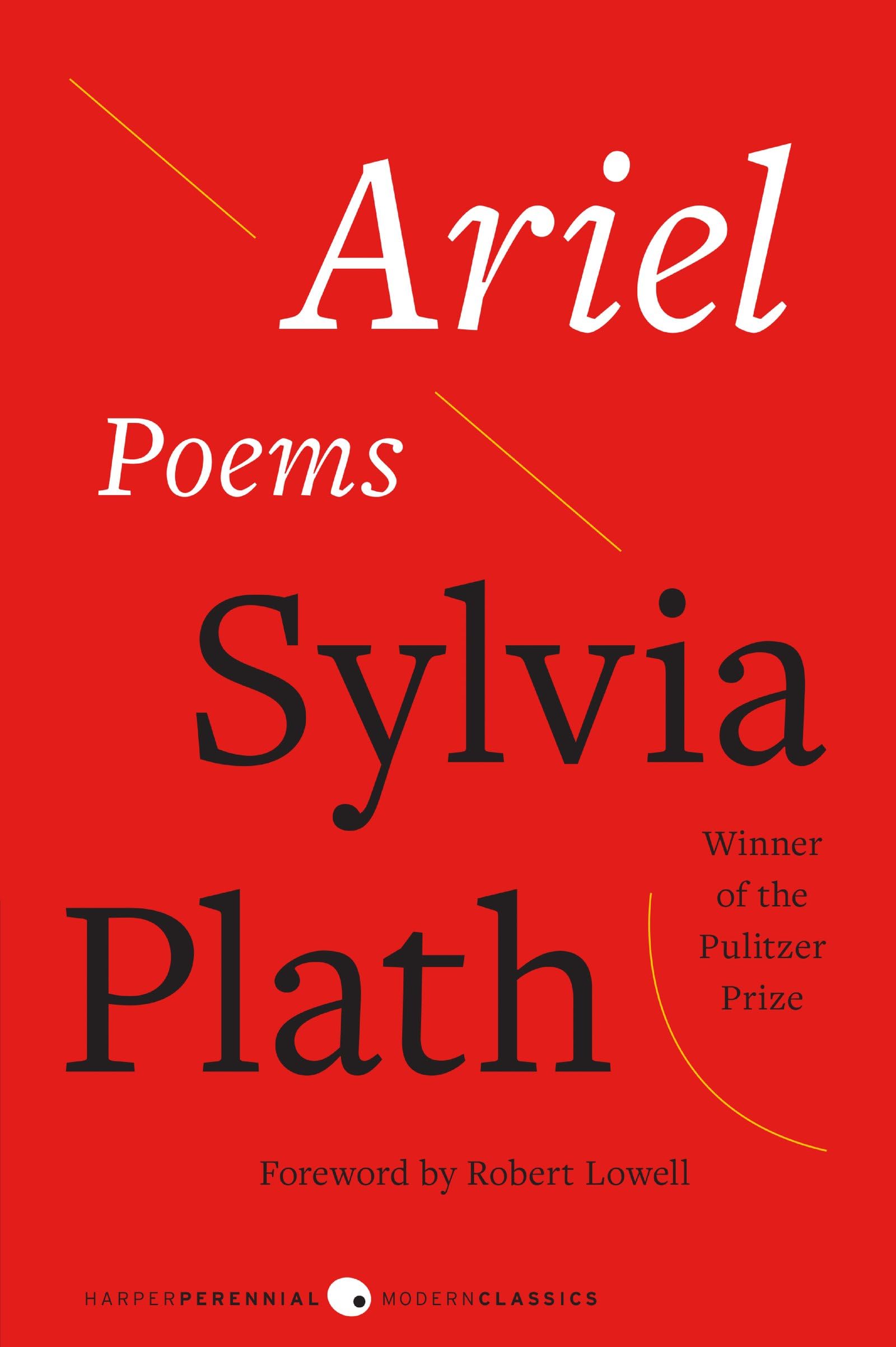
Ariel: Poems – Sylvia Plath's Celebrated Posthumous Masterpiece and Poetry Collection
Product ID: 15465900
Desertcart purchases this item on your behalf and handles shipping, customs, and support to USA.
"Sylvia Plath's last poems have impressed themselves on many readers with the force of myth. They are among the handful of writings by which future generations will seek to know us and give us a name." — The Critical Quarterly Sylvia Plath's celebrated collection. When Sylvia Plath died, she not only left behind a prolific oeuvre but also her unpublished literary masterpiece, Ariel . Ted Hughes helped bring the collection to life in 1966, and its publication garnered worldwide acclaim. This collection showcases the beloved poet’s brilliant, provoking, and always moving poems, including "Ariel," "The Applicant," "Lady Lazarus," and "Edge", and once again shows why readers have fallen in love with her work over generations. Review: Just Read Her Poetry, Let Her Stop "Standing" For Things... - This collection, and Plath in general I think, get both unfairly burdened and paradoxically minimized. So many readers want Plath to mean and to be so many things. Ultimately, this hagiography leads to diminishing the depth of her art to a patina of idiot wind like "feminist," "confessional," and "obsessed with her Daddy/Elektra stuff." All of which has unfortunately kept me away from deeply reading Plath for so long. Interestingly, I came to re-read this collection (or really, in my mind, to read it now for the first time) only because I was reading and LOVING the collected poems of Ted Hughes. He was simply blowing my mind---so I read a bit about him, and though I knew he was married to Plath and a bit about the soap operatic story of his second wife, I never appreciated how much HE, this awe inspiring genius poet stood in total awe of Plath's work. If he was that impressed, I had to see what the fuss was about. And underneath all the expectations and labels, what it's about is DAMN good poetry. The collection starts off with "Morning Song," which is the most accurate, beautiful, sad, and perfect poem I've ever read about caring for children and caring for yourself when you're caring for children. The phrase I used when describing some of the lines to my wife was "inevitable." That's the highest compliment one poet can give another---it means that she didn't get CLOSE to the "truth" of what she was trying to say...she didn't "turn a clever phrase" or tell the truth "slant." She wrote PERFECT words and lines. They HAVE TO be that way. She said it the best it can be said. Done. Luckily for artists after her, she didn't do this ALL the time (who could?) While MANY of the poems in Ariel are inevitable, some miss. Some still hold on to Plath's earlier style in Colossus wherein she attacks the Thesaurus and pursues a sense of ambiguity to the point of producing coldness and vague, limpid lines. But do not be put off by these cautions or by any possible cliche or negative expectations---Plath was an intensely gifted and cosmically touched poet---Ariel roars. Review: An imagery masterpiece and deconstruction of being a happy housewife - Basically, everybody should read this. I don't care if you don't like poetry. I paid a buck fifty for the paperback "Revised" edition (arranged by Plath's daughter Frieda in an attempt to be more faithful to her mother's arrangement, in contrast to the arrangement by Frieda's father, Ted Hughes), but this is a million dollar book. The poetry is rich in images, with ominous visions of Nazis and death sharing the pages with bees, puking babies, and other fixtures of domesticity. Plath is playful with language, but sharp and relentless in her deconstruction of the world around her. She does not give any illusion of her life as a mother and wife being a fairy tale ending; she readily admits that suicide is on her mind. So thickly layered are each of her poems, I will gladly reread them all a dozen more times to find more juicy double meanings and commentary tucked away in the lines. Some of my personal favorite poems were: Lesbos -- The kitchen is not a holy ground to Sylvia. She enjoys zero time spent with another woman, possibly the mistress who took her husband away, whose grating attitude makes idle chit-chat a living hell. The Applicant -- "First, are you our sort of person?//Do you wear//A glass eye, false teeth or a crutch,//A brace or a Hook,//Rubber breasts or a rubber crotch" This poem speaks for itself. Daddy -- Among the most well-known poems from this collection, it devilishly mixes childlike word play with black images of fascism, "The boot in the face, the brute//Brute heart of a brute like you". It reads like a scathing, adult version of Dr. Seuss. I love it. Just get it already!


| Best Sellers Rank | #116,422 in Books ( See Top 100 in Books ) #37 in Love Poems #52 in American Poetry (Books) #79 in Death, Grief & Bereavement Fiction (Books) |
| Customer Reviews | 4.6 out of 5 stars 1,967 Reviews |
M**D
Just Read Her Poetry, Let Her Stop "Standing" For Things...
This collection, and Plath in general I think, get both unfairly burdened and paradoxically minimized. So many readers want Plath to mean and to be so many things. Ultimately, this hagiography leads to diminishing the depth of her art to a patina of idiot wind like "feminist," "confessional," and "obsessed with her Daddy/Elektra stuff." All of which has unfortunately kept me away from deeply reading Plath for so long. Interestingly, I came to re-read this collection (or really, in my mind, to read it now for the first time) only because I was reading and LOVING the collected poems of Ted Hughes. He was simply blowing my mind---so I read a bit about him, and though I knew he was married to Plath and a bit about the soap operatic story of his second wife, I never appreciated how much HE, this awe inspiring genius poet stood in total awe of Plath's work. If he was that impressed, I had to see what the fuss was about. And underneath all the expectations and labels, what it's about is DAMN good poetry. The collection starts off with "Morning Song," which is the most accurate, beautiful, sad, and perfect poem I've ever read about caring for children and caring for yourself when you're caring for children. The phrase I used when describing some of the lines to my wife was "inevitable." That's the highest compliment one poet can give another---it means that she didn't get CLOSE to the "truth" of what she was trying to say...she didn't "turn a clever phrase" or tell the truth "slant." She wrote PERFECT words and lines. They HAVE TO be that way. She said it the best it can be said. Done. Luckily for artists after her, she didn't do this ALL the time (who could?) While MANY of the poems in Ariel are inevitable, some miss. Some still hold on to Plath's earlier style in Colossus wherein she attacks the Thesaurus and pursues a sense of ambiguity to the point of producing coldness and vague, limpid lines. But do not be put off by these cautions or by any possible cliche or negative expectations---Plath was an intensely gifted and cosmically touched poet---Ariel roars.
Z**L
An imagery masterpiece and deconstruction of being a happy housewife
Basically, everybody should read this. I don't care if you don't like poetry. I paid a buck fifty for the paperback "Revised" edition (arranged by Plath's daughter Frieda in an attempt to be more faithful to her mother's arrangement, in contrast to the arrangement by Frieda's father, Ted Hughes), but this is a million dollar book. The poetry is rich in images, with ominous visions of Nazis and death sharing the pages with bees, puking babies, and other fixtures of domesticity. Plath is playful with language, but sharp and relentless in her deconstruction of the world around her. She does not give any illusion of her life as a mother and wife being a fairy tale ending; she readily admits that suicide is on her mind. So thickly layered are each of her poems, I will gladly reread them all a dozen more times to find more juicy double meanings and commentary tucked away in the lines. Some of my personal favorite poems were: Lesbos -- The kitchen is not a holy ground to Sylvia. She enjoys zero time spent with another woman, possibly the mistress who took her husband away, whose grating attitude makes idle chit-chat a living hell. The Applicant -- "First, are you our sort of person?//Do you wear//A glass eye, false teeth or a crutch,//A brace or a Hook,//Rubber breasts or a rubber crotch" This poem speaks for itself. Daddy -- Among the most well-known poems from this collection, it devilishly mixes childlike word play with black images of fascism, "The boot in the face, the brute//Brute heart of a brute like you". It reads like a scathing, adult version of Dr. Seuss. I love it. Just get it already!
G**N
Loved
Loved
J**A
Good seller
I bought it in good condition so the quality is more than satisfactory @thejasmineisabella on socials
K**E
Plath brilliantly rebels against the cultural box of a "woman's place" ...
Ariel: The Restored Edition: A Facsimile of Plath's Manuscript, Reinstating Her Original Selection and Arrangement (Modern Classics) The introduction written by Plath's daughter, Freida Hughes, is especially moving. It definitely adds something interesting to the text, especially if it's not your first time reading the collection, the original version of which was arranged by Ted Hughes, Sylvia Plath's ex-husband by the time she had finished "Ariel." This particular version includes the original manuscript and Plath's intended arrangement. This collection is both praised and criticized as a revolutionary "feminist" text. Plath brilliantly rebels against the cultural box of a "woman's place" in Ariel. The speaker in Ariel is blatantly dissatisfied with the monotony of domesticity, and she blazes with desire for something "more." She is larger than life, other-worldly- she does not fit in the domestic sphere. Of course this collection is also famous as it was finished just before her suicide. Plath writes beautifully of the internal struggle caused by mental illness. I read this collection once at 19 and bought this particular copy at 22, having just been diagnosed clinically "depressed" and prescribed anti-depressants. The second time through was extremely cathartic. Plath gives voice to the war depression wages against mind and body. This is an extremely important text; Plath's creative genius translates something I thought much too complex for words.
K**N
"Love set you going," she wrote, "like a fat gold watch."
Now at long last, we get the "Ariel" we deserve. Plath's admirers have been waiting a long time, since at least the early 1980s when Ted Hughes first revealed that he had changed the order of the poems in his wife's final manuscript. He had added some poems--the final, freezingly depressing ones--and then re-arranaged the bulk of the book to leave an impression of a woman gone over the brink into a chilling fugue state. Now Frieda Hughes, Plath's daughter, 2 when her mother killed herself, has performed a ritual act of atonement to her mother's memory, and given us the original, "happy" (relatively speaking) ARIEL which we have never been able to see. At $24,95, the book's a little expensive, but it feels as though money had been spent on its planning and execution, so you don't feel rooked. In one section, the gray paper on which the facsimile materials are printed is easy on the eyes, aiding the eye as it struggles with Plath's numerous emendations. We get the notes Plath wrote for her own use when she had to do that reading at the BBC towards the end, the more-British-than-thou reading we have grown to love and hate at the same time. Frieda Hughes contributes an interesting and contextualizing introduction in which she seeks to reconcile the differing viewpoints of her mother and father--a challenging task, but she's up to it. The book ends up with four of the bee-keeping poems--and another in the appendix, "The Swarm," which Sylvia kept changing her mind about including. Should she leave it in? Take it out? The title is in brackets. Thus the book ends with a hopeful note, with the freshness of Devon instead of the bleak London winter. It ends, pleasantly enough, with the words, "They taste the spring."
J**N
Ariel The Way Sylvia Plath Wanted It
This is an amazing book. I'm very glad Ms. Hughes (Frieda Hughes) did this, because what Ted Hughes did was not what Sylvia Plath wanted at all, or else the manuscript would have been that way. I think that the poems are beautiful, and are written perfectly. It includes many great poems (i.e; The Applicant, Morning Song, Tulips, etc.) that show Plath's intelligence, but also her inner sadness, and misery that she was going through when she wrote these poems. This book also includes the real pages she wrote on her typewriter (They have her handwriting on them, and it's very interesting to see). My final comments: If you are going to buy Ariel, never buy the one that says "Sylvia Plath (Author), Ted Hughes (Editor)" or whatever it says that involves Ted Hughes. All I can say is avoid anything that has his name along with Sylvia Plath's, so if you want her journal for example, buy the one that I luckily noticed before I bought the one Ted Hughes edited, The Unabridged Journals of Sylvia Plath. Sylvia Plath is an amazing poet, and if you, for example, are new to her poetry, Ariel: The Restored Edition is the book to buy. I also recommend Anne Sexton, and Robert Lowell if you like the confessionals.
E**A
Not a huge Plath fan, but needed it for College .
Book arrived in excellent condition, and though I might not care for Plath as a writer, it was required reading for a course I am taking and I'm just thrilled that it arrived on time (unlike many of my other books...). Plath is undoubtedly a brilliant writer, just extremely dark. This final volume of poetry, released posthumously after her suicide by husband Ted Hughes and edited for this edition by daughter Frieda) has its highs and lows, but is worth a look!
M**K
Disappointed
The book arrived with the corner damaged. This was a gift
K**S
Great
It was a gift. But the owner said it's great.
S**S
Cult Classic!
Sylvia lives immortally in her words. Reading Ariel was such an immersive experience. It is brutally mundane, raw, destructive, and eloquent. I won’t claim that all the poems are likeable or enjoyable, because they aren’t, but that’s what juxtaposes against the ones which are great even more greatly. After reading Plath’s poetry and swimming in the depth of her words, all I have realised is that Sylvia’s in a league of her own. There’s no comparison between her and any other poet or poetess. If poets and poetesses write in the genre of “poetry,” Sylvia has invented her own genre. Her words remind me of daggers and feathers. I don’t know what virtues we humans in the 21st century have committed to be deserving of reading words left away by Sylvia Plath. If a person isn’t ready to acknowledge or confront their hidden demons, they should not make a commitment to read this book until they are ready. It is one of the books which you spend even your last breath recovering from.
P**C
Confiable
El libro llegó en excelentes condiciones.
き**り
気になる詩人
this heat のガレス・ウィリアムズの唯一のユニット作品で、この詩人を知りました。興味がつきません。
Trustpilot
1 month ago
4 days ago