
Buy anything from 5,000+ international stores. One checkout price. No surprise fees. Join 2M+ shoppers on Desertcart.
Desertcart purchases this item on your behalf and handles shipping, customs, and support to USA.
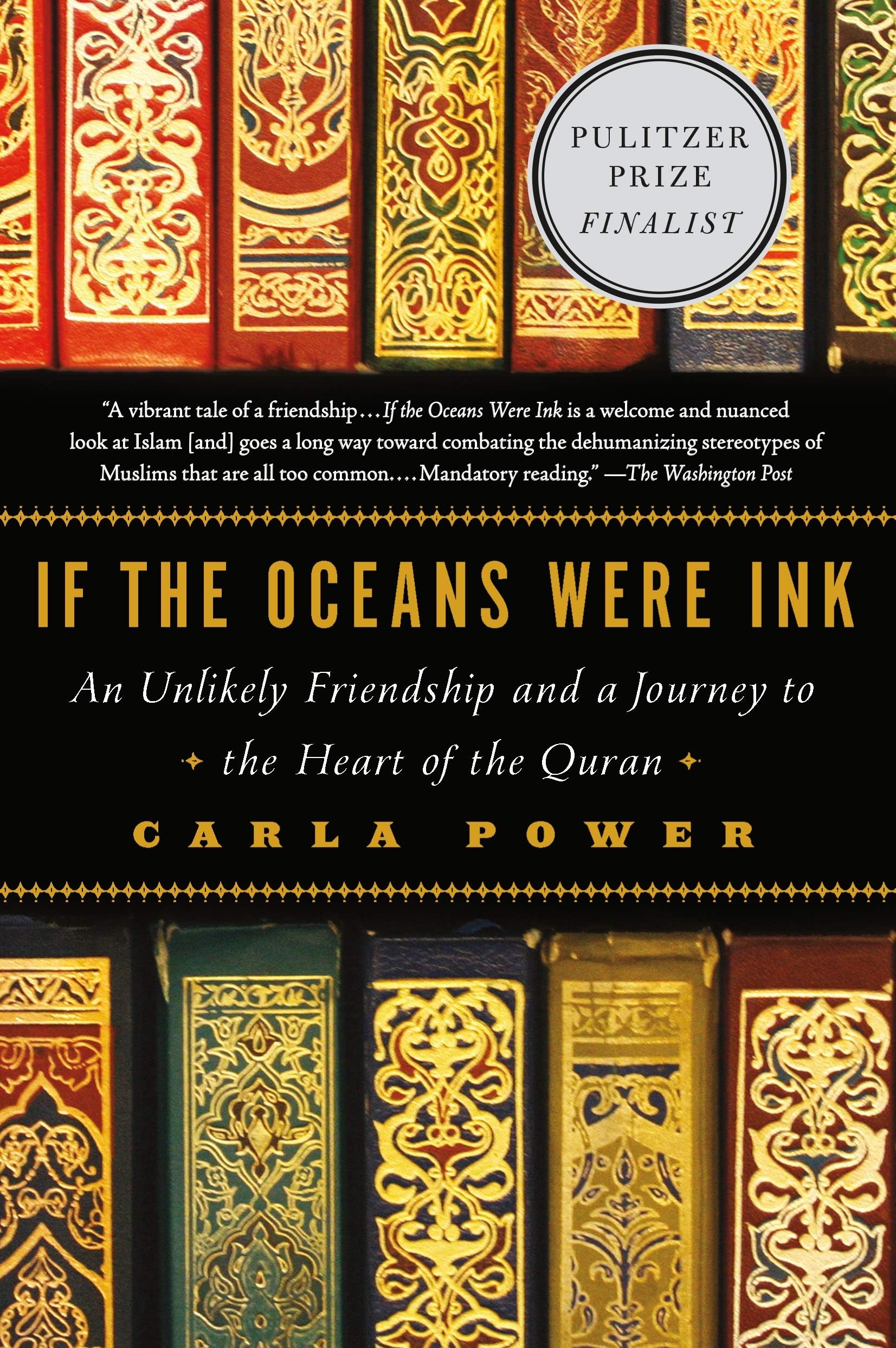
PULITZER PRIZE FINALIST โข NATIONAL BOOK AWARD FINALIST โข Named A Best Book of the Year by The Washington Post and The Denver Post โข P raised by Fareed Zakaria as โintelligent, compassionate, and revealing,โ a powerful journey to help bridge one of the greatest divides shaping our world today. If the Oceans Were Ink is Carla Power's eye-opening story of how she and her longtime friend Sheikh Mohammad Akram Nadwi found a way to confront ugly stereotypes and persistent misperceptions that were cleaving their communities. Their friendship-between a secular American and a madrasa-trained sheikh-had always seemed unlikely, but now they were frustrated and bewildered by the battles being fought in their names. Both knew that a close look at the Quran would reveal a faith that preached peace and not mass murder; respect for women and not oppression. And so they embarked on a yearlong journey through the controversial text. A journalist who grew up in the Midwest and the Middle East, Power offers her unique vantage point on the Quran's most provocative verses as she debates with Akram at cafes, family gatherings, and packed lecture halls, conversations filled with both good humor and powerful insights. Their story takes them to madrasas in India and pilgrimage sites in Mecca, as they encounter politicians and jihadis, feminist activists and conservative scholars. Armed with a new understanding of each other's worldviews, Power and Akram offer eye-opening perspectives, destroy long-held myths, and reveal startling connections between worlds that have seemed hopelessly divided for far too long. Praise for If the Oceans Were Ink โA vibrant tale of a friendship.... If the Oceans Were Ink is a welcome and nuanced look at Islam [and] goes a long way toward combating the dehumanizing stereotypes of Muslims that are all too commonโฆ. If the Oceans Were Ink should be mandatory reading for the 52 percent of Americans who admit to not knowing enough about Muslims.โโ The Washington Post โJournalist Power writes about her year studying the Quran with a Muslim scholar she befriended while working at a think tank in London. For some, this will be a strong introduction to Islam. To others, it's fodder for discussion on the Sheikh's views, how Westerners (such as Power) interpret those views and the interplay of culture and religion.โ โ The Denver Post โFor all those who wonder what Islam says about war and peace, men and women, Jews and gentiles, this is the book to read. It is a conversation among well-meaning friendsโintelligent, compassionate, and revealingโthe kind that needs to be taking place around the world.โโ Fareed Zakaria, author of The Post-American World โCarla Powerโs intimate portrait of the Quran, told with nuance and great elegance, captures the extraordinary, living debate over the Muslim holy bookโs very essence. A spirited, compelling read.โโ Azadeh Moaveni, author of Lipstick Jihad โAn inspiring story of two [people] from different worlds who refuse to let religious and cultural differences, prejudice, and ignorance get in the way of their friendship, If the Oceans Were Ink is as thought-provoking as it is elegantly written. It takes a difficult, highly charged topic and puts it into terms that are not only understandable and eye-opening, but beautiful.โโ Bustle (11 Beautifully Written Memoirs by Women) โUnique, masterful, and deeply engaging. Carla Power takes the reader on an extraordinary journey in interfaith understanding as she debates and discovers the Quranโs message, meaning, and values on peace and violence, gender and veiling, religious pluralism and tolerance.โโ John L. Esposito, University Professor and Professor of Islamic Studies, Georgetown University, and author of The Future of Islam โA thoughtful, provocative, intelligent book.โโ Diana Abu-Jaber, author of Birds Of Paradise and The Language of Baklava โ With a journalistโs mind for the story, a born travelerโs heart for the adventure of crossing borders, and a seekerโs yen for the poetry and mysticism of belief, Power creates an exceptional record of a timeless quest.โโ Merritt Tierce, a National Book Foundation โ5 Under 35โ honoree and author of Love Me Back Review: An Enlightening Memoir - In her yearlong study under the guidance of renowned Islamic scholar Sheikh Mohammad Akram Nadwi, journalist Carla Power gained profound insight and clarity of the Qurโanโs humane message of peace and inclusiveness. Her memoir is a remarkably moving tribute to the great knowledge and compassion that echo forth from the true teachings of the Prophet Muhammad. Through her experiences, we can gain a deep appreciation for the beauty, complexity, and humanity of the Qurโanic verses. Power highlights how the Sheikhโs studies bear testament to the manifold contributions and significant influences women have made throughout the history of Islam. In fact, no religion has women playing so vital a role in its development than Islam. Too often over the centuries, it has been radicals and extremists who have polluted the true message of the Qurโan. In doing so, they have chosen to exploit laws and customs to carry out oppression, violence, and terror. Power learned from the Sheikh how to return to a close examination of the Prophetโs sage words and deeds, which reveal the inspiring faith and universal values of the Qurโan. In its essence, Islam advocates devotion to prayer, focus on charity, and closeness to God. Islam espouses equal rights and justice, and an empowering form of humanity can be found in the life of the Prophetโs wisdom and actions. To be a true Muslim one must show loyalty to the Prophetโs words and deeds, the hadith and sunna. Through the Prophetโs vision and message, one finds a call for moderation of actions, acceptance of others, equality of all people, and piety towards God. Muhammadโs community of Muslims was to spread peace, feed the hungry, and honor kinships. The Prophet preached never to force beliefs on anyone. His hopes were to bring learning and understanding. He knew his limits and he taught to avoid anger, power, and wealth. He also taught his followers to be generous and demonstrate a gentle character. These attributes will ultimately help people relate to the true message of Islam. In fact, nowhere in Islam do hierarchies or divisions exist. Nor does compulsion. Islam not only tolerates differences, it values them as part of Godโs design. The Qurโan stresses how no singular group has exclusive salvation, and it questions any group that claims only a singular path exists to reaching paradise. So why is Islam viewed with suspicion and fear? The Sheikh explained to Power how obsessive rules and laws have too often devolved into punitive measures and acts of extremism, which directly defy what the Prophet taught and stood for. Sadly, abandonment of Islamโs true message occurred over centuries with the decline of the traditional madrasa system. The intellect and moderation of Islam slowly deteriorated into the harsh words and practices of radicals. Extremists now conduct misguided readings of the Qurโan and settle on reckless interpretations. The Sheikh explains how Islam is about justice and how all fighting and protesting should be redirected into time spent on prayer and honoring God. Extremists have made Islam about political struggle, when they should be focused on piety. By making political power the only goal of Islam, extremists abandon the way of the Prophetโs teachings. Their quest for radical law destroys their piety towards God. Real piety requires a commitment to oneโs individual belief in honoring God and following the Prophetโs message of peace and understanding. State-endorsed Islam is nothing more than hypocrisy. Problems arise when Muslims chose identity politics over piety. Returning to a loyal reading of the Qurโan reveals a great humanity based on reason and tolerance. Islam began with a command to recite and read, so any call to arms is misguided because Islam demands its followers to think, pray, submit, and be patient in their quest to gain a closeness to God. This knowledge of returning to God is the cycle of life that the Prophet pursued. Carla Power learned through her studies with Sheikh Akram that the piety rooted at the heart of Islam calls for the defense of human rights and a devotion to individual consciousness over laws imposed by the state. Powerโs memoir celebrates exactly what Islam teaches: that to practice true humanity, one must learn to see the whole of the world and learn to accept and understand others. If the Oceans Were Ink is an enlightening book that offers us knowledge and insight about the great humanity of Islam. Review: An important read amidst an East and West divide - If the Oceans were Ink comes at a crucial moment. While Islam has been around for thousands of years, prejudice towards its religious practices, born of the actions of extremists, has never been greater. Carla Power draws attention to an important distinction between these extremistsโthose that you see and hear in the mediaโand the everyday civilians who practice their faith much like anybody else: peacefully, and without using religion as an excuse for violent action. Power does this by returning to the text that informs Islam, the Quran, and extracting from it truths that teach empathy, respect, and more. Because of the myths this book sets straight, and because of the time it dedicates to a religion and culture that many make assumptions about, If the Oceans were Ink is of humanitarian scope and importance. Through her work, Power encourages her readers to expand their minds in order to understand the complexity of a reality that has been repeatedly reduced to a โus versus themโ narrative. In doing so, not only does she inform and educate, but she also gives her audience the tools with which to restructure their own, perhaps biased and otherwise unchallenged beliefs. If the Oceans were Ink is easy to follow regardless of oneโs background or knowledge in Islam teachings. It is largely structured by means of an extended interview wih Sheikh Mohammad Akram Nadwi, who by his title of Sheikh is entitled to teach and guide others in Islamic faith. The Sheikh provides a range of views on various relevant issues, including child marriage, womenโs rights, and other religions. Sheikh Akram is both progressive and conservative in different waysโmaking clear the fact that Western labels are inadequate for categorizing groups of people in the Middle East. Instead, political affiliations and views are more nuanced, requiring a specific understanding of individualsโ opinions. I particularly enjoyed this book for the fact that its writer, Power, was consistently aware of her own biases and privileges given her position in this journalistic project. While her dedication to this issue clearly exemplified her questionings of the media and search for the truth, Power still acknowledged that there were ways in which her perspective could be increasingly understanding, and she sought to pursue this personal, positive change. Her motivations for interviewing the Sheikh and developing more direct contact with Islam were quite noble in my eyes, and I believe she also used this opportunity to help others see beyond assumption. In this sense, I believe that Power has used her platform to create positive change and plant a seed through which greater empathy and consideration might be developed. I must add, furthermore, that going into this book I had my own biases, as most of what I knew of the religion of Islam was merely what Iโd heard about from others in passing, or in the media. Largely, my knowledge composed of the prejudices and forms of oppression against Muslims that exist today, a great part of which comes from members of the United States. I was not an active participant in this prejudice but I did also disagree with many political differences existent in several Islamic countries, such as for example laws against womenโs rights. If the Oceans were Ink sheds some light on the intricacies hidden behind these wide-sweeping laws, suggesting that there is much dissent within the culture itself, and that these elements are often separate entities from those of religion. Overall, this book encouraged me to question what I hear in the media and, in some cases, popular discourse, and to consider that what might be today construed as one truth is not what originally existed in the text, in the Quran.
| Best Sellers Rank | #185,909 in Books ( See Top 100 in Books ) #56 in Sociology of Religion #69 in Sociology & Religion #4,295 in Memoirs (Books) |
| Customer Reviews | 4.4 out of 5 stars 452 Reviews |
R**K
An Enlightening Memoir
In her yearlong study under the guidance of renowned Islamic scholar Sheikh Mohammad Akram Nadwi, journalist Carla Power gained profound insight and clarity of the Qurโanโs humane message of peace and inclusiveness. Her memoir is a remarkably moving tribute to the great knowledge and compassion that echo forth from the true teachings of the Prophet Muhammad. Through her experiences, we can gain a deep appreciation for the beauty, complexity, and humanity of the Qurโanic verses. Power highlights how the Sheikhโs studies bear testament to the manifold contributions and significant influences women have made throughout the history of Islam. In fact, no religion has women playing so vital a role in its development than Islam. Too often over the centuries, it has been radicals and extremists who have polluted the true message of the Qurโan. In doing so, they have chosen to exploit laws and customs to carry out oppression, violence, and terror. Power learned from the Sheikh how to return to a close examination of the Prophetโs sage words and deeds, which reveal the inspiring faith and universal values of the Qurโan. In its essence, Islam advocates devotion to prayer, focus on charity, and closeness to God. Islam espouses equal rights and justice, and an empowering form of humanity can be found in the life of the Prophetโs wisdom and actions. To be a true Muslim one must show loyalty to the Prophetโs words and deeds, the hadith and sunna. Through the Prophetโs vision and message, one finds a call for moderation of actions, acceptance of others, equality of all people, and piety towards God. Muhammadโs community of Muslims was to spread peace, feed the hungry, and honor kinships. The Prophet preached never to force beliefs on anyone. His hopes were to bring learning and understanding. He knew his limits and he taught to avoid anger, power, and wealth. He also taught his followers to be generous and demonstrate a gentle character. These attributes will ultimately help people relate to the true message of Islam. In fact, nowhere in Islam do hierarchies or divisions exist. Nor does compulsion. Islam not only tolerates differences, it values them as part of Godโs design. The Qurโan stresses how no singular group has exclusive salvation, and it questions any group that claims only a singular path exists to reaching paradise. So why is Islam viewed with suspicion and fear? The Sheikh explained to Power how obsessive rules and laws have too often devolved into punitive measures and acts of extremism, which directly defy what the Prophet taught and stood for. Sadly, abandonment of Islamโs true message occurred over centuries with the decline of the traditional madrasa system. The intellect and moderation of Islam slowly deteriorated into the harsh words and practices of radicals. Extremists now conduct misguided readings of the Qurโan and settle on reckless interpretations. The Sheikh explains how Islam is about justice and how all fighting and protesting should be redirected into time spent on prayer and honoring God. Extremists have made Islam about political struggle, when they should be focused on piety. By making political power the only goal of Islam, extremists abandon the way of the Prophetโs teachings. Their quest for radical law destroys their piety towards God. Real piety requires a commitment to oneโs individual belief in honoring God and following the Prophetโs message of peace and understanding. State-endorsed Islam is nothing more than hypocrisy. Problems arise when Muslims chose identity politics over piety. Returning to a loyal reading of the Qurโan reveals a great humanity based on reason and tolerance. Islam began with a command to recite and read, so any call to arms is misguided because Islam demands its followers to think, pray, submit, and be patient in their quest to gain a closeness to God. This knowledge of returning to God is the cycle of life that the Prophet pursued. Carla Power learned through her studies with Sheikh Akram that the piety rooted at the heart of Islam calls for the defense of human rights and a devotion to individual consciousness over laws imposed by the state. Powerโs memoir celebrates exactly what Islam teaches: that to practice true humanity, one must learn to see the whole of the world and learn to accept and understand others. If the Oceans Were Ink is an enlightening book that offers us knowledge and insight about the great humanity of Islam.
B**A
An important read amidst an East and West divide
If the Oceans were Ink comes at a crucial moment. While Islam has been around for thousands of years, prejudice towards its religious practices, born of the actions of extremists, has never been greater. Carla Power draws attention to an important distinction between these extremistsโthose that you see and hear in the mediaโand the everyday civilians who practice their faith much like anybody else: peacefully, and without using religion as an excuse for violent action. Power does this by returning to the text that informs Islam, the Quran, and extracting from it truths that teach empathy, respect, and more. Because of the myths this book sets straight, and because of the time it dedicates to a religion and culture that many make assumptions about, If the Oceans were Ink is of humanitarian scope and importance. Through her work, Power encourages her readers to expand their minds in order to understand the complexity of a reality that has been repeatedly reduced to a โus versus themโ narrative. In doing so, not only does she inform and educate, but she also gives her audience the tools with which to restructure their own, perhaps biased and otherwise unchallenged beliefs. If the Oceans were Ink is easy to follow regardless of oneโs background or knowledge in Islam teachings. It is largely structured by means of an extended interview wih Sheikh Mohammad Akram Nadwi, who by his title of Sheikh is entitled to teach and guide others in Islamic faith. The Sheikh provides a range of views on various relevant issues, including child marriage, womenโs rights, and other religions. Sheikh Akram is both progressive and conservative in different waysโmaking clear the fact that Western labels are inadequate for categorizing groups of people in the Middle East. Instead, political affiliations and views are more nuanced, requiring a specific understanding of individualsโ opinions. I particularly enjoyed this book for the fact that its writer, Power, was consistently aware of her own biases and privileges given her position in this journalistic project. While her dedication to this issue clearly exemplified her questionings of the media and search for the truth, Power still acknowledged that there were ways in which her perspective could be increasingly understanding, and she sought to pursue this personal, positive change. Her motivations for interviewing the Sheikh and developing more direct contact with Islam were quite noble in my eyes, and I believe she also used this opportunity to help others see beyond assumption. In this sense, I believe that Power has used her platform to create positive change and plant a seed through which greater empathy and consideration might be developed. I must add, furthermore, that going into this book I had my own biases, as most of what I knew of the religion of Islam was merely what Iโd heard about from others in passing, or in the media. Largely, my knowledge composed of the prejudices and forms of oppression against Muslims that exist today, a great part of which comes from members of the United States. I was not an active participant in this prejudice but I did also disagree with many political differences existent in several Islamic countries, such as for example laws against womenโs rights. If the Oceans were Ink sheds some light on the intricacies hidden behind these wide-sweeping laws, suggesting that there is much dissent within the culture itself, and that these elements are often separate entities from those of religion. Overall, this book encouraged me to question what I hear in the media and, in some cases, popular discourse, and to consider that what might be today construed as one truth is not what originally existed in the text, in the Quran.
M**E
Swimming with a Sheik
If the Oceans were Ink is a fabulous effort to bring Islam to the west, to understand and to breathe life into a distant but whole worldview. The authorโs yearlong journey to immerse herself into the sheikโs world and give it the space to move her is nothing short of a breathe taking adventure. She bravely bares herself and her liberal Western views as they are illuminated by the sheikโs reveals of all things Islam. During the journey both travelers learn much and gain respect both for and of one another. This is a tale told not to change minds that canโt help but do so. Read it, learn from it, understand and find the truth that so often emerges - we are not so different as we are led to believe.
J**N
Brilliant and Very Readable - a Book to add to your permanent collection
I should get a commission for the number of times I have recommended this book. If you want a sane and sober view of Islam, without trying to convert you to how wonderful it is or how horrible, if you seriously want to understand a different point of view without feeling you are being attacked, this is it. Gently written, with great compassion and yet without losing a point of view, this book walks you through some of the major questions that most westerners have without being aggressive or dismissive. I I likened this book to my grandmother's fudge. My grandmother made fudge that was so rich, taking a bite would probably have put your system into terminal shock. You scraped little bits with your teeth, and let the richness melt in your mouth. This book, for me at least, was like that. I would read for a little, and then put the book aside to digest what I had read. It took me a while to get through, not because it was complex or difficult but because it was so rich, and provided so much stimulus for my own thought and reflection. I continue to recommend this book, and this will be a book I will re-read several more times, I know. I am grateful to the friend who recommended it to me, and I am confident in recommending it to others.
M**Z
It is sad and unfortunate that things have not been going well ...
It is sad and unfortunate that things have not been going well in the Islamic countries, and those involved in violence in the west and elsewhere are claiming to be carrying out their evil deeds in the name of Islam. Should we really blame it on the religion or the Quran? Since 9/11 I have read a number of books published in the west which without a second thought come out with certain partial quotations from the Quran and boldly assert that it preaches and encourages its followers to carry out inhuman activities against non-muslims. Almost all such quotes from the Quran are generally out of context. The authors tear them of the the total subject matter. It becomes very clear from reading such publications that many of their authors have never made any serious effort first to understand the true spirit of Islam and they have hastily come to certain wrongful conclusions which a serious and profound scholar of Islam even from another religion will not accept. Those who put the blame on the Quran and Islam mix up the meanings of their Quranic citations with the still prevailing ancient tribal cultures of the people of the many muslim countries. In addition, the lack of education, ignorance of large number of muslims and their extremely narrow understanding of Islam should not be overlooked. Very few non-muslim writers and none of the anti Islam ones have tried to capture the real spirit of the Quran keeping also in view the historical times when it was revealed to the Prophet Muhammad (over a period of 23 years) and the problems of that era which needed response and remedies. In this context, Carla Power deserves a hugh praise for studying Islam with a serious mind and has penetrated deeply into the purpose and meaning of various subjects in the Quran. Anyone who will read her book will realize that one should not form a hasty judgement and interpret verses from the Quran simply to support their argument as lawyers do in the courts. The book : If The Oceans Were Ink, is both for Muslims and non-Muslims. It contributes greatly to the interfaith understanding and harmony. The author deserves to be congratulated for being an impartial observer in reflecting on various subjects in the Quran.
H**R
... after reading Fareed Zakaria's review suggesting it as a good place to start in gaining an understanding of Islam
I read this book after reading Fareed Zakaria's review suggesting it as a good place to start in gaining an understanding of Islam. It indeed gives you the opportunity to see one Muslim scholar's experience and understanding, trading depth for breadth. The sheikh, as she calls him, is appealing is his sincerity, dedication and good heartedness. All went well for me until late in the book when the rigidity of his thought and its reliance on the literal truth of everything written in the Quran became apparent. The flames of hell are not a metaphor but what really awaits the sinner. Allah is separate and to be feared. The concern for me became the fundamentalism, the reliance on ancient words and language in the living of life over developing presence and and a sense of being in one's life. So while I gained a much better understanding of al least one devout Muslim's beliefs I was not reassured. Clearly he views people of my persuasion are headed for the flames. Although the project was for the author to spend a year with him to learn about his religion I found it disconcerting that he showed little or no curiosity about the author's world view which again emphasized the closedness of his view. I gave the book 4 stars because the author does a good job of exploring one Muslims beliefs which was her goal. I did not give it 5 because I thought to goal to narrow. It did not address the range of Muslim beliefs and the prospects for harmony with non-Muslims. After submitting the review above I read "Islam and the Future of Tolerance", a dialog between Sam Harris, an atheist intellectual, and Maajid Nawaz, a Muslim intellectual and former Islamic activist. It is a book about ideas and facts and statistics rather that about an individual relationship so it better addressed my needs to understand broader Islam in the current world and the prospects for mutual accommodation. Although I have been critical of the harshness of Harris' critique of religion in the past I found this discussion with mutual concern and respect between these scholars heartwarming and very informative. My intuitions about the problem of fundamentalism prevalent in Islam on reading "If the Oceans were Ink" seemed vindicated. The way forward they present will be difficult. Good will and respect, not evident in our current political discord, will be required.
S**L
A must-read in today's current climate.
It's become all too easy for people in this country to blame an entire religion for many of the terrible incidents occurring at home and abroad of late. Nevermind just how many of these tragedies have to be ignored in order to do so, but more importantly, these people have no actual knowledge of what the religion actually says about anything. And it is with that in mind that I wanted to read this book about the Muslim faith in the modern world. It does delve a bit into the history, but largely assumes that readers can go elsewhere for that (I recommend "The First Muslim" for more on Muhammad). Instead, this book follows an agnostic, female, British reporter as she spends 1 year learning from and debating with a Muslim Sheik. Unsurprisingly, she learns that the many quotes from the Quran that are used to justify violence or to justify hatred towards Muslims are taken out of context. No matter what the religion, there will be those who use its texts erroneously to convince others that theirs is the right way. She also learns that, despite what many would like the world to believe, the Quran flat out commands its followers to treat everyone, regardless of creed, with kindness and respect, and repeatedly condemns violence in every case, with only very narrow and specific exceptions of self-defense. This is a must read in today's current climate, to help give people a better idea of the true meaning of this oft misunderstood religion, but it can also give the reader an idea of how men in power throughout history have twisted religions in general to suit their needs. In seeing the actions and words of Sheikh Mohammad Akram Nadwi, one is also presented with a shining example of how to live amongst one's fellow humans with grace and compassion, a lesson that many of us are in dire need of right now. As with any religion, there are some stances that Islam takes that I don't agree with, and this is certainly not intended to convert anyone, but I do feel like I understand it just that little bit more, and that's something that much of the world, particularly in America, could do with more of.
V**O
This book was "meh"
I am generally interested in reading books about Islam and religious studies. Over the years, I've read two Reza Aslan books (No God But God and Beyond Fundamentalism) on Islam and was expecting this book to be a similar read, especially as it is marketed as a "journey to the heart of the Quran." The first half of the book is confusing and reads as a biography of the Sheikh, which is not what it was marketed as (rather, I was expecting the Sheikh to be the navigator, not the subject). It also lacks direction and reads like raw journalist notes rather than a book with direction and purpose. I also found a lack of conflict in the first half of the book. I found Power's narration patronizing and apologetic rather than analytical. The second half of the book gets better and actually walks through topics and analyzes the text of the Quran and how scholars interpret it. Reza Aslan's two books are much better if you are interested in Islam either from a religious studies perspective (No God But God) or from an analysis of modern fundamentalism (Beyond Fundamentalism). Indeed, Power's cites him often in the second half of the book. In Power's defense, the writing is good and the book has its moments. If you've exhausted books on the subject, then by all means read it. If not, start elsewhere and skip this one.
A**H
Great!
It arrived, it reads. (It's in excellent condition.)
M**M
It's a life changing book of understanding of the eternal ...
It's a life changing book of understanding of the eternal messages of the Quran, how to live it's messages and the platonic consequences on individual lives.
M**R
A must read for all
Go for it
A**E
good book
was easy to read and thought provoking
J**J
Five Stars
Fascinating
Trustpilot
2 days ago
1 month ago