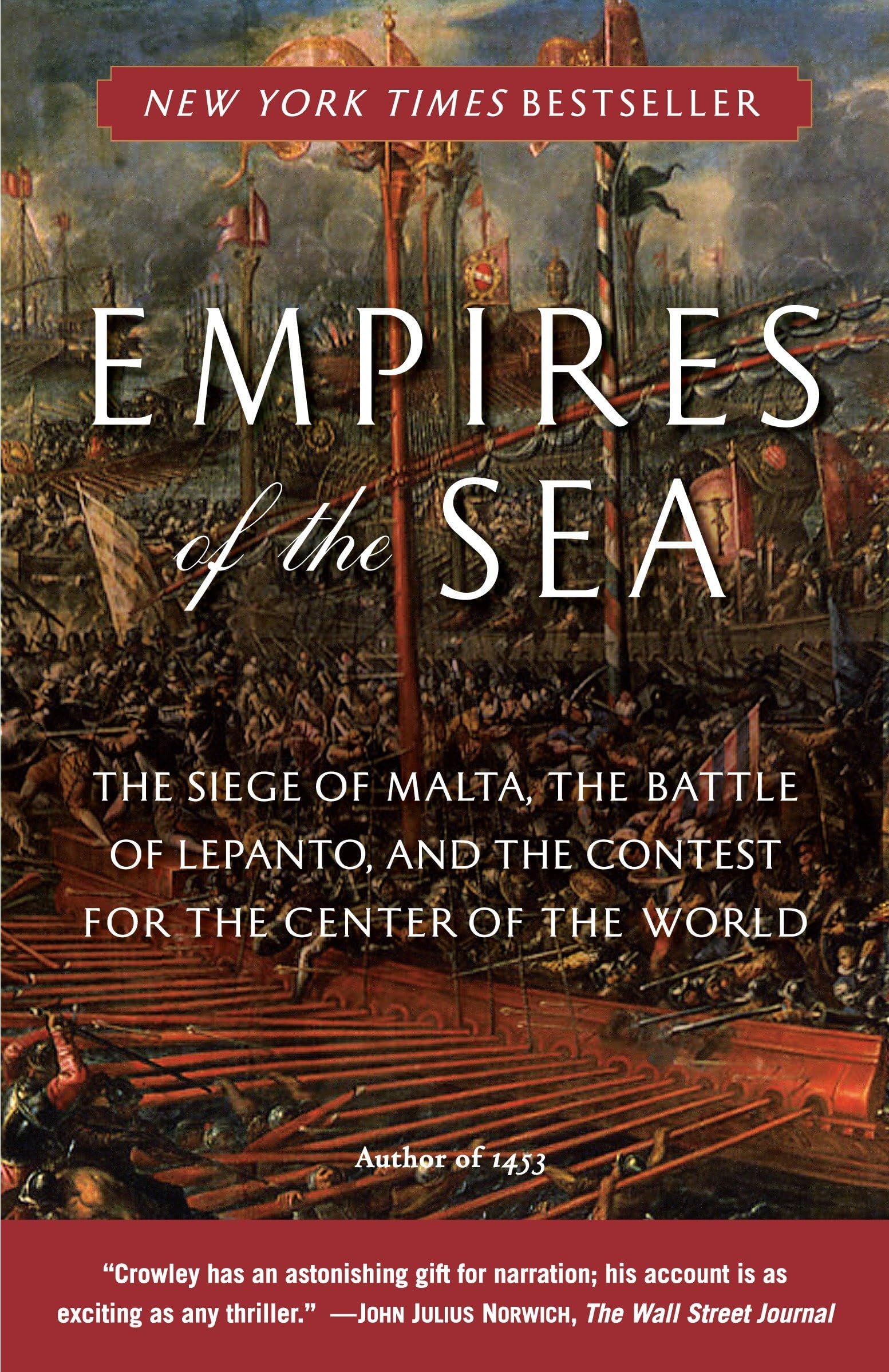
Empires of the Sea: The Siege of Malta, the Battle of Lepanto, and the Contest for the Center of theWorld
Product ID: 1372473
Desertcart purchases this item on your behalf and handles shipping, customs, and support to USA.
In 1521, Suleiman the Magnificent, Muslim ruler of the Ottoman Empire, dispatched an invasion fleet to the Christian island of Rhodes. This would prove to be the opening shot in an epic clash between rival empires and faiths for control of the Mediterranean and the center of the world. In Empires of the Sea, acclaimed historian Roger Crowley has written a thrilling account of this brutal decades-long battle between Christendom and Islam for the soul of Europe, a fast-paced tale of spiraling intensity that ranges from Istanbul to the Gates of Gibraltar. Crowley conjures up a wild cast of pirates, crusaders, and religious warriors struggling for supremacy and survival in a tale of slavery and galley warfare, desperate bravery and utter brutality. Empires of the Sea is a story of extraordinary color and incident, and provides a crucial context for our own clash of civilizations. Review: Riveting....who said history was boring? - Empires of the Sea: The Siege of Malta, the Battle of Lepanto, and the Contest for the Center of the World by Roger Crowley provides the reader with a clear picture into the world of the 16th century Mediterranean and more importantly into warfare for the time. Crowley wastes no time with preliminaries but gets quickly to work in the first chapter with Suleiman's attack on Rhodes. There's no beating around the bush here. Crowley does a terrific job looking at the art of war and how the two sides differed in their respective approaches to battle. On the one hand, the Knights of Saint John, who, like the Templar's, was an international organization with members pulled from the major European countries and provinces of the time. On the other was the Turkish army of Suleiman, large, mobile, well equipped and quick to mount an offensive; apparently lacking nothing needed for conquest. That the Christians were out-numbered is made clear. To the defenders of Malta the loss of any knight was a loss that was difficult if not impossible to replace. Suleiman had numbers on his side and spent freely suffering huge casualties for the time of both his soldiers and slaves. It was all out warfare. Rhodes was strategically important, in part, due to the loss of Constantinople in 1453. However, the loss of Rhodes could not compare to the loss of Malta fifty years later. Without Malta, Italy would become the "front lines" in the battle between Christendom and the door to Europe would be open. Crowley also does a masterful job by incorporating primary sources where possible. Descriptions by eyewitnesses are scattered throughout the text and add an important element to the book. Also the Turkish side of things is presented pretty clearly as illustrated with the following: "Selim, Ottoman Sultan, Emperor of the Turks, Lord of Lords, King of Kings , Shadow of God, Lord of the Earthly Paradise and of Jerusalem, to the Signory of Venice: We demand of you Cyprus, which you shall give Us willingly or perforce; and do you not irritate our horrible sword, for We shall wage most cruel war against you everywhere; nor let you trust in your treasure, for We shall cause it suddenly to run away from you like a torrent; beware to irritate Us." (page 207) Empires also does a great job in examining the growing Turkish presence in the Med as a naval power. Sulieman's reach and projection of power was made possible in part by the wonderful naval commanders that were available to the Sultan and by the absolute naval incompetence of the Europeans. In the end Sulieman's navy couldn't help him however. Crowley writes for the layman and explains himself clearly. The information that is presented is done so in context and though I'm not an expert on the subject feel that I've read a complete treatment of the topic. The maps that are included in the book make sense and are easy to read and the inclusion of the illustrations and woodcuts add to the information in the text. I recommend Empires of the Sea. Peace Review: Well-written account of the Mediterranean in the 16th century - Roger Crowley is an excellent writer and this book provides an interesting account of the epic struggle between Catholic Spain and the Ottoman Turks for control of the Mediterranean during the sixteenth century. It spans the period from the Ottoman's capture of the island of Rhodes from the Knights of St John in 1521 to the defeat of the Ottoman fleet at Lepanto in 1571. Crowley does a good job of describing the ebb and flow of the struggle during this period. At times, the Turks and their corsair allies attained dominance, raiding the coasts of Italy and Spain almost at will. During those periods, the Pope's fears that Rome itself might fall to the Turks appeared realistic. The narrative brings home the relative fragility of Christian Europe, divided as it was between Catholics and Protestants and between the Hapsburgs and their rivals, notably, France. Crowley is writing popular history, which is a good thing in terms of readability but also means that there may be aspects of his narrative that academics would have issues with. Although I am a long way from being an expert on this period, I do have a few criticisms. I found it surprising that Crowley devotes almost no attention to the failure of the Turks to take Vienna in 1529. Although he is concentrating on the Mediterranean -- he also devotes little discussion to the Spanish attempts to suppress Protestantism in the Netherlands -- I think that the struggle over Vienna played such a significant part in the Ottoman's decision to concentrate on expanding their control in the Mediterranean that it merited more discussion. Crowley also mentions that many current historians no longer see the Battle of Lepanto as a decisive turning point. He discusses the fact that Ottomans rapidly rebuilt the fleet they lost in that battle and that they continued to menace the Hapsburgs in the Balkans. But he argues that, in fact, Lepanto was an important turing point because, in effect, a de facto truce prevailed thereafter in the Mediterranean with neither side attempting to make significant gains at the expense of the other. I was left puzzled why the Ottomans didn't press on in the Mediterranean if their fleet was quickly rebuilt. I was also unimpressed by Crowley's attempt to provide a brief economic explanation for the long-run decline of the Ottoman Empire. His argument has something to do with the indirect effects on the Ottomans of the surge of gold and silver from the New World into Christian Europe, but his reasoning is hard to follow. Finally, at several points, Crowley describes in somewhat lurid detail the atrocities that the two sides inflicted on each other. Necessary, perhaps, in establishing the context of the struggle, but I wanted to give a head's up to anyone who might find such things unsettling. These quibbles aside, if you have an interest in this period, you should enjoy reading Crowley's book.



| Best Sellers Rank | #36,936 in Books ( See Top 100 in Books ) #13 in Turkey History (Books) #20 in History of Islam #25 in Naval Military History |
| Customer Reviews | 4.6 out of 5 stars 2,035 Reviews |
R**O
Riveting....who said history was boring?
Empires of the Sea: The Siege of Malta, the Battle of Lepanto, and the Contest for the Center of the World by Roger Crowley provides the reader with a clear picture into the world of the 16th century Mediterranean and more importantly into warfare for the time. Crowley wastes no time with preliminaries but gets quickly to work in the first chapter with Suleiman's attack on Rhodes. There's no beating around the bush here. Crowley does a terrific job looking at the art of war and how the two sides differed in their respective approaches to battle. On the one hand, the Knights of Saint John, who, like the Templar's, was an international organization with members pulled from the major European countries and provinces of the time. On the other was the Turkish army of Suleiman, large, mobile, well equipped and quick to mount an offensive; apparently lacking nothing needed for conquest. That the Christians were out-numbered is made clear. To the defenders of Malta the loss of any knight was a loss that was difficult if not impossible to replace. Suleiman had numbers on his side and spent freely suffering huge casualties for the time of both his soldiers and slaves. It was all out warfare. Rhodes was strategically important, in part, due to the loss of Constantinople in 1453. However, the loss of Rhodes could not compare to the loss of Malta fifty years later. Without Malta, Italy would become the "front lines" in the battle between Christendom and the door to Europe would be open. Crowley also does a masterful job by incorporating primary sources where possible. Descriptions by eyewitnesses are scattered throughout the text and add an important element to the book. Also the Turkish side of things is presented pretty clearly as illustrated with the following: "Selim, Ottoman Sultan, Emperor of the Turks, Lord of Lords, King of Kings , Shadow of God, Lord of the Earthly Paradise and of Jerusalem, to the Signory of Venice: We demand of you Cyprus, which you shall give Us willingly or perforce; and do you not irritate our horrible sword, for We shall wage most cruel war against you everywhere; nor let you trust in your treasure, for We shall cause it suddenly to run away from you like a torrent; beware to irritate Us." (page 207) Empires also does a great job in examining the growing Turkish presence in the Med as a naval power. Sulieman's reach and projection of power was made possible in part by the wonderful naval commanders that were available to the Sultan and by the absolute naval incompetence of the Europeans. In the end Sulieman's navy couldn't help him however. Crowley writes for the layman and explains himself clearly. The information that is presented is done so in context and though I'm not an expert on the subject feel that I've read a complete treatment of the topic. The maps that are included in the book make sense and are easy to read and the inclusion of the illustrations and woodcuts add to the information in the text. I recommend Empires of the Sea. Peace
H**N
Well-written account of the Mediterranean in the 16th century
Roger Crowley is an excellent writer and this book provides an interesting account of the epic struggle between Catholic Spain and the Ottoman Turks for control of the Mediterranean during the sixteenth century. It spans the period from the Ottoman's capture of the island of Rhodes from the Knights of St John in 1521 to the defeat of the Ottoman fleet at Lepanto in 1571. Crowley does a good job of describing the ebb and flow of the struggle during this period. At times, the Turks and their corsair allies attained dominance, raiding the coasts of Italy and Spain almost at will. During those periods, the Pope's fears that Rome itself might fall to the Turks appeared realistic. The narrative brings home the relative fragility of Christian Europe, divided as it was between Catholics and Protestants and between the Hapsburgs and their rivals, notably, France. Crowley is writing popular history, which is a good thing in terms of readability but also means that there may be aspects of his narrative that academics would have issues with. Although I am a long way from being an expert on this period, I do have a few criticisms. I found it surprising that Crowley devotes almost no attention to the failure of the Turks to take Vienna in 1529. Although he is concentrating on the Mediterranean -- he also devotes little discussion to the Spanish attempts to suppress Protestantism in the Netherlands -- I think that the struggle over Vienna played such a significant part in the Ottoman's decision to concentrate on expanding their control in the Mediterranean that it merited more discussion. Crowley also mentions that many current historians no longer see the Battle of Lepanto as a decisive turning point. He discusses the fact that Ottomans rapidly rebuilt the fleet they lost in that battle and that they continued to menace the Hapsburgs in the Balkans. But he argues that, in fact, Lepanto was an important turing point because, in effect, a de facto truce prevailed thereafter in the Mediterranean with neither side attempting to make significant gains at the expense of the other. I was left puzzled why the Ottomans didn't press on in the Mediterranean if their fleet was quickly rebuilt. I was also unimpressed by Crowley's attempt to provide a brief economic explanation for the long-run decline of the Ottoman Empire. His argument has something to do with the indirect effects on the Ottomans of the surge of gold and silver from the New World into Christian Europe, but his reasoning is hard to follow. Finally, at several points, Crowley describes in somewhat lurid detail the atrocities that the two sides inflicted on each other. Necessary, perhaps, in establishing the context of the struggle, but I wanted to give a head's up to anyone who might find such things unsettling. These quibbles aside, if you have an interest in this period, you should enjoy reading Crowley's book.
G**H
Spellbinding tales of slaughter on the Mediterranean
If you are going to read this book, you'd better like slaughter. It features lots of blood. Mostly, this occurs during sieges of fortified towns, but sea battles claim their fair share of victims too. All of it is described with great gusto, skill and narrative flair by the author, who clearly loves a good battle and knows how to recount it. In this, the book is similar to his previous work, 1453, which was largely devoted to the conquest of Constantinople by Mehmet the Conqueror. Fast forward three-quarters of a century to Mehmet's great-grandson Suleiman the Magnificent (known as "the Lawgiver" to the Ottomans), and once again the story and the carnage resume with Empires of the Sea. Crowley begins his story begins with the taking of Rhodes in 1522. Suleiman had been on the throne for only two years, and the tradition was that a sultan consolidated his authority early in his reign with a series of victories. He had already conquered the fortress of Belgrade, in what is today Serbia. Rhodes was next. Since it lay just off the coast of Turkey, and was a stronghold of the crusading Knights Hospitaller who had kept their toehold in the Eastern Mediterranean ever since being booted out of the Holy Land upon the failure of the Crusades, Rhodes was an obvious target. The Turks were very adept at siegecraft, and along with their massive advantage in manpower, took the Knights' key fortress after a prolonged siege and great loss of life. Suleiman generously allowed the defeated Knights to leave the island, thinking that would be the last of them. He was wrong. The balance of power in the sixteenth century in Europe and around the shores of the Mediterranean was mainly contested by two great powers: the Ottoman Empire and the Hapsburg Empire. The Ottomans' territories stretched across much of North Africa, and then from the Middle East through Turkey and the Balkans, all the way to Hungary. Their expansion into Central Europe was largely checked by the Hapsburgs, whose territories were a patchwork quilt across Europe, and included parts of Central Europe, Austria, parts of Germany, parts of Italy, the Netherlands, and Spain. Suleiman the Magnificent was to enjoy a long reign of almost half a century, from 1520 to 1566, the longest serving sultan of the Ottoman Empire. His main opponent, the Hapsburg King of Spain and Holy Roman Emperor, Charles V, had a similarly long reign from 1516-1556. Both monarchs had other worries than just each other. Suleiman was regularly engaged in wars in the Balkans as well as against the Persians, fighting a war against the Safavid Persian Empire that lasted nearly a quarter century. Charles V had to deal with the very combative Kings of France and with rebellious subjects in the Netherlands. At various times, the French would even go so far as to ally themselves against the Ottomans to counter the power of Charles V. In the Mediterranean, the Ottomans expanded across North Africa, absorbing the Barbary States of Tripoli, Tunis and Algiers. Autonomous provinces of the Empire, they were still an important part of the Ottoman military presence in the Western Mediterranean because of their fleets of corsairs. The corsairs functioned partly as free-lance pirates and partly as instruments of Ottoman naval power, seizing shipping and mounting coastal raids in Spain, the Balearic Islands and along the coast of Italy. However, strategically situated in the middle of the Mediterranean was the island of Malta, off the coast of Sicily. The Knights Hospitaller, after their defeat in Malta, had roamed homeless for some years, before eventually being given lordship over under the island, under the leadership of the Grand-master La Valette. Here, they became the Knights of Malta, and carried on their war against Islam, mainly through imitating the tactics of the corsairs. The Knights seized shipping wherever they good, roaming throughout the eastern Mediterranean under the noses of the Turks. After they seized one ship too many -- to be precise, the galley of the Sultan's Chief Eunuch -- Suleiman decided to put an end to the Knights once and for all. A massive invasion fleet was dispatched in 1565, and the fortresses of Malta were besieged. Tens of thousands died, but just as the fall of Malta seemed imminent, a Spanish relief force was landed and put the Ottomans to flight. The capital of Malta, Valletta, is named in honor of the commander who successfully defended it against near-impossible odds. Not long after, Suleiman died on campaign in Hungary -- though his death was kept secret, by using a double to conceal his death, until his retinue could return with his cold body to Istanbul. His successor and sole surviving son, Selim, was determined to follow in his father's conquering footsteps. He immediately set out to take the Venetian possession of Cyprus, with a much larger force than the one which had attempted to take Malta. After a couple of very bloody sieges -- of Nicosia and Famagusta -- the island was taken. These sieges are described in graphic, sometimes gruesome detail by Crowley. The new and aggressive Sultan was the proximate cause for the Christian powers of the Mediterranean, principally Philip II of Spain, Pope Pius V, and the Venetians to form a new alliance. Assembling a massive fleet, they set out to hunt down the Ottoman fleet. Amazingly, in October of 1571, they did so. What followed was the bloodiest naval battle in history, at Lepanto just off the west coast of Greece, as two massive fleets of oared galleys collided with one another in a spectacular cataclysm. The superior firepower of the Christian fleet prevailed, mainly due to the Venetians whose heavily armed gun platforms, known as "galleasses", destroyed most of the Ottoman fleet and killed 40,000. Through all of this, Roger Crowley's gift as a story-teller shine through. He focuses mainly on the military events and the personalities of the major military leaders, using his great narrative powers and his eye for interesting detail and anecdote to enliven the story. Yet he sketches in enough of the background grand strategy of the major powers involved to provide wider understanding. Even if you know nothing of this era of history or its war-making techniques, Crowley manages to make the story both clear and compelling.
T**Y
Epic historical battles
One of the best books I’ve ever read. Intriguing and inspiring. They should make a movie. Starts a little slow and picks up fast to level 10. Couldn’t put it down
N**T
Great writer brings older history alive! Excellent book.
I previously read Crowley's book 1453 about the Ottoman conquest of Istanbul (at that time of course Constantinople after Constantine). I discovered two things. One thing is a fantastic account of how Mehmet the Conqueror was able to marshall his forces towards final conquest by the Ottomans (well almost) of the crown jewel of the Byzantine Empire. The second was the discovery on how good a writer Roger Crowley is. He was able to capture (pun intended) this history in an exciting way. This book, if you will, is like a second volume as it concerns the Ottoman conquests of the Mediterranean. This is a very exciting account of the years around 1500 when both Mehmet and then his son were trying to gain control of the Med, through sieges in Rhodes, then Lepanto and the Adriatic Sea in modern day Greek and Yugoslavian waters. The book is easily read and becomes a book you want to keep on reading because it is not a dry account of dates and places but a living account of the events being described. Crowley makes the events interesting and vital. I learned about the men involved in a compelling way. I have purchased City of Fortune (about Venice during a similar time period), and look I forward after that to reading his new book about Portugal's conquests - both driven by Ottoman expansion in a way so all books are related. He is a very good writer with a gift for bringing history alive. You can't ask for more.
R**E
A dramatic story well told
Crowley does a great job of framing the dramatic struggle for control of the Mediterranean in the 16th Century. In the East, Suleiman the Magnificent, the absolute ruler of the vast Ottoman empire, united, organized, and expanding to conquer Christian lands. In the West, Philip of Spain, the titular political and military leader of a Christendom divided by myriad conflicting loyalties, rivalries, and interests. The story begins with the siege of Rhodes, the last outpost in the East of the crusading Knights of St. John, in 1522. Against overwhelming odds, the Knights held Suleiman's army off through six months of fierce fighting. Eventually, to prevent the great further bloodshed that would be required to take the city if he forced them to fight until the end, the surviving knights were permitted to surrender the city and leave unmolested with the banners, weapons, records and relics of their order intact. Suleiman would live to regret the decision. The heart of the story is the great seige of 1565. After many years of piracy and raiding, the simmering war for the control of the central sea came to its climax in the Ottoman campaign to conquer the strategic hinge of the Mediterranean, the tiny rocky island of Malta. Once again, it was the Knights of St. John who stood on the walls where the overwhelming blow would fall. But there was no possible retreat this time. Fewer than five hundred knights under the determined leadership of their elderly Grand Master Jean de Vallette who had been among the survivors of Rhodes were joined by about four thousand Spanish and Italian infantry and three thousand local Maltese militia. Unlike Rhodes where their fortifications had been the absolute state of the art of the age of gunpowder, the Christian forces manned walls that were poorly sited, out of date, and in need of repairs. Facing them was the cream of the Ottoman war machine at least 35,000 strong drawn from every corner of the sultan's empire: riflemen from Egypt, cavalry from Anatolia, the Balkans, Salonika, and Greece, the landholding sipahis, and the sultan's own elite janissaries. These were joined by the world's most experienced gunnery corps with the huge array of artillery, armorers, engineers, sappers, and carpenters that made them justly confident that Malta with its secure deep water port would soon be the sultan's new forward operating base in the west. The Ottoman's landed on May 18th beginning a struggle that is one of the most dramatic stories of sacrifice and determination in the annals of military history. It was an incredibly near-run affair, but on September 11th, the Turks withdrew from the devastated island leaving the behind around a third of their original force killed in the four month siege and, more importantly, leaving the few hundred remaining defenders still defiantly in command of the smoking ruins that had been their defenses. The climax of the saga is the Battle of Lepanto on October 7, 1571, the only large scale naval battle of the war. On the one side, the Ottoman armada which had just captured and incorporated the formerly Venetian island of Cyprus. On the other side, the Holy League of Spain, the Papacy, the Knights of St. John, and Venice was, in the apt phrase of Niccolo Capponi, a League of Mistrust. The Christian fleet was outnumbered but the Ottoman's were outgunned. In the event, it was a dramatic Christian victory. Though the Ottoman's would quickly make up their losses in ships and soldiers, their losses in experienced sailors were more serious. They would continue to advance on land for more than a hundred years reaching their high water mark on September 11th, 1683 before the walls of Vienna. But the battle for control of the Mediterranean was essentially over with the consolidation of their gains in the Eastern half of the sea. Crowley does an admirable job of compressing the whole story into 300 pages. It is probably the best single volume on the subject though it does require him to simplify the story in places. For example, the sensitive diplomatic dance between Philip, Pope Pius V (who was the indispensable driving force behind the League) and Cosimo I de Medici is left entirely out. If you're interested in a fuller treatment of the Siege of Malta, you can't do better than The Great Siege: Malta 1565 . Bradford is a great storyteller but he relies heavily on the account of the knights themselves and is thus a little unfair to Don Garcia de Toledo, Philip's viceroy of Sicily, who refused to dispatch the relief force until he was confident that they had a good chance of getting through to the besieged knights. If you're interested in more detail about the Battle of Lepanto, check out Victory of the West: The Great Christian-Muslim Clash at the Battle of Lepanto . Capponi will give you a much fuller understanding of the recruitment, training, and equipment of the Ottoman armies and the internal politics of the Sultan's court. He also addresses in more detail the very complex, and sometimes very personal, political and diplomatic backstory that, against all odds, brought the Christian fleet together on that fateful October morning. Finally, he presents a meticulous breakdown of the various sorts of ships, their armaments, manning, tactics, and relative costs. All of this detail means that the story doesn't move along as quickly as it does in Crowley, but it is very valuable for readers who want to go a little further.
M**Y
Great read
Excellent summary of events in 1500s between ottoman aggression and Christian defense told in way that was a series of exciting stories
U**M
Hooked Me in the First 10 Pages
This book is outstanding. In the first half of the book you basically have: 1. The Ottoman Empire which is reaching the apex of its maritime capabilities. 2. The Barbary Pirates of North Africa who are in league with the Ottomans and strike the coastal regions of Europe with impunity. 3. A knightly order left over from the last crusade which plays as "down and dirty" as their Ottoman enemies. These knights make a stand on the island of Malta ultimately defeating an Ottoman force much larger than their own. Sound like fiction? Roger Crowley does good job of portraying the dynamics of the time: the desperation of entire Christian communities enslaved, the division of Europe, the power of the Ottoman Empire, the hesitation to commit large naval forces into battle, etc. He also explains the technology of the time including the manpower-intensive galley which represented the ultimate in naval warfare. It is no small stretch to envision a much different Europe had Lepanto or Malta played out differently. Further, I find that good historical books play up small factors that ultimately decide the outcome. For instance, if Anastagi had not carried out the cavalry charge from Mdina at the critical moment it is likely Malta would have fallen to the Ottomans. This book reads like fiction with the author making use of foreshadowing. The major characters intertwine in complex ways and often generationally. Like all good story telling you can empathize with all of the characters involved; from Sultans to galley slaves. However you can't help but be shocked by the brutality of the period - all in the name of God. This is one of those books that I literally stayed up too late reading. I have been reading quite a bit on my Kindle lately and as a result reserve 5 stars for truly exceptional books. I feel compelled to give "Empires of the Sea" 5 stars.
M**E
Anybody who enjoys the Mediterranean will enjoy this also
Well-written, is both informative and interesting. You can hardly visit the Greek islands, Malta, Rhodes etc. without being touched by the history and events covered in this delightful book.
A**.
Libro molto interessante, consigliato
Libro molto interessante, scritto in maniera avvincente quasi fosse un romanzo. Interessante anche la descrizione dei caratteri dei personaggi, rende più comprensibile l'evoluzione storica dei fatti narrati. Al pari di City of Fortune, È un peccato che non sia stato tradotto in italiano.
M**N
Very Good Audio Book
I have a forty minute highway commute to and from work and I typically spend the time listening to audio books. I wasn't familiar with the work of historian Roger Crowley so I took a chance and ordered the audio book version of Empires of the Sea. It turned out to be a very good audio book. The battles between Islamic Ottoman Empire and Christian Europe for control of the Mediterranian Sea (the Center of the World in the book title) seem to have been overlooked by historians for a few decades but there are a number of recent books published about these important events. Roger Crowley has written three that I'm aware of. Crowley puts the conflict into historical context and shows how close Christian Europe came to losing this contest with the Ottomans in the 16th century. He then goes into a fairly detailed discussion of the siege of Rhodes by the Ottomans as a lead in to the book's main focus, the siege of Malta in 1565 and the Battle of Lepanto in 1571. Along with the military history of the conflict, he covers the political and economic factors at play on both sides. Crowley's writing style lends itself well to narration and the reader does a good job narrating the text. The audio book is done in mp3 format so the unabridged book fits on one CD. Overall a very interesting audio book that I'd recommend to anyone interested in this period of history and/or anyone interested in more background on today's conflicts between Islamists and the West. Crowley's other two books don't seem to be on audio books yet. I would encourage Roger Crowley's publishers to rectify that situation fairly quickly. After hearing this audio book, I would buy Crowley's other books on audio book.
G**A
Un tres bon livre d'histoire.
Et une lecture passionante.
M**R
Great reading
Empires of the Sea by Roger Crowley covers the time period between 1520 and 1580 when Ottoman naval forces fought for suzerainty over the Mediterranean with the Spanish and the Venetians. The story starts with the honourable surrender of Rhodes by the Knights of St John under L'Isle Adam to Suleiman (the Magnificent) after a longer siege in 1522 and their later moving to Malta in 1530 with Charles V's permission. During that time the two Barbarossas (Oruch and Hizir - later Hayrettin) terrorize the Mediterranean. Hayrettin enters into Suleiman's service and becomes admiral of the sultan, Andrea Doria his adversary in the service of Charles V. 1565 Suleiman's fleet (Piyale Pasha) and army (Mustapha Pasha) attack Malta. After initial successes of the Ottomans (the taking of St Elmo) and a lengthy and brutally fought siege, the defenders under grandmaster Jean de la Valette repulse the massive invasion force with the help of a ten thousand man strong relief force sent by Philip II (the Prudent). 1570/71 the Ottomans take Nicosia and Famagusta from the Venetians with an eighty thousand man strong force. The holy league created under Pius V (Spain, Venice and the Papacy) comes too late to rescue Cyprus from the Ottomans but faces the Ottoman fleet at Lepanto. With luck (the Ottomans seek open naval confrontation) and under the command of Don Juan of Austria the holy league prevails. The battle left and estimated forty thousand dead. Later in 1580 Spain and the Ottoman Empire conclude a peace treaty and set out the spheres of influence of both maritime powers. Nothing less than brilliant!
Trustpilot
1 week ago
5 days ago