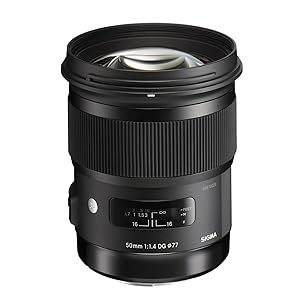
📸 Elevate your vision with Sigma’s sharpest 50mm masterpiece — don’t just shoot, create iconic art.
The Sigma 50mm F1.4 Art DG HSM Lens for Canon is a professional-grade prime lens featuring a fast F1.4 aperture, ring-type ultrasonic autofocus motor, and advanced optical elements for exceptional sharpness and bokeh. Designed for Canon EF mount cameras, it supports full-time manual focus and is compatible with Sigma’s USB Dock for precise autofocus calibration. Weighing 1.25 pounds and equipped with 77mm filter threads, this lens is celebrated for its edge-to-edge clarity, color fidelity, and versatility in low-light and artistic photography.

| ASIN | B00JPL7CK6 |
| Batteries | 1 12V batteries required. |
| Best Sellers Rank | #962 in SLR Camera Lenses |
| Customer Reviews | 4.7 4.7 out of 5 stars (1,663) |
| Date First Available | April 11, 2014 |
| Is Discontinued By Manufacturer | No |
| Item Weight | 1.25 pounds |
| Item model number | 311101 |
| Language | English |
| Manufacturer | Sigma Corporation of America |
| Product Dimensions | 3.9 x 85.4 x 99.9 inches |
J**E
5 Years Later: Sigma Art is Highest Rated Auto Focus 50mm Lens (DXOMARK) & Excellent Value
Frankly, I was never a big fan of normal lenses. This lens completely changed my mind. I have used this 50mm 1.4 Art lens extensively for 5+ years and it is on my camera most of the time. It was the first small format lens for my Nikon that offered me the kind of resolution I was used to as a long time large format or view camera photographer. It is also remarkably sharp. Check out the benchmark tests for the very top lenses at DXOMARK. I use mine on an aging D800e like in the ratings. That is also the same coupling used for my Sigma 85mm 1.4 Art lens which still stands at the time of this writing as that site's #1 rated lens overall. This is not just puffery. I mention this because I was initially very skeptical of Sigma's dramatic transformation into the league of the highest performance lens manufacturers. I was a reluctant convert. Nothing in SIgma’s history made me anticipate that, which I suppose makes its success all the more noteworthy. Some reviewers have not been able to drop their historical bias against the brand. But the evidence is overwhelming for Art Series lenses. It is also an easily testable proposition. Every lens manufacturer's glass color is different and today we have many choices in third party well as Nikon lenses. Nikon lenses tend to be relatively neutral so Sigma Art lenses are close cousins. I need neutral in my workflow. Other people prefer the warmth of other brands’ color. In post production this issue is easily managed either way. Every lens has its own individual look in rendering the world whether that is inside your studio or in the field, sometimes literally in the field. I happen to need high resolution and optical sharpness. My living is based on getting my work reproduced in books and as an artist I make very large prints for galleries and museum exhibitions. Other photographers might not need those characteristics in order to print large but will use them to make high quality prints from cropped images that still hold up very well. This lens performs very well for all those demands and excels when coupled with high resolution sensors and careful use. As you know any lens will appear better or worse depending on the performance capabilities of specific digital cameras and sensors. If you want to see this lens’ full potential you will need to invest in a high resolution camera. That is now all about the coupling of optics and electronics. [And I add with emphasis, the more you know about pragmatic issues like focussing your camera, manually and with auto focus, the more you will ensure that you are getting the most from what this sophisticated gear has to offer. Skills and knowledge still count and will transform your images as you acquire more. Moreover, courses offering higher levels of decision making can help refine your ideas and compositions. Subjects like art history, design, and aesthetics are some of the things that help take you to the next levels and are good investments when you want to get to the next levels regardless of your gear. You will get more out of your equipment applying what you learn across the board.] It is a fast lens. This one is literally as good as they can get today. You may not need a lens that is sharp at f1.4 very often but when you do you will be very happy. Too many fast lenses are not useable until you stop them down including Nikon’s 50mm 1.4G, but not this one. I can recommend the image quality of the recent, refined but much more expensive Nikon 58mm 1.4G lens, which I consider a specialty lens compared to the "good for everything" Sigma 50 mm Art lens. Fast lenses are effective for separation of an object from a background as well as for low light situations when using a flash fill is not appropriate or will not provide what you want. The Sigma's bokeh is everything I need. It is such a subjective matter that I can’t predict your response but many folks tend to have very strong opinions about this subject making for many contentious debates. But I have not noticed much consensus over the decades. That is not a criticism, just an observation. I don’t use terms like dreamy or creamy. They are limited in what I can convey to you using them and there can be a number of nuanced aesthetic phenomena going on simultaneously in any specific bokeh that deserves a more substantial treatment. Examples include shapes change by lens, distance and f stop. What happens in the highlights, midtowns and shadows also vary from lens to lens. Tonal and color transitions can widely vary and just can’t be adequately reduced to words like blur. There are obviously no metrics for dreamy. Of course, there are many other aspects of optical rendering that are challenging and next to impossible to comprehensively describe using words or describe their effect on viewers. Every lens has its own characteristics for better and worse. But everyone seems to know what they want after they see it so please try out the lens first to see if it gives you what you are looking for. In my lens f4.5 and on both sides of it offer the very best range for sharpness but frankly this lens outperforms the competition at virtually every f stop. Few lenses can make me this happy at so many different apertures. Most lenses are much more clearly optimized and less flexible. Don’t worry if you need more depth of field. All lenses are NOT created equal at lower f stops any more than they are at other settings. Once again, this is a clearly demonstrable and testable matter. Find out all of your lenses’ strengths. Remember there are also lens to lens variations even within the same model. Get specific. It can be well worth the time in the long run for some folks. You will know who you are. As a cautionary tale, be wary of some astonishingly foolish reviews online. You know that already but some are not simply worse in degree but cross over into kind—utter nonsense. I was surprised, shocked and amused by some ridiculous sham reviews. Try and find what actual shooters, not bloggers, have to say first. One wannabe pro claimed we should avoid the sharpest lenses because they are only intended for amateurs, not professionals. This person is not a professional, let alone an expert but unfortunately pretends to be. That is one kind of deception, an appeal to authority. Be skeptical. Be discriminating and let common sense prevail. There is a lot of your money at stake. All 50mm lenses are part of the "normal" focal length range that proves to be very flexible in a variety of uses. They prove easiest when composing since what you see in the viewfinder will be what you get in terms of scale and perspective. Also the unusual lack of flaws and weaknesses in this Sigma Art lens include its corner to corner sharpness that is especially appropriate when making panoramas. There is also reliable uniformity in each file's color, contrast, tonal distribution, lack of distortion and unbeatable clarity. You will have few problems to clean up in post production after stitching. IMO, the world looks very different through great glass. Once you experience that, relatively ordinary lenses will likely disappoint you thereafter. I was hooked decades ago and my discriminating clients appreciated the difference. There are caveats. First, the auto focus strains in many low light situations although that can be as much about the camera as the lens. Low light severely reduces contrast upon which most auto focus relies. It is not a huge issue in my particular case because in those situations I prefer to use a tripod and manual focus anyway. I probably use manual focus more than the majority of people in all situations but I can usually rely on the auto focus when there is enough contrast. Since it is about reverse engineering Nikon's proprietary technology, Sigma offers an inexpensive tool to assist you in fine tuning auto focus if you need it, their dock. It works with all Sigma Art Series lenses and some other Sigma lenses. Focus speed is very good but I do not make big demands on it by often shooting high speed moving objects. I have lenses that are faster but most of the rest are slower. Possibly your biggest reservation is about size and weight. I understand although I gladly accept its weight, 1.8 pounds, in return for consistently outstanding performance, resolution and sharpness. I also have too kits, one for list weight travel. That too is about personal preferences and needs as well as budgets. There are always trade offs. In terms of subject matter, it is not my first choice for portraiture because of distortion from moving in closer than conventional portrait focal lengths require. But if you want distortion then it is the answer, not a problem. Similarly if you want to play with “normal” distribution of space and scale you will need to either go wider or into telephoto lenses to achieve results like intentional distortion and compression. But note that I am describing the trade offs of any normal focal length lens in general. For example, it you wanted the same image quality as this lens but in a focal length are appropriate for most portrait work, you might consider the Sigma 85mm 1.4 Art lens. It is even a bit sharper. It is close to be an astonishing lens in my estimation. But they are close in performance. Lastly, this 50mm lens has no VR equivalent, image stabilization. That could be a deal breaker for some of us. It will matter most in low light situations or if hand holding has been a problem for you. Again, in what I do, a tripod offers one solution but it can’t always take the place of VR in every situation. You simply might not have that option in the kind of shooting you do. Overall, I consider the $950 I paid to have been a steal and the best quality I had ever paid for such a reasonable amount of money although I must add the Sigma 85mm 1.4 Art is tied for value. It is being sold much cheaper today. I am conservative in my buying advice. Know your seller's credentials and policies ahead of time in case anything goes wrong. Amazon charges more but you are always completely protected. And yes, long ago I found that out the hard way. It was a lasting lesson. In summary, this lens is pure pleasure to use, flexible in purpose, affordable and reliable. Test it out for yourself.
J**R
Fantastic lens - just NOT out of the box fantastic!
First Impressions: When I received the product, I was very impressed with the weight, the build quality, the smooth manual focus with just the right amount of resistance to make it easy to be precise. The weight was both impressive and at the same time, a little annoying - but there's a lot of glass in this lens, and for a 50mm, it's HUGE. One thing that I knew about in advance (but didn't care for) was that the mounting ring isn't sealed. On the other hand, the mount is steel, so it's going to be much more durable than those plastic mounts we see on some lenses. Of course, just like you would expect, I popped it on my D750 and took it out for a spin. Also like you would expect, I started shooting at F/1.4 - of course! The images were... ok. No-where near as sharp as my images from my Nikon DX F/1.8 35mm... or my Tokina DX F/4 12-28mm... or my Tamron F/2.8 70-200mm. Nor was it as sharp (at the long end) as my Nikon kit DX 55-200mm. While I found this disturbing, I started shooting at smaller F-stops... 6.3, 8, 9, etc. As you would expect, the quality improved quite a bit. At the time, I figured I was facing an auto-focus fine tuning issue... and I was right. I'd gone through some similar issues with my Nikon kit lens, as well as my Tokina 100mm macro lens (when using it as a telephoto). However... now I was faced with an interesting problem. Sigma sells a USB dock (about $59), but I usually used the on-camera auto-focus fine tuning settings to fix issues. The (free) software that uses the dock allows you to make auto-focus fine-tuning changes at - on a prime lens - four different distances. I decided to use my Google-Fu to see if this was a worthwhile investment or not... and I came to the conclusion that it was after reading tons of reviews and forum commentary. Given the cost of the lens, I figured it was a minor investment if it really gave me what I was looking for. So I bought the dock, and rather than using my traditional auto-focus tuning chart, I decided to just take shots at the different ranges at F/1.4 (to make focus issues VERY apparent) and adjust accordingly. This took me about an hour... It was the best $59 and 60 minute investment I've ever made. :) Once I'd tuned the lens based on my pictures, I took it out for a real-world spin... and it was EXACTLY as good as I'd read it to be. :) Sharpness was incredible... not that sharpness is really the only criteria for lens choice, but it's certainly something you have to consider, along with bokeh, focus speed, focus accuracy, F-stop range and so forth. (All of which this lens handles wonderfully well!) Summing it up... once you fine-tune this lens, it lives up to it's hype 100%. :) Having said that... if you're not up for doing AF fine-tuning yourself, you can buy one and have Sigma do it for you. You'll just have to ship it back to them to get it done. (If there's a local authorized Sigma dealer near you, they might do it for you... or not.) Just so we're clear, not ALL the writings I found about this lens required AF fine-tuning. Some were perfect right out of the box, so your mileage may vary. Having said that... if you haven't learned to use your camera's AF fine-tuning (pretty much all DSLR makers have this in their cameras), then you really, really, REALLY should learn how. Chances are you'll find that some of your lenses aren't performing quite as well as they could. :) So, some general pro's and cons: Pros === Sharpness Bokeh Focus accuracy (single-point) Focus speed (single-point) Zero distortion Excellent contrast Excellent color transmission Professional build quality Wonderful manual focus ring Amazing picture quality overall Very nice carrying case Excellent lens cap, doesn't pop off, etc. Cons ==== Weight Lack of dock seal Need to purchase USB dock (perhaps) Storage dock-cap on lens is a bit loose (can use a Nikon cap instead.) ============== Update 8/17/2015 ============== This lens - after AF tuning - is absolutely amazing. I have to say that while I've spent more for a lens, I've never spent my money better. ============== Final Update 9/5/2015 ============== A word about the auto-focus fine-tuning on this lens. First - doing auto-focus tuning at F/1.4 is very, very difficult at close ranges. Finding the focus (forward or back) can be very challenging - it gets easier at more distance (5 feet and up), but at 16 and 28 inches... seeing where the actual focus is can be tough no matter what chart you use. Stick with it, though - and read below, because there's some very important information specific to Sigma Art lenses that you'll need. :) I had bought (via Amazon) a Datacolor SpyderLensCal SLC100, thinking it was time for me to finally move off my old free paper-printed focusing chart. This focusing aid (the SypderLensCal) was and is good for LONG- DISTANCE auto-focus fine tuning. Do NOT use it for ranges of less than 3 feet - all my lenses on both my cameras (D750 and D7100) had a lot of trouble focusing on the target... something I found out later on after spending much time being frustrated by my tuning efforts on this 50mm Sigma Art. Setting aside target problems, I had used the Sigma manual to do tuning for each of the ranges on the lens... while I was initially very pleased with the result, I found inconsistencies over time. After spending many hours re-doing and re-re-doing the settings on the lens with WILDLY varying settings according to each fine-tuning session, I finally called Sigma and asked them what (if anything) I was doing wrong. I had followed their online PDF documentation to the letter - testing and adjusting focus on the closest setting first, followed by the next closest, etc. Turns out their documentation left out one tiny detail, which the tech support guy provided within a minute of our discussion. You have to reset all the settings to the default of ZERO before moving on to the NEXT RANGE. If you leave the closer range (or ranges) in place, it will skew the results of your front/back focus issue. Worse, (as I found out) if the numbers are big enough, you don't really get a change in the adjustments of later settings - I had some of them up to +20 (the max) at one point! Once I changed out the target and followed the proper procedure, I got some fantastic results. The adjustments on my lens copy were small: +1 at 16 inches, 0 at 28 inches, +6 at 60 inches, and +7 at Infinity. (All with a zero auto-focus fine-tuning on my camera settings.) (Although I used a chart to set up infinity, I ended up increasing it from +6 to +7 when I did my real-world tests. My chart testing was inside, and even though I was beyond the 11 feet indicated by the lens, truly distant objects required a little more refining.) Now the sharpness is outstanding and consistent at all ranges - no anomalies - and I'm 100% happy with my lens. :) As stated, this is the last update... hope this helps!
T**T
Einleitung: 50mm, das steht für viele noch als die Standard Brennweite an Kleinbild. You see what you get, oder so ähnlich könnte man es auch beschreiben. Denn 50mm an Kleinbild, hier an Nikon FX, bildet in etwa das ab was der Mensch sieht. Für den täglichen Gebrauch ist solch ein Objektiv Ideal und bisher waren gerade 50mm Objektive meistens klein, leicht und Lichtstark. Bei Offenblende gerne mal etwas weicher aber dafür mit einem schönen Freistellungspotenzial. Und jetzt kommt da das Sigma 50mm Art 1.4 daher und es bricht mit einigen vorher so feststehenden Begrifflichkeiten im Zusammenhang mit 50mm Objektiven. Aber wo genau, das versuche ich hier im Test zu zeigen. Lieferumfang: + das Sigma Art 50mm 1.4 DG HSM + Garantiekarte (3 Jahre bei Registrierung) + Deckel für Bajonett und Linse + Streulichtblende + Schutztasche Erster Eindruck, Haptik und Verarbeitung: Das Objektiv kommt gut Verpackt in einem unscheinbaren weißen Karton. Es ist wie auch das 35mm Art sehr hochwertig verarbeitet. Das aktuelle Design bei den Art/Sports/Contemporary Objektiven von Sigma gefällt mir ausgesprochen gut. Jetzt kommt der erste Punkt bei dem das Sigma mit üblichen 50mm bricht, es ist Riesig und es ist schwer. Mit seinen 10 x 8,5cm und einem 77mm großen Filterdurchmesser überragt es die Konkurrenz deutlich. Es liegt sehr gut in der Hand und der Fokusring läuft stramm aber dennoch sehr angenehm. Der AF/MF Schalter ist ebenfalls sehr knackig zu bedienen, ich glaube das ist das richtige Wort. Auch bei dem Sigma Art 50mm 1.4 DG HSM kommt durch die verwendeten Materialien, Metall und sehr hochwertiger Kunststoff, direkt ein Gefühl von Wertigkeit auf. Dazu trägt auch das ordentliche Gewicht von 815g einen großen Anteil zu bei. Also ein richtig ordentliches Stück Glas. Der breite Fokusring hat eine angenehme Riffelung und lädt geradezu dazu ein auch mal manuell Bedient zu werden. Was den Aufbau angeht, ist das Sigma sehr Aufwendig produziert. Nicht ganz so Aufwendig wie das 35mm aber für ein 50mm 1.4 doch sehr: Hier findet man 13 Linsen in ganzen 8 Gruppen. Hierunter finden sich ganze 3 Linsen mit SLD Technik (Special Low Dispersion) welche in Kombination mit einer asphärischen Linse für sehr gute Bildqualität sorgen soll. Die 1.4 Konkurrenz aus dem Hause Canon bietet 7 Linsen in 6 Gruppen und das Nikon 8 Linsen in 7 Gruppen. Dazu spielen sie mit jeweils 290g bzw. 280g auch Gewichtstechnisch in einer anderen Liga. Was den Vergleich in der Verarbeitung angeht ist das Sigma Art ebenfalls der Konkurrenz haushoch überlegen. Selbst wenn man die teurere Spezialkonkurrenz anschaut, sieht es nicht anders aus. Der Vorsprung des Sigma wird nur etwas geringer. Das AF-S 58mm von Nikon und das Canon 50mm 1.2 L sind zwar gegenüber ihren kleinen Brüdern deutlich Wertiger, aber auch diese nochmal deutlich teureren Gegner können dem Sigma nicht das Wasser reichen. Es gibt einen Konkurrenten welcher selbst das Sigma stehen lässt, aber dies ist das 3400€ teure Zeiss Otus 55mm 1.4. Noch Größer, noch schwerer und noch Aufwendiger. Diese beiden haben einen Unterschied gegenüber den ganzen anderen 50/58mm Objektiven. Der Linsenaufbau ist deutlich Komplexer und ist bei Zeiss der Distagon Linie entnommen. An diesem Aufbau orientiert sich auch das Sigma 50 1.4 Art. Im Gegensatz dazu folgen die anderen eher dem von Zeiss bekannten Planar Design. Autofokus: Sigma nutzt bei seinen Objektiven schon eine ganze Zeit einen HSM (Hypersonic Motor = Ultraschallmotor) welcher hier in seiner besten Form, Ringform, anzutreffen ist. Dieser sorgt für schnelles, leises Fokussieren und es ist zu jeder Zeit ein manuelles Eingreifen möglich. Selbst bei F 1.4 ist der Fokus sehr präzise und passt an meiner D800 ohne jegliche Korrektur. Im Vergleich zum AF-S 50mm 1.4G ist das Sigma deutlich flotter Unterwegs, hier kann auch das etwas schnellere 1.8G nicht mithalten. Stabilisator: Keiner Vorhanden, daher nicht zu bewerten. Bei 50mm empfinde ich einen Stabilisator auch nicht als wirklich notwendig. Schärfe und Kontrast: Jetzt zur Bildqualität. Und was Sigma versprochen hat, dem Otus von Zeiss Konkurrenz zu machen, gelingt auf Anhieb. Selbst bei Offenblende sind die Bilder schon so scharf und Kontrastreich, das es die Konkurrenz von Canon und Nikon vor Neid erblassen lässt. Und was das extreme daran ist, hier geht es nicht um Nuancen, hier geht es schon fast um Welten. Das 50mm 1.4 von Nikon erreicht eine ähnliche Schärfe wie das Sigma erst bei f3,5-f4. Wer das zum ersten Mal sieht kann es kaum glauben, so ging es mir zumindest. Selbst das Sigma 35mm Art kommt nicht an diese Schärfe heran, nur das Otus liegt auch hier minimal vor dem Sigma. Danke Sigma das ihr hier dem Zeiss Konkurrenz macht, so wie versprochen und ihr zum 2ten mal mit den 50mm Begrifflichkeiten brechen könnt. Denn 50mm bei f 1.4 müssen nicht weich sein, sie können auch anders. Vignettierung, Verzeichnung, CAs und Bokeh: Wie alle sehr Lichtstarken Objektive sehen wir auch beim Sigma bei 1.4 eine deutliche Vignettierung (Randabschattung). Hier reden wir von ca. 1,6 Blenden welche sich bei weiterem Schließen der Blende deutlich abmildert. Bei f2 erreicht sie noch 0,6 Blenden um bei f2.8 unter 0,3 Blenden anzukommen. Das ist dann ein sehr guter Wert. Die Konkurrenz zeigt hier nochmals in allen Blendenbereichen deutlich mehr Vignettierung. Die Vignettierung wird zudem durch alle aktuellen Bildbearbeitungsprogramme heraus gerechnet und ist beim bearbeiteten Foto dann nicht mehr sichtbar. Ich finde dass eine angenehme Vignette wie im Fall des Sigmas sogar einen netten Effekt dem Bild geben kann, da der Helligkeitsverlauf sehr angenehm verläuft. Die Verzeichnung befindet sich an Kleinbild mit seinen 1,31% auf nicht ganz so gutem Niveau, aber es fällt im Alltag nicht sehr auf. Auch die Konkurrenz aus den Häusern Nikon und Canon machen dies nicht besser. Jetzt zum Bokeh. Hier scheiden sich die Geschmacksgeister. Ich empfinde es als Angenehmer/Weicher wie beim 50 1.4G und auch gegenüber dem 58 1.4G sehe ich es vorne. Einen Vergleich zum Canon 1.2 oder 1.4 kann ich nicht ziehen da ich nicht Vergleichen kann. Bilder im Internet zeigen zumindest das diese nicht besser sind. Hier traue ich aber immer eher meinen eigenen Aufnahmen und da ich sie im Falle von den Canon nicht habe gebe ich hier auch keine Wertung ab. So genannte CA's sind sehr minimal zu finden, für solch ein Lichtstarkes Objektiv ist das wirklich schon Bemerkenswert. Die bereits oben beschriebene Linsenkonstruktion scheint hier ihre volle Kraft zu entfalten. Der Konkurrenz aus den Häusern Nikon und Canon zeigen dort sehr deutlichere Farbfehler und erreicht die Qualität des Sigmas selbst nach Abblenden nie. Sehr erstaunlich Sigma, sehr erstaunlich. Fazit: Jetzt kommen wir mal wieder zum Fazit eines Sigma Art Objektivs. Es wird jetzt sehr Langweilig denn ich muss mich leider wiederholen. Geil, geil geil. (Sorry für meine Ausdruckweise) Mehr kann man nicht sagen. Was Sigma dort der Konkurrenz aus den Häusern Canon und Nikon vor den Latz geknallt hat überzeugt auf ganzen Linie. In allen Belangen, wirklich allen Belangen schlägt das Sigma alles bisher da gewesene im 50mm 1.4 und sogar 1.2 Bereich. Ja, es ist Groß, ja es ist Schwer aber dafür bietet es etwas was kein Anderes bieten kann. Eine Bildqualität die einen einfach Staunen lässt, Grandios. Ich kann sie jedem ans Herz legen und wünsche allen viel Spaß mit dem Traumstück.
G**S
Arguably the best third-party 50mm lens for Canon, and better than Canon’s entry level and mid-level 50mm lenses.
T**N
An exceptional piece of kit that will get you some wonderful photos. Sharp as hell and very fast and accurate autofocus. 50mm is an ideal general or street photography lens, and even worth a try for honing in on particular elements of cityscapes and landscapes. The f/1.4 and overall construction make it superb optically with good low-light characteristics. Possibly the best on the market at this focal length apart from the expensive manual focus jobs.
D**.
Recibí el objetivo con la caja rota y el objetivo con la tapa caída. Estuve a punto de devolverlo pero al mirarlo detenidamente ví que estaba perfecto. Penoso que un producto tan caro y teóricamente nuevo venga así, y seguramente usado. Al ver que estaba bien lo puse en la cámara y ufff..... brutal. El mejor objetivo que ha pasado por mi cámara. Al usarlo en una D3300 lo uso principalmente para retratos y fotos que requieran gran detalle. Para mi sorpreaa es el único sigma Art que tengo que no ha hecho falta pasarlo por el dock. A f1.4 es maravilloso, muy buena nitidez y espectacular bokeh. Desde F2 a F8 es lo más bestia que he visto nunca. Definición espectacular de centro a esquina. Enfoque rapidísimo y me enfoca realmente bien en condiciones de muy poca luz. Es grande y pesado pero no lo he notado nada incómodo, es agradable al cogerlo y te permite una estabilidad muy buena, que al no tener estabilizador se agradece. Puedo tirar a velocidades de 1/30 con cierta fiabilidad e incluso algo menos. Por este precio de 630€ en oferta, es compra obligada.
M**R
This lens just blew me away! I'm a long term photographer who has used a fair few lenses on various cameras over the last decade and this lens beats any others in the 35 to 85mm focal range! it's so detailed I can even use it as a macro lens! I also have a Nikon 35mm 1.8g, a Nikon 85mm 1.8g and a couple of Tokina wide angles and only the 85mm comes close in terms of image quality and lack of distortion. The images I've taken with this sigma are bright, incredibly sharp, lovely soft bokeh for the background in the images and with no chromatic aberration or barrel distortion that I can detect at all. Ever so slight vignetting in some images, but way less than any other prime lens I have. The flexibility one has for making great artistic images with this lens are phenomenal. The website DX0 gave this lens top score in their database and I can see why. The only two drawbacks I've found: 1. My lens came badly calibrated to my D7200 with the autofocus getting almost 1cm out from the single point I selected. This is not hard to fix either with the sigma docking station or autofocus adjustments in the camera if you have the top range cameras that support such adjustments, it was more inaccurate than my other lenses, until I calibrated it, so make sure you do that. 2. This lenses focal plane behaves differently and somehow in a more complex way than my other prime lenses (at low F numbers) which can trip you up in the beginning. It's definitely an art lens and not really a lens for people who stick the camera on full auto for point and shoot.
Trustpilot
2 weeks ago
3 weeks ago