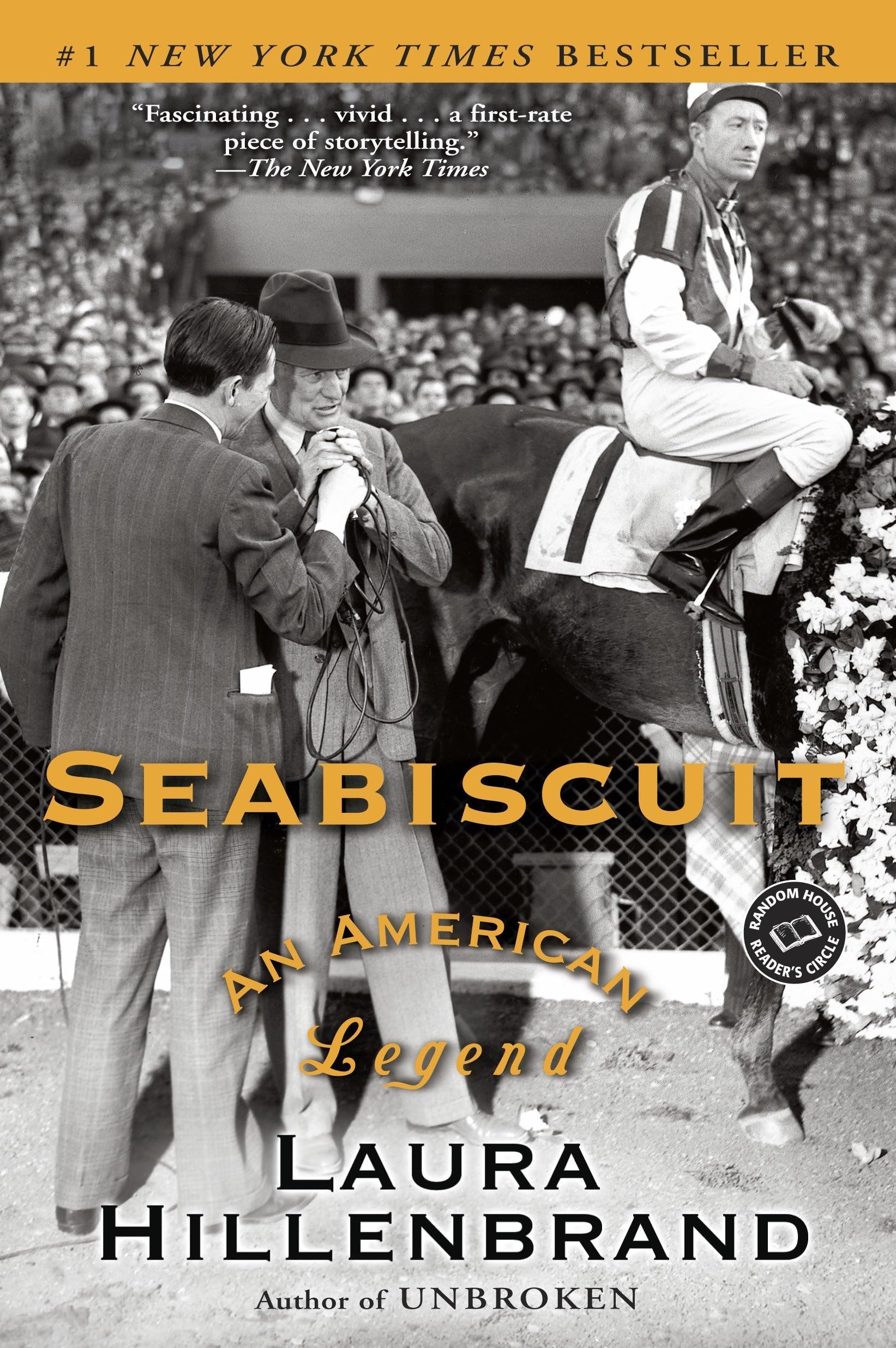
Seabiscuit: An American Legend (Ballantine Reader's Circle)
Product ID: 1356748
🏆Underdog triumph
🏇Legendary racehorse saga
📚Top-ranked storytelling
Desertcart purchases this item on your behalf and handles shipping, customs, and support to USA.
🏇 Ride the legendary comeback that redefined American sports history!
Seabiscuit: An American Legend by Laura Hillenbrand is a bestselling, critically acclaimed biography that chronicles the incredible journey of Seabiscuit, a modest racehorse turned national icon. Blending rich historical detail with compelling human stories, this book captures the grit, drama, and triumph of 1930s American horse racing, making it a must-read for sports enthusiasts and history buffs alike.


| Best Sellers Rank | #40,250 in Books ( See Top 100 in Books ) #2 in Horse Racing (Books) #10 in Sports History (Books) #123 in United States Biographies |
| Customer Reviews | 4.6 out of 5 stars 4,640 Reviews |
S**S
The Original Racetrack Cinderella Story
Laura Hillenbrand is a wordsmith of the top rank. She has written a great book about a horse who has largely been forgotten except by veteran racing fans: Seabiscuit. Seabiscuit, a descendent of the legendary Man O' War, had a rather modest racing career at the beginning having started from the claiming ranks. Thanks to a great trainer, he galloped his way up to the stakes level after having literally dozens of races under his girth. Seabiscuit was not the only colorful character in this claimer-to-champion saga. His trainer Tom Smith was a controversial character who loathed publicity and yet at the same time encouraged it. For example, Hillenbrand's stories of Smith's attempts to thwart the media and racing timers from reporting Seabiscuit's workouts (because Smith feared the weights assigned by the track would be so great as to hamper the horse's considerable ability) are hilarious. Seabiscuit's regular jockey, Red Pollard, was a man who loved to quote Shakespeare but also had to cover up a disability that may have contributed to one of Seabiscuit's most famous losses: Pollard was blind in one eye. Like most jockeys he battled a weight problem. (In one chapter, Hillenbrand writes brilliantly and humorously of the struggle of jockeys like Pollard to make the unnaturally low weights required of racing.) Finally, Seabiscuit's millionaire owner, Charles Howard, was perhaps the least colorful of the horse's connections, but he lost faith in neither Smith nor Pollard. He was the glue who held this unlikely hodgepodge together. Hillenbrand slowly but very entertainingly works the Seabiscuit story to the legendary 1938 match race with yet another descendent of Man O' War, 1937 Triple Crown winner War Admiral. She doesn't ignore the Admiral's connections either. Sam Riddle comes to life, as do the horse's infamous temper tantrums on the racetrack. There are constant difficulties in getting the two great horses together on the same track on the same day, including jockey Pollard's injuries (vividly described by Hillenbrand), Seabiscuit's injuries, and other delays. When the horses finally do get together (with the underdog Seabiscuit clobbering the Admiral), Hillenbrand writes with such vividness that you feel you are right there at the track witnessing the race. (She was fortunate enough to have obtained rare footage of this race and several other Seabiscuit races.) After the climax of this famous race, Hillenbrand continues the Seabiscuit saga to the deaths of the principals. On the last page she writes of Howard having buried Seabiscuit to a secret site at his ranch where he had an oak sapling planted where the great horse was buried. She writes: "He told only his sons the location of the grave and let the oak stand as the only marker. Somewhere in the high country that was once Ridgewood, the tree lives on, watching over the bones of Howard's beloved Seabiscuit." What a great writer. What a read.
P**P
Superb!
Even if you have no interest in horses or horse racing, this book is so wonderful it will grab at your heart and leave it thumping as you ride with the jockeys on the incomparable Seabiscuit. You'll find the horrible existence of the jockeys before there was medical insurance or protective headwear appalling, but there's something magical about these guys and horses- they know their horses as well as a modern fellow would know his car. George Woolf, one of the greatest jockeys who ever lived rode a horse as though he and the animal were one, a centaur. Author Hillenbrand's descriptions of how it must feel to have a 40 mile an hour machine under you will put you right in the saddle. You know Seabiscuit is going to beat War Admiral when the two are matched up for the famous Pimlico race but the author gives a thrilling description of that pivotal event and you almost feel sorry for War Admiral who did the best he could, both horses setting track speed records. But Seabiscuit sort of thumbed his nose at the Admiral, spooking him, and pulled away. The humans in the story are no less compelling. Charles Howard the former bicycle repairer who became a millionaire and sentimental owner of Seabiscuit. Tom Smith the trainer, who virtually never smiled, never said much but knew the soul and heart of a horse and often slept right in the stall with his charges. Seabiscuit was not only small for a thoroughbred, he had knobby knees, a scruffy tail, had a bad temper and given to sulking and acting up. Smith had an instinct. He saw in Seabiscuit what a horse whisperer sees- he saw the power. Smith turned Seabiscuit into a horse of a different color. The two jockeys who rode the Biscuit- George Woolf and Red Pollard, played him like a violin. But the price was high: Red was frightfully injured in accidents on the track and had been blinded in one eye by a rock one of the horses kicked up during a race. (Now of course jockeys wear protective helmets). Red, although his leg had been shattered, and earlier his chest caved in by a horse that fell on him, rode Seabiscuit to victory in the Santa Anita Handicap. Woolf, who was a diabetic in the days before the disease could be controlled, apparently fainted while riding in a race, slipped from the saddle and fell to the ground. He died the next day. There was romance in being a top jockey but also a horrible reality and enormous danger. The sport of kings took a huge toll in the days before insurance and protective gear. Nowadays a little of the romance is gone but this splendid book will put the romance right in your lap.
W**R
A very enjoyable story
I thoroughly enjoyed reading this book and hearing about these people and this horse, although I am not a big horse racing fan. This is a well written book, and I enjoyed getting to know them.
K**Y
'Come on Dover, Move Your Bloomin' ...!!!
I just found out about this absolutely magnificent book last month. I was channel surfing, and ran across the Laura Hillebrand interview on C-Span. I was immediately mesmerized by the name 'Seabiscuit' and listened intently to the story of how the book was done, saw the Seabiscuit memorabilia Miss Hillebrand brought to the interview, and was fascinated with the facts of the horse himself, what he did, and how it came about. I immediately ordered the book. It is a fascinating story of the little horse that could, his rich owner, the extraordinary man who trained him, and who could talk to horses, and the tragic, magnificent jockeys who rode him in his famous races. All I could say when I finished the book was, 'What a horse!' It is a story straight out of Hollywood, but this is the real thing. As unlikely a partnership that ever was found the soon-to-be-great horse, bought him, trained, him, rode him, and loved that stellar animal that mesmerized Depression-ridden America in the mid-to-late thirties. No matter what others may say, there was only one Seabiscuit, and there is only one book to get on him-this one. He may have been the greatest race horse the United States ever produced, bar none. The author is a magnificent story-teller. Except in Dick Francis novels (and he was a jockey) I have never read the stride-for-stride descriptions of horse races that the author here discribes. You actually hold your breath as you read the passages, and you end up reading them so fast to see who wins, you have to go back and reread them so as not to miss anything. Miss Hillebrand is one of the three best authors I have ever read, and she has captured the spirit of her horse, those who were closest to him, and the spirit of the times in this very well-done book. I certainly hope she continues to write, and I will look forward to her next effort with great anticipation. This is one of the best books of this or any other year. This is one of the great horse stories of all time, and if you don't read it, you are missing out on both a literary treat, a great American saga, and a first-rate read that is impossible to put down. If you love horses and stories about them, or just love a great read, this is the book for you. It deserves the Pulitzer.
B**M
A Thrill On Every Page
A story about a horse that celebrates the triumph of the human spirit, "Seabiscuit" is almost too good to be true. Yet Laura Hillenbrand's 2001 book about an ungainly thoroughbred who would win 33 races and upend a sport comes with generous footnotes that tether it to reality. Even so, the book starts with a bit of a whopper: The claim Seabiscuit was a bigger newsmaker in 1938 than FDR or Hitler. Snopes.com picks this one apart, though it doesn't change a jot of my admiration for the book or its author. Some authors work with dry data and musty factoids. Hillenbrand resurrects passions and reassembles the texture of the times from living memory. You may get a tall tale or two, but more important is an immersive feeling of what it was like to have been a witness to something so ridiculously grand and heart-tugging. As much as the book is about the horse, it's even more about his most regular rider, the half-blind, busted-down, habitually unlucky Red Pollard. When Pollard and the Biscuit came together, history was made, and made again. Hillenbrand puts you with Pollard in the saddle. "With the crowd on its feet, Pollard spread himself flat over Seabiscuit's withers, reins clutched in his left hand, right hand pressed flat to Seabiscuit's neck, head turned and eyes fixed on Professor Paul's broad blaze," she writes. The fact Pollard suffered so much to get where he was comes across vividly. Hillenbrand herself suffered from a decades-long chronic exhaustive condition while writing this, and seems to channel her experience in Pollard especially, "sinking downward through his life with the pendulous motion of a leaf falling through still air." It accounts for some undeniable lack of critical reserve, but at the same time, her poetic turns of phrase and ability to lay out the technical dimensions of the sport and of Seabiscuit's abilities (including the horse's unorthodox, swivel-legged gait) break through the jargony boundaries of horseracing in high, readable style. About the most difficulty I've had reading this book (three times already) is from the fear of getting my heart broken, even when I think I know what happens next. Seabiscuit was no natural world-beater; he lost to more than a few horses and was an underdog from his earliest racing days to his final run. Pollard got injured so badly on a racetrack he was thought to be at death's door, then went back only to suffer another catastrophic injury that everyone but Pollard thought had ended his career. "Getting back on the horse" is a common term these days; Pollard's story gives it deeper meaning. In Seabiscuit he found his ticket to glory, with Hillenbrand you get to share his ride.
C**R
ONE THRILLING RIDE FROM BEGINNING TO END
I'm one of those racing fans that the tracks just hate. I love watching the beauty of the horses running, & then I worry about the horses that don't win. I never bet or get into the money or snobbery aspect of racing which is probably why I saw the movie & didn't bother to read the book until recently. I liked the movie, but I purely LOVED the book! It was one of those books that you try to stretch out as long as you can, yet you can't wait to get back to reading, & then miss it like heck when you do finish. For starters, Laura Hillenbrand's writing is remarkable. Even though I thought I knew the story-and there was so much more to it-it still held my attention from the very first page to the last. Her choice of words was particularly descriptive. The train didn't puff into the station; it groaned. In the match race between Seabiscuit & War Admiral, War Admiral "scratched & tore at the track" & Seabiscuit "drove over the track, his forelegs pulling the homestretch under his body & flinging it back behind him." These are perfect action words. Her description of trainer, Tom Smith is pure poetry: "He had a colorless translucence about him that made him seem as if he were in the earliest stages of progressive invisibility." Reading the author's descriptions of the races isn't like watching the race. It is more like viewing it from the back of the horse, & all the excitement is that much more heightened. "Seabiscuit" engages your heart from the start--for the characters & certainly for the horses. And when Red Pollard is severely hurt-which he is again & again, when Seabiscuit is injured at Santa Anita while under George Woolf & later when Woolf is killed, your heart your heart cries. Many times I had to remind myself that these events were unfolding more than 60 years ago because Hillenbrand makes them seem so immediate. Last, but certainly not least, is the inspiration of the story. What was it that made Red Pollard get back on a horse after nearly dying twice. (I do wish she had mentioned what happened to Modern Youth, the horse Red was thrown from in the barn.) Where did they get the stamina to continue? Whenever I think I can't go on, I'll think of these people. Some reviewers say even those who aren't into horse racing will like this book. I'm not sure I agree, but reading this book might just make a racing fan out of you.
B**Y
amazing, inspirational book!
The story of Seabiscuit, his owner, trainer and the two jockeys who rode him is a story I will never forget - and in fact, it gives me courage at this time in history. Extraordinary men and an extraordinary horse in extraordinary circumstances at a time in history (the Great Depression of the 1930s) when hope - similar to current times in 2024 - was in short supply, came together to produce a story that would be nearly unbelievable if it were fiction. Laura Hillenbrand is also an extraordinary writer who is able to bring the personalities, emotions and excitement in the story of Seabiscuit to life. So glad I had not seen the movie or knew much about Seabiscuit prior to reading this book.
E**T
The little horse that could
If you think Steinbeck's fictional Joad family had a tough time during the Great Depression, read Laura Hillenbrand's "Seabiscuit" to find out what it was like to be a down-at-the-heels jockey or trainer trying to make a living from `The Sport of Kings' back in the 1930s. Hillenbrand not only gives her reader a fresh perspective on the Depression, she also lets us into the hearts and minds of three men and one great racehorse. Before reading this book, I had the vague notion that Seabiscuit was a gelding who won a big match race against War Admiral. Okay, I thought, so Seabiscuit got lucky. War Admiral was a triple-crown winner, and even War Admiral's sire, the immortal Man O'War lost one race. I could not have been more wrong (for one thing, Seabiscuit was a stallion). In some respects, Seabiscuit was like the Depression-era survivors who filled the stands to watch him: hard-bitten, tough, struggling to win in spite of bad knees and the weight that race-track stewards piled onto his back when he began to win. The bay colt started thirty-five (!) times at age two, and evidently impressed no-one as he could have been claimed for $2,500 more than once. At age three, when trainer Smith bought him for his new owner, Buick-dealer Charles Howard, he paid $7,000 for a colt whose, "... body, built low to the ground, had all the properties of a cinder block. Where Hard Tack [Seabiscuit's sire] had been tall, sleek, tapered, every line suggesting motion, his son was blunt, coarse, rectangular, stationary. He had a sad little tail, barely long enough to brush his hocks. His stubby legs were a study in unsound construction with squarish, asymmetrical `baseball glove' knees that didn't quite straighten all the way, leaving him in a permanent semicrouch." Paging through old issues of "The Blood-Horse," I see that Seabiscuit at age three was described as `useful.' It was not until the colt turned four that his rags-to-riches fairy tale truly began. At four and five he was one of the best handicap horses in training, although he lost the Santa Anita Handicap (the `Big Cap') twice in close finishes---and this was the one race that his owner, Charles Howard had set his heart on winning. The fairy tale might have ended when Seabiscuit turned six---he injured his knee and was retired to stud. But his owner never gave up hope. Read this marvelous book to see what Seabiscuit, his owner, trainer, and jockeys accomplished when the rugged, little stallion turned seven---well past the retirement age for most Thoroughbreds.
Trustpilot
1 day ago
2 weeks ago