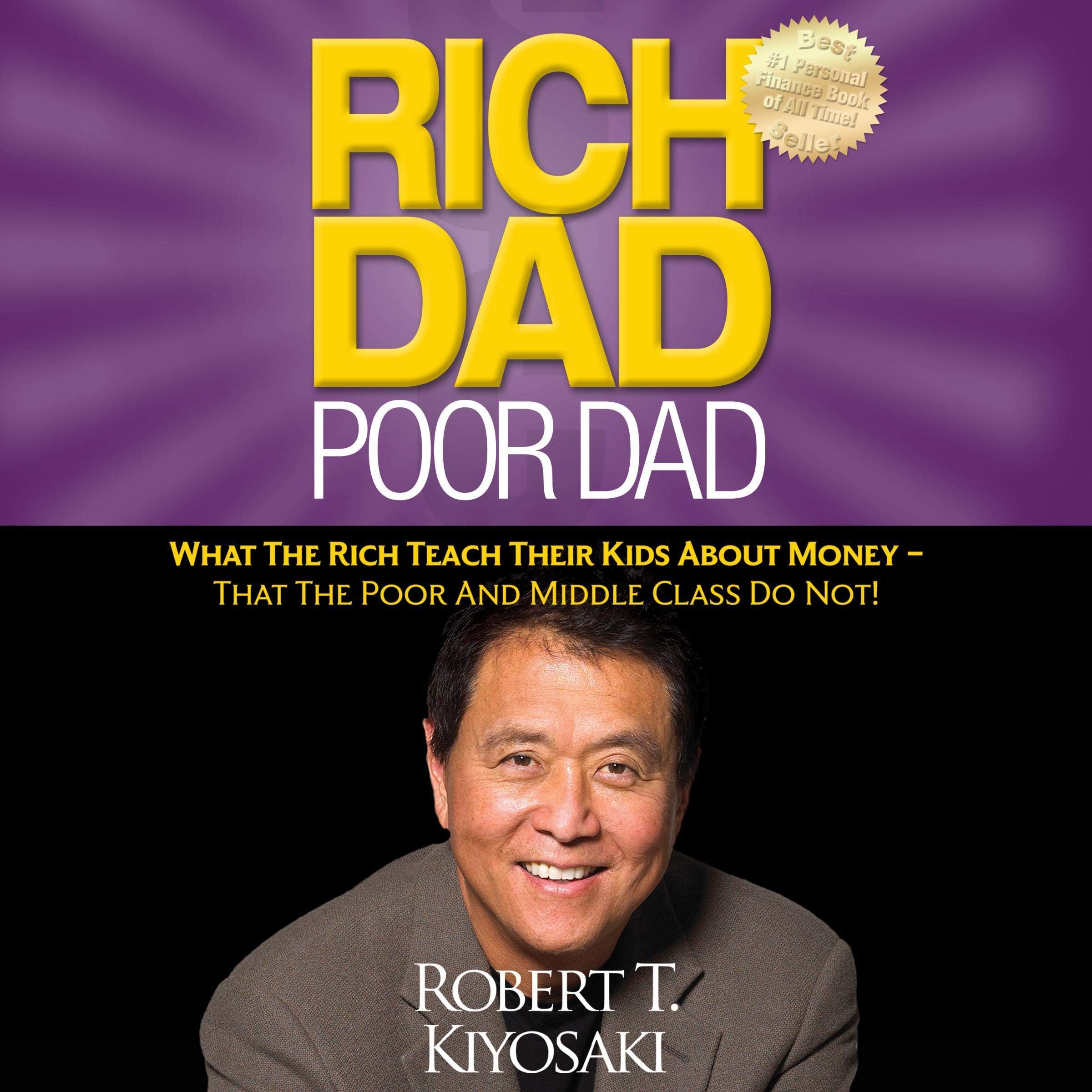
Rich Dad Poor Dad: What the Rich Teach Their Kids About Money - That the Poor and Middle Class Do Not!
Product ID: 1274355
Desertcart purchases this item on your behalf and handles shipping, customs, and support to USA.
Rich Dad Poor Dad is the #1 personal finance book of all time. Listen today to set yourself up for a wealthy, happy future. Robert Kiyosaki’s easy tips and straight talk will… Explode the myth that you need to earn a high income to become rich Challenge the belief that your house is an asset Define once and for all an asset and a liability Show parents why they can’t rely on the school system to educate kids about money Clearly lay out what to teach kids about money for their future financial success With an incredible number of 5-star reviews, Rich Dad Poor Dad has challenged and changed the way tens of millions of people around the world think about money. With perspectives that often contradict conventional wisdom, Kiyosaki has earned a reputation for irreverence and courage. He is regarded worldwide as a passionate advocate for financial education. His easy-to-understand audiobook empowers you to make changes now - and enjoy the results for years to come. "The main reason people struggle financially is because they have spent years in school but learned nothing about money. The result is that people learn to work for money… but never learn to have money work for them." --Robert Kiyosaki Rich Dad Poor Dad - The #1 Personal Finance Book of All Time! “ Rich Dad Poor Dad is a starting point for anyone looking to gain control of their financial future.” -- USA Today Review: Enriching read! - Hey there all, I recently completed reading Rich Dad Poor Dad: What The Rich Teach Their Kids About Money That the Poor and Middle Class Do Not!. Let me tell you that this book has been in my peripheral vision for quite some time. Or at least the title of it has been! I finally read it and found that it completely fits in my current learning cycle, so there was much that I was able to readily see and almost immediately able to apply. First off I will preface this with a fact that the title always sounded to me like it was how to transform yourself from a poor dad to a rich dad. This was not so. Although it has the information within to create that transformation, at least if you choose to apply some fo the principles, and of course in theory! Know this, though, this is not a rags to riches overnight book. It is a journey over a fair span of a lifetime. Robert T. Kiyasaki tells his tale as a young man growing up in Hawaii, his paternal father being a well-educated man who throughout this book always seems to be on the verge of monetary disaster, even though he followed in seemingly appropriate steps required to climb the ladder to success. His adopted father had the school education of 8th grade; what his adopted father had was a key understanding of finance, of assets, debits, expenses etcetera and had over time become incredibly wealthy. Now how Robert came to adopt rich dad is by way of Rich Dad's son Mike. The two of them were close friends and at a young age (3rd grade). They had made the decision that they would like to become rich. The wanted to make money. Which is what they quite literally did attempt to do. They went around and collected empty toothpaste tubes, created a cast, and began to mint their own nickels. Rich dad saw this and while found the overall situation to be humorous, he informed them of the imposing legalities of their situation and offered to have them stop by his office to work for him. Initially, the boys worked for him for a very low wage, 10c an hour! After some time, Rober becomes fed up and demands a raise or else he is going to quit. Whereby rich dad imparts a critical lesson: Most people will work for the money and if they don't receive the respect or monetary wage that they feel is appropriate, they will go elsewhere. However, once they do so, they find themselves in the same situation. They were more than likely going to accept a paycheck knowing that they will struggle financially. Some may even take a second job, working harder and still accepting a measly gain. Robert asks "So what will solve the problem?" Rich dad points to his head and says "This stuff between your ears." All of this is distilled into what Robert calls lesson #1 : "The poor and the middle-class work for money. The rich have money work for them." What's entertaining is that immediately following this even, rich dad has the boys work for him for free! This imparted the lesson that you work to gain knowledge, not necessarily money AKA the rich don't work for money. He then proceeds to illustrate in the book through a few diagrams of how the rich and poor view their money in a cash flow pattern and how the poor view the job as income and expenses as food, shelter, transport, etc, neglecting the assets and liabilities columns. The middle class is fairly similar with income being received for their job, however, they do tend to recognize the liabilities column. Where the rich differ is that they have an assets column in which you will find stocks, bonds, real estate and intellectual property which will provide them with their income, which they continue to invest into more assets. Assets create wealth. Seems like a fairly simple formula. The major takeaway here is not so much that assets create wealth, it's how to identify an asset, that little gem didn't really seem to present itself clearly while reading, but it is there nonetheless! These views and philosophies are fully fleshed out in the remainder of the book, denoting that most or many will fall prey to the ongoing rat race whereby they build a substantial amount of debt through poor financial education and ultimately have to work in order to stay the course. Rarely being able to lift above and see a way out. Robert offers some alternative views on how we are taught to view finances, and not everyone may agree nor may follow his advice. He does suggest that if you are not willing to take risks and prefer to follow another route, that you should begin at a very young age to invest. It may take a while longer to create a fortune for yourself, however, it is the recommended way! I don't think that you can look anywhere in the financial world and that same advice is not given! While this touches on the surface of what is in this book, I do hope that it whets your appetite to continue to read even if it is to teach your children or others about financial literacy. Overall the book was a simple read with an easy flowing storytelling style, and it filled my own head with plenty of food for thought! On a scale of Rich Dad to Poor Dad, I found this to be a fairly enrichening read! Review: Brief, easy to follow method to learn about how to make money work for you! - Kiyosaki does a tremendous job simplifying the seemingly complicated dynamics of money. He does make it sound easy, but like many of the countless analogies he uses, it just takes a little practice, experience, and motivation to start. Like riding a bicycle or playing baseball, after a while you get the hang of it and it will "look easy" to others not familiar with the many opportunities that could have money work for you. That's the motiff throughout the book: finding ways to make money work for you. He begins with an explanation of how he had two dads, one whose rich and one poor (biological). Kiyosaki does a seamless job comparing the two dads he had growing up, drawing comparisons and contrasts as the book progresses. It gives the reader an idea of characteristics that tend to come with the wealthy and the poor. Some of the topics that he covers are : myths about money, the traditional view that getting good grades and finding a job to work for money isn't enough, taxes and the secrets of the rich, and of course, his tips and mentalities as to how to have money work for you. I found myself easily going through the chapters. He writes with a very colloquial tone, friendly almost. He really wants you to understand the concepts, perhaps change some of your habits, and if you not, pass on some knowledge and wisdom about money to your children. He speaks with a lot of wisdom, and again, he makes real estate investing, stocks, and owning corporations and business sound very easy. That's not much of an issue though, because he encourages you to start somewhere and take smart, educated risks. In the end, I'm left reading this book with a feeling of inspiration, knowledge, and an "ah-ha" moment. The financial intelligence he refers to in his book is all within us. We've just got to break some old habits (if not, just stick with some safer decisions), learn about investment opportunities, don't listen to everyone who tells you otherwise, and to start somewhere. After you've read this book, your journey isn't finished. He advises that you learn as much as you can and take smart risks. Well written book, great narrative and insight, and definitely a life-changing type of a book. You will feel invigorated and ready to take your life to the next step.
B**Y
Enriching read!
Hey there all, I recently completed reading Rich Dad Poor Dad: What The Rich Teach Their Kids About Money That the Poor and Middle Class Do Not!. Let me tell you that this book has been in my peripheral vision for quite some time. Or at least the title of it has been! I finally read it and found that it completely fits in my current learning cycle, so there was much that I was able to readily see and almost immediately able to apply. First off I will preface this with a fact that the title always sounded to me like it was how to transform yourself from a poor dad to a rich dad. This was not so. Although it has the information within to create that transformation, at least if you choose to apply some fo the principles, and of course in theory! Know this, though, this is not a rags to riches overnight book. It is a journey over a fair span of a lifetime. Robert T. Kiyasaki tells his tale as a young man growing up in Hawaii, his paternal father being a well-educated man who throughout this book always seems to be on the verge of monetary disaster, even though he followed in seemingly appropriate steps required to climb the ladder to success. His adopted father had the school education of 8th grade; what his adopted father had was a key understanding of finance, of assets, debits, expenses etcetera and had over time become incredibly wealthy. Now how Robert came to adopt rich dad is by way of Rich Dad's son Mike. The two of them were close friends and at a young age (3rd grade). They had made the decision that they would like to become rich. The wanted to make money. Which is what they quite literally did attempt to do. They went around and collected empty toothpaste tubes, created a cast, and began to mint their own nickels. Rich dad saw this and while found the overall situation to be humorous, he informed them of the imposing legalities of their situation and offered to have them stop by his office to work for him. Initially, the boys worked for him for a very low wage, 10c an hour! After some time, Rober becomes fed up and demands a raise or else he is going to quit. Whereby rich dad imparts a critical lesson: Most people will work for the money and if they don't receive the respect or monetary wage that they feel is appropriate, they will go elsewhere. However, once they do so, they find themselves in the same situation. They were more than likely going to accept a paycheck knowing that they will struggle financially. Some may even take a second job, working harder and still accepting a measly gain. Robert asks "So what will solve the problem?" Rich dad points to his head and says "This stuff between your ears." All of this is distilled into what Robert calls lesson #1 : "The poor and the middle-class work for money. The rich have money work for them." What's entertaining is that immediately following this even, rich dad has the boys work for him for free! This imparted the lesson that you work to gain knowledge, not necessarily money AKA the rich don't work for money. He then proceeds to illustrate in the book through a few diagrams of how the rich and poor view their money in a cash flow pattern and how the poor view the job as income and expenses as food, shelter, transport, etc, neglecting the assets and liabilities columns. The middle class is fairly similar with income being received for their job, however, they do tend to recognize the liabilities column. Where the rich differ is that they have an assets column in which you will find stocks, bonds, real estate and intellectual property which will provide them with their income, which they continue to invest into more assets. Assets create wealth. Seems like a fairly simple formula. The major takeaway here is not so much that assets create wealth, it's how to identify an asset, that little gem didn't really seem to present itself clearly while reading, but it is there nonetheless! These views and philosophies are fully fleshed out in the remainder of the book, denoting that most or many will fall prey to the ongoing rat race whereby they build a substantial amount of debt through poor financial education and ultimately have to work in order to stay the course. Rarely being able to lift above and see a way out. Robert offers some alternative views on how we are taught to view finances, and not everyone may agree nor may follow his advice. He does suggest that if you are not willing to take risks and prefer to follow another route, that you should begin at a very young age to invest. It may take a while longer to create a fortune for yourself, however, it is the recommended way! I don't think that you can look anywhere in the financial world and that same advice is not given! While this touches on the surface of what is in this book, I do hope that it whets your appetite to continue to read even if it is to teach your children or others about financial literacy. Overall the book was a simple read with an easy flowing storytelling style, and it filled my own head with plenty of food for thought! On a scale of Rich Dad to Poor Dad, I found this to be a fairly enrichening read!
D**Y
Brief, easy to follow method to learn about how to make money work for you!
Kiyosaki does a tremendous job simplifying the seemingly complicated dynamics of money. He does make it sound easy, but like many of the countless analogies he uses, it just takes a little practice, experience, and motivation to start. Like riding a bicycle or playing baseball, after a while you get the hang of it and it will "look easy" to others not familiar with the many opportunities that could have money work for you. That's the motiff throughout the book: finding ways to make money work for you. He begins with an explanation of how he had two dads, one whose rich and one poor (biological). Kiyosaki does a seamless job comparing the two dads he had growing up, drawing comparisons and contrasts as the book progresses. It gives the reader an idea of characteristics that tend to come with the wealthy and the poor. Some of the topics that he covers are : myths about money, the traditional view that getting good grades and finding a job to work for money isn't enough, taxes and the secrets of the rich, and of course, his tips and mentalities as to how to have money work for you. I found myself easily going through the chapters. He writes with a very colloquial tone, friendly almost. He really wants you to understand the concepts, perhaps change some of your habits, and if you not, pass on some knowledge and wisdom about money to your children. He speaks with a lot of wisdom, and again, he makes real estate investing, stocks, and owning corporations and business sound very easy. That's not much of an issue though, because he encourages you to start somewhere and take smart, educated risks. In the end, I'm left reading this book with a feeling of inspiration, knowledge, and an "ah-ha" moment. The financial intelligence he refers to in his book is all within us. We've just got to break some old habits (if not, just stick with some safer decisions), learn about investment opportunities, don't listen to everyone who tells you otherwise, and to start somewhere. After you've read this book, your journey isn't finished. He advises that you learn as much as you can and take smart risks. Well written book, great narrative and insight, and definitely a life-changing type of a book. You will feel invigorated and ready to take your life to the next step.
B**Y
Learn how to handle money
Robert Kiyosaki opens up the world of the elite class in his book Rich Dad, Poor Dad. I’ve gotten to know how the finically intelligent brain looks at problems; it’s far different than how the middle and lower classes are taught to think. Recounting his youth of growing up on Hawaii, Kiyosaki compares his real poor father’s lessons about money to that of his friend’s rich dad. Robert keeps his advice interesting through a montage of flashbacks which is refreshing when compared to other writers that use the same format or story for multiple ideas throughout their book. He is very interactive with his writing which engages you to read on. Kiyosaki is surprisingly talented with his authoring it feels as though you have sat down for a conversation with a mentor. Possibly the best part about Kiyosaki’s book is that he is giving information but not forcing you to believe in the same ideas that he does. As a high school sophomore I feel quite luckily that there are easy to understand books like Robert’s to teach about finical intelligence on a level that I would understand since I haven’t handled money as much and don’t know all the lingo in other popular finance books. I think all teens should read this book since we are often not taught this knowledge in school and it shows how capitalism works. This book would be ideal for adolescent that will have to start handling money in the near future, however, I would recommend it to everyone looking to understand finance. I feel as though Kiyosaki has made this an easy guideline for young adults to comprehend where all of their money it coming and going through teaching about liabilities, expense, income and assets through his 10 steps. Robert also makes a good point that finical intelligence it critical to live even if you work a 9 to 5 job because, you will know where to put money. Unfortunately finical awaken is not taught in schools so it leaves many kids being thrown into the corporate world straight out of college with $80000 worth of student loans. That is why young people should read this book, to understand how not to get trapped. However, the only downfall to Robert’s book it that it heavily relies on anecdotes which, is also its greatest glory. If you are looking for a book to tell your how to start a business or enter the stock market this is not it. Rich Dad, Poor Dad is about how to preserve money and create more income with what you have. He of course cannot make an outline for you to make a company or a personalized savings plan that is your problem. This book can be a small piece to help find what you were doing wrong and strategize a way to solve your finical issues. Since there is not much specific data behind what makes a millionaire/billionaire it makes sense that Kiyosaki uses personal memories to convey his knowledge of money. Definitely a four out of five stars book.
M**N
Good info to know.
Great book. Wish I knew these secrets 30 years earlier.
K**Z
Great book
This book was brought to my attention by my business coach at Spectacular Business School, it is a Program that help me you create any business under the sun & assist you and teach you how to run it, advertise, create AI videos that get thousands of views and a lot more. During the beginning of the program they work with how we think about money because many of us have not had a good relationship with money and if we don’t have a good relationship with money, we cannot create money. This book was one of those books that shows how the writer had a dad that taught him how to have a good relationship with money (Friends dad) and the other dad Is his real dad that taught him the mentality of money don’t grow on trees. If you are a person that is working at creating wealth for yourself, this is one of those books that will teach you what you need to create wealth
K**R
So valuable
I wish I had this book as a teen. I really learned so much from this book, breaking down valuable lessons of how to look at FINANCES!!!! I highly recommend that EVERYONE read this book, unless they are wealthy, and have been wealthy for many years.
T**R
Changed my life !
This is a great book and more importantly the advice actually works when consistently applied. Robert's advice helped me start two small businesses and become financially free (not rich, but free form needing a job) when I was around 26 yrs old. I had an excellent lifestyle but screwed it up through lack of self-discipline and financial IQ. I have since went back into the workforce(rat-race) and am rebuilding my asset column and moving towards financial freedom once again. ***On to the book*** RichDad PoorDad is about the financial advice the author was given from his biological dad which he calls is poor dad and his best friend's dad which he calls his rich dad. The core of the book centers around the 6 Lessons of the Rich which are as follows: Lesson #1 - The rich don't work for money The poor and the middle class work for money the rich have money work for them. Lesson #2 - Why teach financial literacy? If you want to be rich you need to be financially literate. Lesson #3 - Mind your own business The rich focus on acquiring income producing assets. KEEP your day job but focus on building your personal investment portfolio (what the author calls minding your own business) Lesson #4 - The history of taxes and corporations The rich understand and take advantage of the tax benefits of having a corporation. Lesson #5 - The rich invent money Train your mind to make (or invent) money instead of work for it. Great opportunities are seen with the mind not your eyes. Lesson #6 - Work to learn-Don't work for money Work more for what you will learn then what you will earn. Focus on acquiring the skills you need for your future success in the present. Don't get stuck complacent in the rat race. After these six lessons Robert spends the rest of the time covering pitfalls to avoid and providing practical tips on getting started. I have tons of notes from this book but a few practical ideas stood out to me, I even taped them on my wall at home. 1. "Poor people have poor habits. A common poor habit is innocently called "Dipping into Savings." The rich know that savings are only used to create more money not to pay bills." ***Yes, have an emergency savings account for unexpected bills and the like but also have a financial freedom account that you save money from each paycheck specifically to create more wealth NEVER to be used for any other expenditure.**** 2. "Financially, with every dollar we get in our hands, we hold the power to choose our future to be rich, poor or middle class. Our spending habits reflect who we are. Poor people simply have poor spending habits." 3. "Keep your day job but focus on building the asset column." Sorry for the long review but this little 10.00 book has literally changed my philosophy about money, made me thousands of dollars and more importantly will be the catalyst for breaking the cycle of poverty in my family forever as I pass the principles down to my kids. I recommend the book along with RichDad PoorDad part 2 which is titled CashFlow Quadrant. Best wishes on your journey to freedom! Tony Rogers Jr Author of Visionary:Making a difference in a world that needs YOU
D**N
Classic Business Book
This is a classic. If you are interested in being an entrepreneur/investor and currently are not this is a good first book to read. Its not the greatest though. In my opinion after reading many business books the Fast lane Millionaire by M.J Demarco beats them all 100%. Rich Dad Poor Dad still is a classic that I recommend reading. Rich Dad Poor Dad is based on the two influential people that Robert Kiyosaki had in his life: his biological dad (Poor Dad), and his business mentor (Rich Dad). In his book Robert explains how each "Dad" believed that money should be earned with a job or created with business. One dad lived out of scarcity, and one lived out of abundance. The whole idea of having a rich dad and a poor dad conveys the fact that "we (regular people)" are capable of choosing what mental framework and financial I.Q we develop. We can chose to trade our time for money via a profession, or we can build a proper "business" that works for us. In Rich Dad Poor Dad, Robert teaches financial literacy by explaining: assets, liabilities, income, expenses, balance sheets, income statements and how they relate to cash flow/ building wealth. His ideas about assets: things putting money in your pocket, and liabilities: things taking money out of your pocket are controversial in an accounting background, however for the purpose of building wealth adopting this mentality can be a tremendous asset itself (: In his book Kiyoski also talks about the importance of building your own business, the history of taxes, the power of corporations, strategies to inventing money as an investor/entrepreneur using a business, and working a job (if you must) to learn more then you earn. In the end of his book Kiyosaki explains how to overcome obstacles and to get started on your path to being an entrepreneur. Be forewarned Robert Kiyosaki approves of: MLM (Multi Level Marking) / Network Marketing / Pyramid Schemes (called by some). His attitude toward MLM is conveyed in his writing. For companies like Amway/ALTICOR, AVON, etc. there are hundreds. Kiosaki is a go-to-guy. Kiyosaki has a book called: Business of the 21st Century that is dedicated to MLM companies. I don't blame him (: he has made millions selling the books. My opinion:If you really want to be an entrepreneur you should be building and owning pyramids not climbing them. If you create a great product: MLM are a wonderful distribution channel.
A**K
Personal Investment Fundamentals explained brilliantly
Kiyosaki's advice on the importance of building assets to accumulate wealth is a revelation to those of us in the middle class. I first read Kiyosaki's Rich Dad Poor Dad book more than 10 years ago, when I had just started my career. Though a lot of what was mentioned went above my head initially, I could soon imbibe the brilliance of what Kiyosaki was trying to convey. Even now, as I re-read the book again, I can see that what Kiyosaki's advice is based on two sound financial principles. -------------------------------------------------------------------- 1. Importance of building assets over liabilities -------------------------------------------------------------------- Middle class tends to focus on acquiring best education, in the form of prestigious degrees. With better education comes the need for higher living standards, which mean build up of liabilities like expensive cars, club memberships etc, which drain one of money. Kiyosaki illustrates how to build assets using his personal story - his biological dad who was highly educated, but ended up being broke; while his other dad (friend's dad) who was not that educated, but went on to become really rich. ---------------------------------------------------- 2. Importance of financial education ---------------------------------------------------- Kiyosaki explains the need for people to understand the basic tax laws, various financial instruments. Though this book barely scratches the surface when it comes to explaining any of these concepts, it is a very good starting point for anyone who is concerned about learning to build wealth. Remember - this book is not a silver bullet that will solve all your financial woes. This book encourages behavioral change, asking everyone to invest more in assets that can then build even more assets. Use this book as a starting point. However, I will say that this book is a must read for any employed middle class professional.
L**R
Inspiring and useful - but only if you have a positive attitude and can make short term sacrifices
This is without doubt the most powerful book I have ever read on personal finance, it has changed my mindset overnight. I genuinely have no idea how anyone could give this book less than 5 stars. I have read some of the 1-star reviews and they seem like some incredibly negative people with 'can't do' attitudes. I purchased this book based on the number of property investors (UK) who have started their journey based on the theory behind this book. I have read it for the first time this week and was so impressed I read it a second time. This book clearly states the mindset you need in order to increase your wealth over time and having read this I fully appreciate it makes perfect sense. I am the 'middle class' that he talks about in the book, I have a good job (my 'profession') and also run a company (my 'business') and this book is a real eye opener to what I have been doing wrong all these years to achieve real wealth. It is all too easy to make excuses for yourself, but in reality everyone can afford to increase their wealth even if it is investing £10 a month towards your future. We all have bad habits or non-essentials we can cut back on if we want to. My advice is to read this book with an open mind, and if you don't feel you want to buy it then see if your local library has one. But if you have a negative attitude and struggle to see good advice when it is in front of you then save yourself the time and don't bother. 5*. Thanks Robert.
C**N
The Best book I've read in my life, please read it, it will change the way you see things.
Im 15 and understood everything in the book. It shows you the difference between his rich dad and poor dad. And gives lessons on how the rich have money work for them and the poor work for money. Please don't even think about it
C**D
A must for anyone who wants to quit the rat race
I wish to all the young people to access to this knowledge in order to be able to choose their lives : either live on paycheck all their lives (i.e. : work for money) or gain financial independence (i.e. : make money work for them). It takes time and the sooner yo start, the sooner you get there (financial independence). This book opens a discovery of financial knowledge that isn't taught at school, thus very important to stay out of financial trouble the rest of your lives. Very easy to read and good and simple examples. I really recommend it.
A**S
Best Seller merecido.
Leitura obrigatória.
Trustpilot
1 month ago
2 months ago