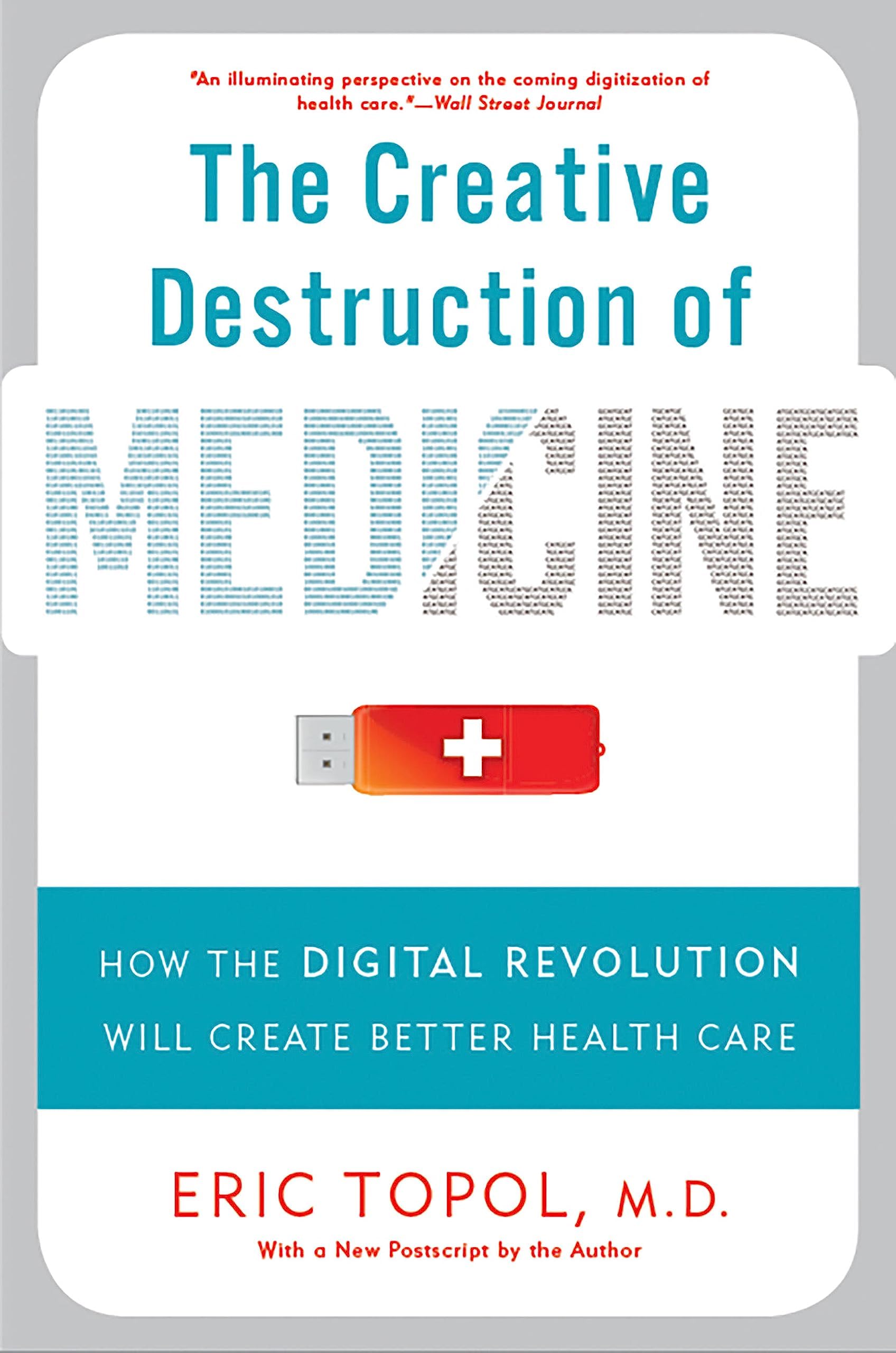
The Creative Destruction of Medicine: How the Digital Revolution Will Create Better Health Care
Product ID: 1274107
💻Big data & digital tech
📉Cost-reducing innovation
🧬Genomics-driven insights
Desertcart purchases this item on your behalf and handles shipping, customs, and support to USA.
🧠 Transform your understanding of medicine before everyone else does!
The Creative Destruction of Medicine by Eric Topol explores how genomics, big data, and digital technology are disrupting traditional healthcare. This influential book advocates for patient empowerment and innovation to create more precise, affordable, and personalized medical care. A must-read for professionals and anyone invested in the future of medicine.


| Best Sellers Rank | #1,288,377 in Books ( See Top 100 in Books ) #221 in Medical Informatics (Books) #507 in Biotechnology (Books) #1,116 in Health Care Delivery (Books) |
| Customer Reviews | 4.4 out of 5 stars 426 Reviews |
A**S
Key Reading for Those Who Deal With Medicine, Patients Especially
This book merits five stars for content. I'd have shaved one away, because this was NOT an easy book to read. The topic, however, is so important that we'll leave a full array. In any event, if your life intersects with medicine in a major way, read it. Dr. Topol is an eminent cardiologist, geneticist, and medical researcher. Here, he argues that the practice of medicine is on the brink of massive structural change. The title attributes this to the digital revolution, but the book is at least as much about the impact of the science of genetics. The combination of these two will produce a medical approach far more closely targetted to the individual, far more precise, and -- ulimately -- far cheaper. A great deal of what Dr. Topol says is very informative and very convincing. Some of it is so "gee whiz" as to be offputting, and some of it sounds like science fiction. Much of what sounds like science fiction, however, is already in development. And some of it is already moving into current practice -- by patients as well as by doctors. This is very important reading for those who have heavy contact with the healthcare system. One of Dr. Topol's key points is that as information becomes much more readily available, patients will have to take on more responsibility for their own care -- no one doctor can make all the right decisions in every area, and no one knows a patient like the patient him or herself. There is a lot in this book that's essential knowledge for those with serious conditions (or those who are helping those with serious conditions). The rather horrifying chapter on medical errors stands out, but there is much, much more. My only problem with the book is that I found it a tough read. That's not so much because it was over-technical. The one instance in which that may be true is the section on the role of genomics in medicine, but that is a hard thing to explain, and not part of the general medical knowledge base -- Dr. Topol notes that at the last report, only 2 out of 150 U.S. medical schools had "more than a brief, cursory curriculum" devoted to genomics beyond simple Mendelian traits. My problem was with the overall approach, which is to throw lots and lots and LOTS of information at the reader, without enough explanation or linking together. Stylistic issues, however, should not deter readers: there's so much very important stuff in this book that it's worth a bit of a slog. Moreover, the readability problem may be with this (elderly) reviewer. Two generally favorable reviews didn't seem to find it a problem. See the Wall Street Journal review at [...]at [...] Anyway, read it.
D**U
The Creative Destruction of Medicine
Given all the havoc that has beset the medical market it is no surprise that Topol has called this a "Creative Destruction of Medicine". The medical system in place from (say) the mid-20th century forward, will not be able to handle the continual flow of retiring baby boomers, let alone senior citizens with ever increasing life expectancies. Like so many promises made over the past years, in its present form medicine will not be able to afford to honor the Medicare entitlement. So the current system must be replaced it with something else that will work. The only good news is that the cost of medicine can be greatly reduced through the aggressive introduction of advanced cutting-edge technology. Topol provides examples of where the injection of a little technology can substantively improve medicine, and at the same time do so at reduced costs. We might be seeing what others in the past have called "inflection points", where radical improvements and changes lead to measurably better patient outcomes. Changes on the cusp, are by no means painless. In the future you personally will be unlikely to get nearly as much one-on-one time with your doctor. Instead you will be seen by other medical professionals like physician assistants, nurse practitioners, and technologists of all stripes . In writing this, I remember the days when my dentist actually cleaned my teeth (!). Now a hygienist tends to that, with the dentist stopping by to take a quick look and shake hands. It would seem the dentists got to the answer faster than medical doctors were able to: Delegate anything and everything you can to less expensive staff so you can see more patients and reap the rewards of an expanded practice.
K**.
Great for young doctors and those in medical care
While I would recommend this book to anyone, I would say it is an especially important, honest, and inspiring book for young doctors, nurses, and researchers. For doctors, the medical care that we learn, practice, and preach is shaped so much by research and guidelines that we barely understand or question. I couldn't agree more that patients, caregivers, healthcare workers, and policy-makers need to be better armed with information to make confident knowledgeable decisions about the new directions that healthcare will take. Through technology, there is a lot of hope and potential to bridge the divides in medicine and engage more voices, which have previously been left out of the healthcare conversation. There is also great potential to make healthcare more efficient and patient-centered. I agree that doctors and patients of the future should strive to tailor prevention, health, and treatment on the individual level. Dr. Topol's book contains a very rich analysis of the current literature, but through an engaging and passionate writing style that reflects his excitement about genomics and medicine. While he uses examples of current innovations, devices, and forward-thinking companies that show potential to improve health, I am impressed that he takes an unbiased, honest, and informative approach to provide us with the best resources and knowledge worth thinking about.
C**L
Wow! What an amazing book and man.
I learned of this doc from a news feature a while back on NBC nightly news and wanted to learn more about what he was doing. This book is not just about medicine. The first chapters are all about the proliferation technology in general and how it has changed the way we think and live. As a believer in holistic medicine and energy healing along with other alternative medicine, I was moved by Dr. Topol's willingness and courage to talk about the lies Big Pharma is telling us about the drugs millions are taking for cholesterol, as one example, that only do not work as promised, but can cause serious trouble. 7% of people who land in hospitals are there due to prescription drug side effects which are a leading cause of death. It's a complicated story driven by profit motives that appear to cause issues in which version of the truth the consumer will get so sales will cover billions in R&D costs. He also talks about doctors who may be more interested in selling you on the need for your heart surgery than getting you a cure that doesn't involve cracking your chest open. Hey, who will pay for all those big MRI machines if we don't keep those surgeries coming? Dr. Topol also believes that with proper support from technology, people with various illnesses can monitor themselves or be monitored remotely and stay out of our staph ridden hospitals. Much of such technology is still in development but future developments will arrive with the same lightning speed that will make your new PC obsolete the day you buy it. Remember, there's big money in medicine! This is a good read that should move all of us to consider that our health options and decisions should be in our own well informed hands. He gets a little technical here and there but altogether, Dr. Topol's heart is in the right place, giving information for our own personally managed good health.
P**E
Deconstructing large population trials
The Creative Destruction of Medicine: How the Digital Revolution Will Create Better Health Care Eric Topol deconstructs large population clinical trials into evidenced based trials for individuals. The problem is it takes large trials to prove evidence even though the subjects are not quality but the typical norm such as the WHI trial. He slashes this trial as the evidence for cancer outweighs the benefits. Unfortunately, he either didn't read the study carefully or he has a bias on HRT. The Premarin Progestin (HRT)arm dramatically increased the risk of breast cancer eight times over baseline as well as dementia, stroke, and CAD. The Premarin(ET) arm showed no risk for CAD and breast cancer. The conclusion is Progestin a synthetic Progesterone has a different molecule structure and through metabolism the by-products caused the outcomes in the HRT arm. Yet, every OB/GYN will stiffly say there is no difference between the molecules. What Dr.Topol ignored were the deaths associated with osteoporotic fractures (50% 2-year mortality) far outnumbered the deaths from breast cancer, MI and CVA put together. In the Nurses Health Study, Dr. Topol ignores the outcome that HRT with Estradiol and progesterone were beneficial at the time of menopause. The investigators concluded that once CAD is established, HRT has no protective or beneficial effect. The Pepi trial showed that Estradiol and Progesterone showed more cardioprotective effect than Estradiol and Progestin (Provera). These large populus trials are necessary to extrapolate the findings to practice safely. Medicine needs these clinical trials for risk benefit before looking at other sub-populations. If the trials were limited to just individuals, the money spent in study samples would far exceed the budget and necessary outcomes.
D**R
absolutely wonderful look at medicine as it IS and as it should/could be
This book is a must for ANYONE who will ever be part of the health care system (as a provider or recipient of health care). Dr. Topol has written this book for the empowered consumer but as a physician who spent a career focusing on quality of care, I found it enlightening and fascinating. Dr. Topol takes us from the population based/guideline based medicine of today (WHEN we are lucky enough to have enough population based evidence for guidelines) to the individualized medicine of the not too distant future and explains how genomics and digitalization will make that possible. There are so many useful aspects to this book including a discussion of how to interpret the literature, how to evaluate the internet as a resource, how to select a top notch doctor and what kinds of conditions that is important for and so much more. Just to find about the MIT OpenCourseWare was worth the price of the book. This book is a major contribution from a doc who has been one of the major contributors to health care in this country. It was recommended to me by a cardiologist friend and I have recommended it to everyone from doc friends to musician friends. Lots of important content written with great clarity in a personal, almost conversational style that makes it a pleasure to read.
M**Y
Essential examination of new technologies promising to herald a new age of digital health
A great read. He navigates the space clearly and brings a huge wealth of personal experiences and anecdotes to the topics. All aspects of healthcare technology are addressed and he takes a broad perspective covering viewpoints of providers, payers, drug companies, docs and patients. His arguments are balanced and well articulated. Essential reading for anyone in the healthcare technology field. There is no doubt that the majority of the content will come to be, in time, given the massive pressures on the system right now. Two issues with the book. Firstly he goes into way too much detail with the genetic sequencing content and totally lost me for large swathes of the narrative. I don't feel this detailed examination is required....for lay people. And up to this point the content was high level. So this content didn't really flow. Secondly he repeats him self often and goes over the same ground over and over again. So with these two points in mind probably the book could have been shorter.
D**T
Fantastic read! The future is here!
Stop waiting for the future, it's already here. Dr Topol has provided a veritable tour de force on the current state of the convergence of mobile health technologies and genomics. This book is written exactly the way Dr Topol presents; with passion, extraordinary depth of knowledge but above all a deep desire to positively influence the direction of modern medicine. Although I am not a stranger to the topics at hand, he discusses them with incredible perspective as to how these new technologies will forever alter the way we practice medicine. It becomes abundantly clear that our practice of 'Medicine by the yard' is clearly not the strategy that will allow us optimally utilize the devices and technologies discussed. For the first time in history we are witnessing an explosion of medical data and devices which are out pacing medicines ability to incorporate and utilize it. The mechanisms that currently exist for disease risk prediction, diagnosis, prognosis, treatment and continuous monitoring will soon appear archaic in the wake of not only the technologies of tomorrow but those that exist right now. We currently have in our hands the unique ability to 'Schumpeter' modern medicine as Dr Topol would say; it is incumbent on us as physicians of the future to ensure this happens. If you are a physician or patient who wants an incredible window into the future of medicine, you will find it here.
G**.
interessante
un libro che ispira e anticipa dei trend che già oggi vediamo all'orizzonte, la medicina basata sul genoma, i pazienti connessi etc etc a me è piaciuto ad alcuni è sembrato scontato....dipende dal lettore e dalle sue aspettative e livello di conoscenza
Y**A
Excellent
Excellent
M**A
The Creative Destruction of Medicine
Tudo certo.
M**K
Five Stars
Very good eTailer
P**W
Well worh reading
My initial reaction was that it was very US centric but it has many lessons of global importance. It was a real page turner and I would thoroughly recommend it to anyone interested in medicine.
Trustpilot
1 week ago
2 weeks ago