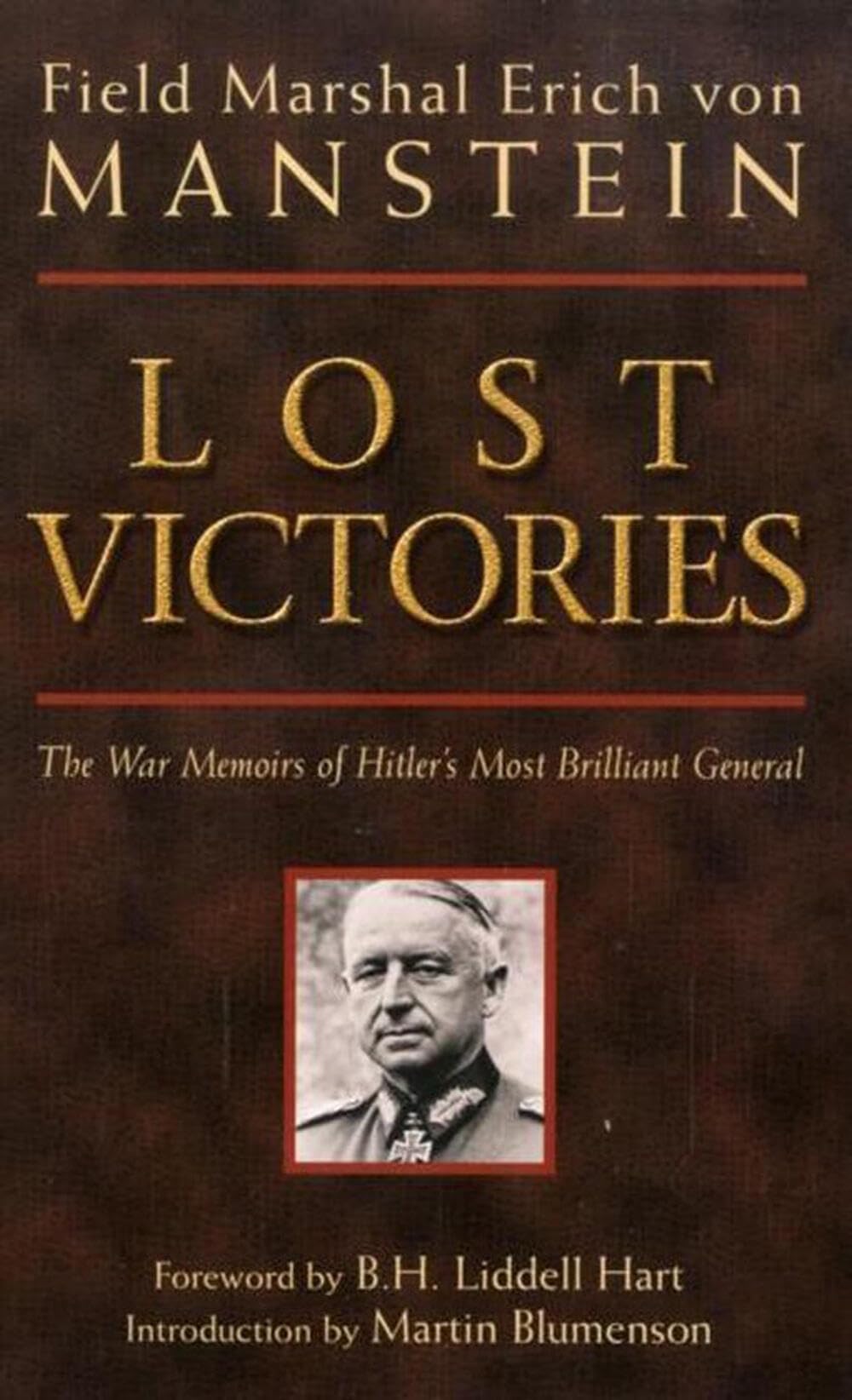
Lost Victories: The War Memoirs of Hitler's Most Brilliant General
Product ID: 10610206
Desertcart purchases this item on your behalf and handles shipping, customs, and support to USA.
Originally published in Germany in 1955, and in England and the United States in 1958, this classic memoir of WWII by a man who was an acknowledged military genius and probably Germany's top WWII general, is now made available again. Field Marshal Erich von Manstein described his book as a personal narrative of a soldier, discussing only those matters that had direct bearing on events in the military field. The essential thing, as he wrote, is to "know how the main personalities thought and reacted to events." This is what he tells us in this book. His account is detailed, yet dispassionate and objective. "Nothing is certain in war, when all is said and done," But in Manstein's record, at least, we can see clearly what forces were in action. In retrospect, perhaps his book takes on an even greater significance. Review: Not for everyone - The five stars is for what it is supposed to be-- a detailed military memoir by an exceptional leader of German armed forces. Manstein was by any judgment a first rate staff officer, who excelled with troops and shone in use of combined force tactics and strategy on a large scale. His impact in WWII was immense -- on both the Western and Eastern Front. He was also convicted for war crimes and served four years of an 18 year sentence noted in a 1981 introduction. That is not noted in the original edition which I also have. He was not a political general, i.e. he was not a Nazi Party member and had long credentials as a professional soldier and offspring of professional soldiers. He had Hitler's ear frequently and stood up to him more than most. Evidence (from other sources) indicated that one of his orders referred to a need to eliminate "Jewish Bolshevism" once and for all. There's no point in retrying his case here,but it does affect the way some of his writing is interpreted. Some of his comments should be read knowing that he had only recently been released from prison. Manstein had a stellar reputation before the war, although he angered some old guard when he waffled on a plan to confront Hitler. In a critical phase at the opening of the war, he was chief of staff to von Rundstedt and took part in military planning. Some of his innovative proposals were passed over. As the Germans planned their attack into France, the Belgians captured some of the Fall Gelb, or Code Yellow plans, essentially another revision of the basic Schlieffen used in WWI. The allies were pleased because it confirmed their basic planning in reaction to such an invasion. The Germans, however, knew that the Allies knew. So the plan was revised again. Rundstedt and Manstein had already been pushing for the plan. An interview was arranged with Hitler. Manstein describes a HItler who was engaged, understood the concepts and had an excellent grasp on technology. Manstein immediately by memo recounted Hitler's agreement with his plan and the final order included its elements. No military plan for large troop movements is ever simple. A critical element in Manstein's plan was sending a major force with tanks through the Ardennes, something thought too difficult. If the plans early phases were successful, the Allies would have little chance to recover. He and most authorities credit the Ardennes drive, orchestrated by Rundstedt and Guderian and not without difficulty, as the major factor in the utter defeat of the Allies in Northern Belgium. Germany held back its armor, leaving mopup to infantry and aircraft. That allowed the evacuation of nearly 340-thousand troops including 26,000 French to be evacuated. Manstein cites three possible reasons; Goring's ego and m aking peace with Britain were two. The third is currently considered the most likely, that Hitler acceded to his generals who wanted to save their armor for the second phase of the French campaign. As Manstein points out, despite the loss of their equipment, the success of the the Dunkirk evacuation later allowed Brittish troops to fight in Africa and Italy. Despite all the success, Manstein thought more could have been achieved. It is here that he sums up Hitler's ultimate weakness, one that worsened. HItler had a firm grasp of operational problems, but lacked the professional training to know when large risks should be accepted. In part because Americans have developed a self-righteous attitude abouut all things French, it's worth repeating Manstein's comment that even had better judgment and energy been shown, the French would have still been destroyed/defeated. Manstein's 38 Corps played a minor role in the battle for France. Manstein deals in detail with the rivalries and factions as Germany turned toward Britain and an invastion in a "between campaigns chapter. After the decision was made to invade Russsia instead of Britain, Manstein moved to 56 Panzer Corps as commander in the early phase Panzer Dash. He praises the quality of the Waffen SS troops and termss it a terrible mistake to have set them up as a separate military organization. He argues that their casualties were disproportionate to their gains ... and that they drained the Army of potential NCOs. Manstein's victory in the Crimea and the annihilation of a powerful Soviet force --Freeing up the 11th Army -- was in his high water mark. He was made field marshal -- and Hitler soon ordered him to take his Army to join the seige of Leningrad, but having had little effect in tthe ill-advised move, Hitler ordered 11 Army to begin moving south again. By this time, Manstein had lost some close associates and his oldest son had been killed and he was shortly named commander of the Don Army Group. Although a Hitler favorite for being a winner, Manstein had not previously reported directly to Hitler. He comments until that point he had felt Hitler's influence on the military only indirectly and from far away. That changed. In the 50s, it had already been fashionable to blame Hitler for everything and he became a cartoon character. Manstein puts a different light on a much more complex man but the end result is no more favorable to Hitler. His analysis of Hitler as strategist and warlord is complex and far reachingg. There is a chapter dedicated to "Hitler as Supreme Commander" including his adoption of Stalin's strategy of holding on to every piece of ground. From this point, Manstein's tale (amid some triumphs) is on a downward trajectory. Stalingrad. Another winter in South Russia and the defensive battles of 1943 and 1944. Manstein drives close enough to encircled Stalingrad to make a breakout possible, but Hitler orders it held at all costs. Paulus and his army are lost and the relief is in vain. The lost victories, those won and those that could have been won, are adding up. But Hitler rejects every plan that might bring victory or at least a stalemate. German troops continue to inflict fearsome casualties on the Russians, The quality of their troops kept declining, but there were always more. This is not a technical book, but it is dense with military thought and considered criticism of Hitler. It must all be in a context. It is one man's view -- and one that is considered by military historians. It will probably be in print as long as there is a military. While HItler would not have used the phrase "Stay the Course" but he said the equivalent in idiom Except that he didn't want to talk to anyone and began isolating himself.When people saw him, he lashed out. He made the mistake and everyone else paid the price. The shame is that it still continues. I cannot regret these lost victories any more than I can wish that my native South had won that war. It's probably a coincidence but still ironic that a new book about Stonewall Jackson is called "Lost Victories. It is possible to understand the pangs of lost victories ... without wishing for a change in result. What is more difficult is to understand why wars that cannot be won are fought -- why the course must be stayed -- why criticism of the leadership is so bad. If the best Germany could hope to achieve against the Soviet Union, planning for that should have started before millions of people lost their lives -- for nothing. Manstein makes the point well, that just because the political arm can order something does not make it right or wise. From a Nazi general yet! Review: Valuable When Read in Context - An incisive, well-written view of important WWII battles from the front row, this book is importantly balanced and enhanced by the accompanying commentary providing needed context about the author and his point of view. Manstein's role in forming post-war judgments on the Wehrmacht was significant, and the commentary helps place this book in its historical context. I found that the unit-by-unit battlefield detail could be wearying, as it was difficult to follow and Kindle does not do maps particularly well. Some of this was aimed, no doubt, at acknowledging the efforts of comrades in arms. The larger assessments were far more interesting to me, including those of Hitler as a military commander/strategist and the Wehrmacht's command, war and political issues. There is an unmistakable defensiveness to the narrative, certainly influenced by post-war and post-hoc concerns. Some of this seems to stem from Prussian military pride and tradition, offended by Hitler's direct involvement in military decisions and operations. But there is also a great silence about the the political units operating within his jurisdiction. Both the Wehrmacht and the Red Army fielded political authorities tasked with carrying out ideological warefare. These units on both sides were responsible for an appalling array of crimes against humanity. Tellingly Manstein describes the work of the Red Army's political commissars in influencing military decisions and operations, but says nothing at all about the work of their counter-part German political units, whose crimes he was ultimately made to answer for after the war. Taken in context, this is an informative and, at times, fascinating read of significant battles by an important commander. However, it is not by any means a full and frank record of those events.
| Best Sellers Rank | #251,875 in Books ( See Top 100 in Books ) #179 in German History (Books) #545 in WWII Biographies #1,895 in World War II History (Books) |
| Customer Reviews | 4.4 out of 5 stars 659 Reviews |
O**G
Not for everyone
The five stars is for what it is supposed to be-- a detailed military memoir by an exceptional leader of German armed forces. Manstein was by any judgment a first rate staff officer, who excelled with troops and shone in use of combined force tactics and strategy on a large scale. His impact in WWII was immense -- on both the Western and Eastern Front. He was also convicted for war crimes and served four years of an 18 year sentence noted in a 1981 introduction. That is not noted in the original edition which I also have. He was not a political general, i.e. he was not a Nazi Party member and had long credentials as a professional soldier and offspring of professional soldiers. He had Hitler's ear frequently and stood up to him more than most. Evidence (from other sources) indicated that one of his orders referred to a need to eliminate "Jewish Bolshevism" once and for all. There's no point in retrying his case here,but it does affect the way some of his writing is interpreted. Some of his comments should be read knowing that he had only recently been released from prison. Manstein had a stellar reputation before the war, although he angered some old guard when he waffled on a plan to confront Hitler. In a critical phase at the opening of the war, he was chief of staff to von Rundstedt and took part in military planning. Some of his innovative proposals were passed over. As the Germans planned their attack into France, the Belgians captured some of the Fall Gelb, or Code Yellow plans, essentially another revision of the basic Schlieffen used in WWI. The allies were pleased because it confirmed their basic planning in reaction to such an invasion. The Germans, however, knew that the Allies knew. So the plan was revised again. Rundstedt and Manstein had already been pushing for the plan. An interview was arranged with Hitler. Manstein describes a HItler who was engaged, understood the concepts and had an excellent grasp on technology. Manstein immediately by memo recounted Hitler's agreement with his plan and the final order included its elements. No military plan for large troop movements is ever simple. A critical element in Manstein's plan was sending a major force with tanks through the Ardennes, something thought too difficult. If the plans early phases were successful, the Allies would have little chance to recover. He and most authorities credit the Ardennes drive, orchestrated by Rundstedt and Guderian and not without difficulty, as the major factor in the utter defeat of the Allies in Northern Belgium. Germany held back its armor, leaving mopup to infantry and aircraft. That allowed the evacuation of nearly 340-thousand troops including 26,000 French to be evacuated. Manstein cites three possible reasons; Goring's ego and m aking peace with Britain were two. The third is currently considered the most likely, that Hitler acceded to his generals who wanted to save their armor for the second phase of the French campaign. As Manstein points out, despite the loss of their equipment, the success of the the Dunkirk evacuation later allowed Brittish troops to fight in Africa and Italy. Despite all the success, Manstein thought more could have been achieved. It is here that he sums up Hitler's ultimate weakness, one that worsened. HItler had a firm grasp of operational problems, but lacked the professional training to know when large risks should be accepted. In part because Americans have developed a self-righteous attitude abouut all things French, it's worth repeating Manstein's comment that even had better judgment and energy been shown, the French would have still been destroyed/defeated. Manstein's 38 Corps played a minor role in the battle for France. Manstein deals in detail with the rivalries and factions as Germany turned toward Britain and an invastion in a "between campaigns chapter. After the decision was made to invade Russsia instead of Britain, Manstein moved to 56 Panzer Corps as commander in the early phase Panzer Dash. He praises the quality of the Waffen SS troops and termss it a terrible mistake to have set them up as a separate military organization. He argues that their casualties were disproportionate to their gains ... and that they drained the Army of potential NCOs. Manstein's victory in the Crimea and the annihilation of a powerful Soviet force --Freeing up the 11th Army -- was in his high water mark. He was made field marshal -- and Hitler soon ordered him to take his Army to join the seige of Leningrad, but having had little effect in tthe ill-advised move, Hitler ordered 11 Army to begin moving south again. By this time, Manstein had lost some close associates and his oldest son had been killed and he was shortly named commander of the Don Army Group. Although a Hitler favorite for being a winner, Manstein had not previously reported directly to Hitler. He comments until that point he had felt Hitler's influence on the military only indirectly and from far away. That changed. In the 50s, it had already been fashionable to blame Hitler for everything and he became a cartoon character. Manstein puts a different light on a much more complex man but the end result is no more favorable to Hitler. His analysis of Hitler as strategist and warlord is complex and far reachingg. There is a chapter dedicated to "Hitler as Supreme Commander" including his adoption of Stalin's strategy of holding on to every piece of ground. From this point, Manstein's tale (amid some triumphs) is on a downward trajectory. Stalingrad. Another winter in South Russia and the defensive battles of 1943 and 1944. Manstein drives close enough to encircled Stalingrad to make a breakout possible, but Hitler orders it held at all costs. Paulus and his army are lost and the relief is in vain. The lost victories, those won and those that could have been won, are adding up. But Hitler rejects every plan that might bring victory or at least a stalemate. German troops continue to inflict fearsome casualties on the Russians, The quality of their troops kept declining, but there were always more. This is not a technical book, but it is dense with military thought and considered criticism of Hitler. It must all be in a context. It is one man's view -- and one that is considered by military historians. It will probably be in print as long as there is a military. While HItler would not have used the phrase "Stay the Course" but he said the equivalent in idiom Except that he didn't want to talk to anyone and began isolating himself.When people saw him, he lashed out. He made the mistake and everyone else paid the price. The shame is that it still continues. I cannot regret these lost victories any more than I can wish that my native South had won that war. It's probably a coincidence but still ironic that a new book about Stonewall Jackson is called "Lost Victories. It is possible to understand the pangs of lost victories ... without wishing for a change in result. What is more difficult is to understand why wars that cannot be won are fought -- why the course must be stayed -- why criticism of the leadership is so bad. If the best Germany could hope to achieve against the Soviet Union, planning for that should have started before millions of people lost their lives -- for nothing. Manstein makes the point well, that just because the political arm can order something does not make it right or wise. From a Nazi general yet!
N**A
Valuable When Read in Context
An incisive, well-written view of important WWII battles from the front row, this book is importantly balanced and enhanced by the accompanying commentary providing needed context about the author and his point of view. Manstein's role in forming post-war judgments on the Wehrmacht was significant, and the commentary helps place this book in its historical context. I found that the unit-by-unit battlefield detail could be wearying, as it was difficult to follow and Kindle does not do maps particularly well. Some of this was aimed, no doubt, at acknowledging the efforts of comrades in arms. The larger assessments were far more interesting to me, including those of Hitler as a military commander/strategist and the Wehrmacht's command, war and political issues. There is an unmistakable defensiveness to the narrative, certainly influenced by post-war and post-hoc concerns. Some of this seems to stem from Prussian military pride and tradition, offended by Hitler's direct involvement in military decisions and operations. But there is also a great silence about the the political units operating within his jurisdiction. Both the Wehrmacht and the Red Army fielded political authorities tasked with carrying out ideological warefare. These units on both sides were responsible for an appalling array of crimes against humanity. Tellingly Manstein describes the work of the Red Army's political commissars in influencing military decisions and operations, but says nothing at all about the work of their counter-part German political units, whose crimes he was ultimately made to answer for after the war. Taken in context, this is an informative and, at times, fascinating read of significant battles by an important commander. However, it is not by any means a full and frank record of those events.
M**L
Great reading
One of most best generals in world war 2. This person literally brought took France in 6 weeks by going through forest that armour couldn't go through. On Eastern front he almost beat the Russians except that battle of kursk. Which he was overwhelmed. He told Hitler to drop dead. Great book
J**E
Memoirs of a German General of WWII
One of the best accounts of the Second World War told from the German side, by one of its most brilliant generals. Around 570 pages, easy read, very enjoyable and didactic, and enormously interesting for its analysis. It covers 3 main campaigns: the campaign of Poland, of France and the war in the East with Russia (chronologically from the fall of '39 to the spring of '44). It reads better than any textbook on the subject; has some satisfactory maps and photos. Even though at some points it gets technical, because this is a military story, it never becomes a bore. The layman can understand this story perfectly. This is a personal view from inside of the German Werhmacht. It's interesting to see not only the big picture of events as he presents it, but especially the plans for battle, the meetings with Hitler and his impressions of him, the portrait of his fellow soldiers, the battles from inside, the daily routines that don't come in textbooks. A book worth the price if only for these details of life. It has some humor in it too, despite all the calamities (see pages 149-150 for the description of the chateau of the manufacturer of Cointreau in France). It also has lots of interesting analyses of the war and whatifs. Insights into the characters of important political and military leaders of the time. An excellent evaluation of the geopolitics of those turbulent times available for everyone. I had to underline many pages of this very juicy book. Now I want to read Rommel's diaries. NB: While reading Gerhard Weinberg's 'A World at Arms', a global history of WWII, I came across this: "Once arrived at the southern front, von Manstein broke with all the other German army and air force generals and believed that it was possible to hold Stalingrad ... Concerned primarily about his reputation as a daring and always successful military commander, both at the time and after the war, he reinforced Hitler's inclination then and faked the relevant portion of his memoirs after the war." And in the end-notes of the book he adds: "Manstein worked as hard to distort the record on this matter as on his massive involvement in the murder of Jews." Important details to know about the personage in question since he, obviously, let's us see him in another -positive- light. Which does not diminish, however, the interest of this book.
W**S
Most Objective Non Allied Perspective On The War In Europe And Russia
I have been reading and studying about WWII, especially the European theater of the war, for about six decades and this is the best book I have read on the subject. Von Manstein's first hand perspective on German operations, especially in Russia, are unparalleled in presenting the war from the German point of view. It also clarifies Hitler's thinking and decisions in the Russian campaign which were so detrimental to the Wehrmacht's success against the Communists. Although an undisputed master of European politics, as proved by his brilliant successes prior to September 1, 1939, Hitler's unprofessional meddling in the planning and execution of military operations by the Wehrmacht, especially in Russia, doomed Germany as early as Dunkirk. Had the arrogance of the British and French in declaring war on Germany been met with a well developed strategy to eliminate both countries as a threat, France did however get what it deserved, Germany would have had a free hand to successfully conquer and occupy the resource rich Russian territory west of the Urals and in the Caucasus. As pointed out by Von Manstein in this book, the superiority of many of the German generals, weapons and soldiers at the time would have assured the success of military operations to compliment the political successes which Germany had achieved in the 1930's. Although Germany had many brilliant general's during this period it is obvious from his memoirs that Field Marshal Erich von Manstein was the most brilliant and versatile of them all. This is a must read book for those interested in a non Allied perspective of WWII in Europe.
B**R
Insightful but Sanitized
I have read dozens of German WWII memoirs. Lost Victories is perhaps the most difficult to rate. It is both hugely insightful and heavily sanitized. It’s as dense as it is fascinating. Manstein himself is at times so compelling I nearly found myself falling for his self-serving revisionism. All of it makes for great reading. Let it be said: Lost Victories is not for the uninitiated layman. It assumes readers already have a strong understanding of the campaigns in the East and the conditions under which they were fought. Though Manstein describes some operations in great detail, he limits his commentary to engagements over which he had direct control. Anyone lacking the “big picture” will thus be confused and disappointed. If, on the other hand, you’re already an Eastern Front aficionado, Lost Victories is compulsory reading. The highlight of the memoir is Manstein’s insight into Hitler’s leadership, psychology, temperament, and strengths and weaknesses as the commander in chief of the German war machine. Though his assessment of Hitler is decidedly critical, Manstein offers praise where appropriate and explains Hitler’s strategic gaffes as charitably as possible rather than gunning him down with charges of incompetence and narcissism, as many others have done. I found his appraisal thoughtful, sober, and convincing. Manstein’s principal failure in Lost Victories is his heavy sanitization of, well, everything. In my estimation, it is not necessary for every Wehrmacht veteran to speak on matters related to the Holocaust. Many frontline soldiers played no part in it. But Erich von Manstein isn’t some run-of-the-mill grunt. He was a corps commander in 1941 and, after his promotion to Field Marshal in 1942, an army group commander until his dismissal in 1944. As such, I consider it a significant sin not to address Einsatzgruppen activities in conquered Soviet territory—activities which Manstein himself supported militarily in the Crimea in 1941. Likewise, Manstein claims to have disobeyed Hitler’s Commissar Order, dismissing it as foolhardy. He said the same thing at Nuremberg but was proven to have received regular reports about the execution of Soviet political officers. Manstein even has the audacity to complain that the Germans didn’t pillage French treasures half so badly as the Allies later did to the Germans. Indeed, it seems he would have us believe all that stolen art just grew legs and hopped the Rhine! Be wary of Manstein’s silver tongue while reading, for he’s as crafty a spinster as he is omitting the darker parts of his career. One leaves Lost Victories with the distinct impression that had Hitler and his yes-men gotten out of the way, Manstein might’ve won Germany the war—or at least fought the Soviets to a draw. Is it possible? Maybe. Some of his arguments are quite powerful. But I advise approaching Lost Victories critically. Whether Manstein was, in fact, “Hitler’s most brilliant general,” as the book’s subtitle proclaims, he certainly wants you to think so. I must voice a few additional stylistic complaints. For one, there aren’t nearly enough maps. I’m not sure why so many memoirs are deficient in this regard, but you’ll find yourself supplementing with regular Google searches. Second, the chapter on the 1943 winter retreat is interminable. It could have been reduced by a third and I’d still have the full picture. Considering it’s almost a hundred pages long, I don’t understand why Manstein devoted so much space to such a repetitive operation other than to laud himself for saving the day. Finally, a translator’s note reveals that numerous personal anecdotes were removed from this English edition due to its length. I’m curious how much space was saved considering Lost Victories is still 550+ pages. Moreover, personal anecdotes typically help move the narrative along. I’d have greatly appreciated that midway through the aforementioned winter retreat chapter. If an unabridged English edition of Lost Victories exists, I recommend purchasing that instead. Nevertheless, with all my criticisms in mind, I still consider Lost Victories essential reading for any serious student of the Eastern Front. Manstein is as talented a writer as he was a general; it was a thrill to see the war through his eyes. Provided you periodically remind yourself of his agenda, it’s not to be missed.
N**9
Great insights from a brilliant commander
I bought this book to learn more about Hitler, than the campaigns in eastern Europe and the USSR. First, let me discuss the latter. As a former US Army MP who was stationed in Germany (89-91) and a USMC officer who is an avid reader of WW2, I learned a great deal about the war in Eastern Europe. The drive on St. Petersburg (then Lenningrad), and his brilliant conquest of the Crimea. Manstein's promotion to Field Marshal and command of Army Group Don, and his unsuccessful attempt to relieve 6th Army trapped in Stalingrad (now Volgograd). His planning and execution of the 1943 offensive to neutralize the Kursk Salient (also unsuccessful). What I most enjoyed were his detailed explanations on operational preparations, execution and when successful, follow through. Manstein also does a fantastic job of explaining Germany’s perilous situation in the late winter of 42 into 43, and post Operation Citadel. As to Hitler, I learned much. Swept away are the black and white views of Hitler as a maniacal, blood-thristy tyrant and what appears is a man far more nuanced than what we learn in the west. What I found most fascinating was Manstein’s assessment that though Hitler possessed an eye for tactical level advantages, he could not grasp strategic planning. Combined with the convincing portrayal of Hitler’s reluctance to make decisions and you have a man who is paralyzed by his own ego while immune to the counsel of others more experienced in war than himself. (Manstein tells how Hitler castigated the OKH by telling him he was in a better position to know how soldiers felt than they, because he’d been in the infantry in WW1). What is lacking, and why I gave this book four stars, is the failure to mention atrocities of the Einstaztgruppen that operated in areas under Manstein’s control. He also goes out of his way to clear himself of any involvement in the final solution. Though I know he wasn’t directly involved, I find it impossible to believe that a Field Marshal and Army Commander that had three Army Groups under his command that he wasn’t receiving reports about mass killings in his AOCs, and his personal feelings on the matter or any attempts to or to not halt genocides. In all, this is a great book. I highly recommend it and though he avoids the topics of genocide, I do think you glean something of a man who didn’t want to acknowledge how his involvement at the highest levels of the German Army helped to facilitate the final solution.
B**D
Manstein--Hitler's best general.
This book is excellent if one likes personal memoirs. Manstein explains war from the German perspective and cites numerous military strategy, troop movement, logistics, tactical plans, victories and, defeats, while providing the reader a personal account of war. This book touches minimally on the politics of war and, there is no mention of the holocaust...the focus is on war waged by Germany. Lost Victories is well written and transcribed from the German language. Manstein provides an unvarnished picture of war and, engagement with the Russians on the eastern front. Why and how Stalingrad was lost is clarified, albeit through Manstein's view of world war II. Hitler is also described (not in depth) from Manstein's personal view, which, will intrigue the reader. Manstein who was arguably Germany's best general shares a glimpse of his personal bias, prejudice, allegiance to Germany, and, duty as a German Officer. As one who reads historical well researched military text, books, biography, and memoirs I highly recommend this book.
C**Y
Para quem quer saber sobre a perspectiva de quem perdeu. A história só conta o lado dos vencedores
Ótimo livro
R**F
An excellent memoir, by a brilliant soldier.
This book is one of the best that I have read in military history. A most interesting insight into the mind of a brilliant soldier, as also into the German army. Highly recommended, from one who has read extensively into military history, and who also has visited many of the relevant sites.
W**L
Brilliante Kriegsführung wie auf dem Schachbrett
Der Generalfeldmaschal Von Mannstein beschreibt in diesem Buch seine Kriegserlebnisse sehr genau. Das Buch ist spannend bis zur letzten Seite schon alleine, weil der Ablauf der Ereignisse an der Front sehr spannend war. Mannstein muss bei seiner Verantwortung schlaflose Nächte gehabt haben. Er verschiebt Panzerdivisionen und Infantriedivisionen wie Figuren auf dem Schachbrett und dies in brillianter Weise. Er hat es geschafft einen zahlenmäßig weit überlegenen Gegner (bei Karkov 8:1) mit seinen taktischen und strategischen Schachzügen zu besiegen. Interessant ist auch seine Insinuierung, dass ihm und anderen deutschen Generälen Hitler durch seine ständigen inkompetenten Einmischungen den Krieg verloren hat.
B**Z
Fascinating Portrait of German Generalship
One of the most fascinating books I have read on the subject of World War II. Quite detailed and describes vividly the thinking and challenges that Manstein faced when trying to convince German military leadership of what became known as the Manstein plan. But the book goes beyond that Western blitzkreig in describing the buildup to the war, initial outbreak and the challenges faced by German high command with Hitler and Manstein with German high command. It’s amazing how strong German military values and soldiering and non-traditional strategies, Allied luck and a leadership culture of survival of the fittest played a part in the initial brilliant victories and eventual defeat.
S**.
Amazing Detail
Some people may find this book a little too detailed but stick with it…… Manstein is probably one of the best generals of his era and has amazing insight into his tactical abilities and how to make the best of sometimes difficult situations with the troops at his disposal. His legendary stands against Hitler’s foul ups are exemplary and helped the German army through some tough situations….. if you like detailed analysis of the state of the Second World War this is for you!
Trustpilot
1 week ago
1 month ago