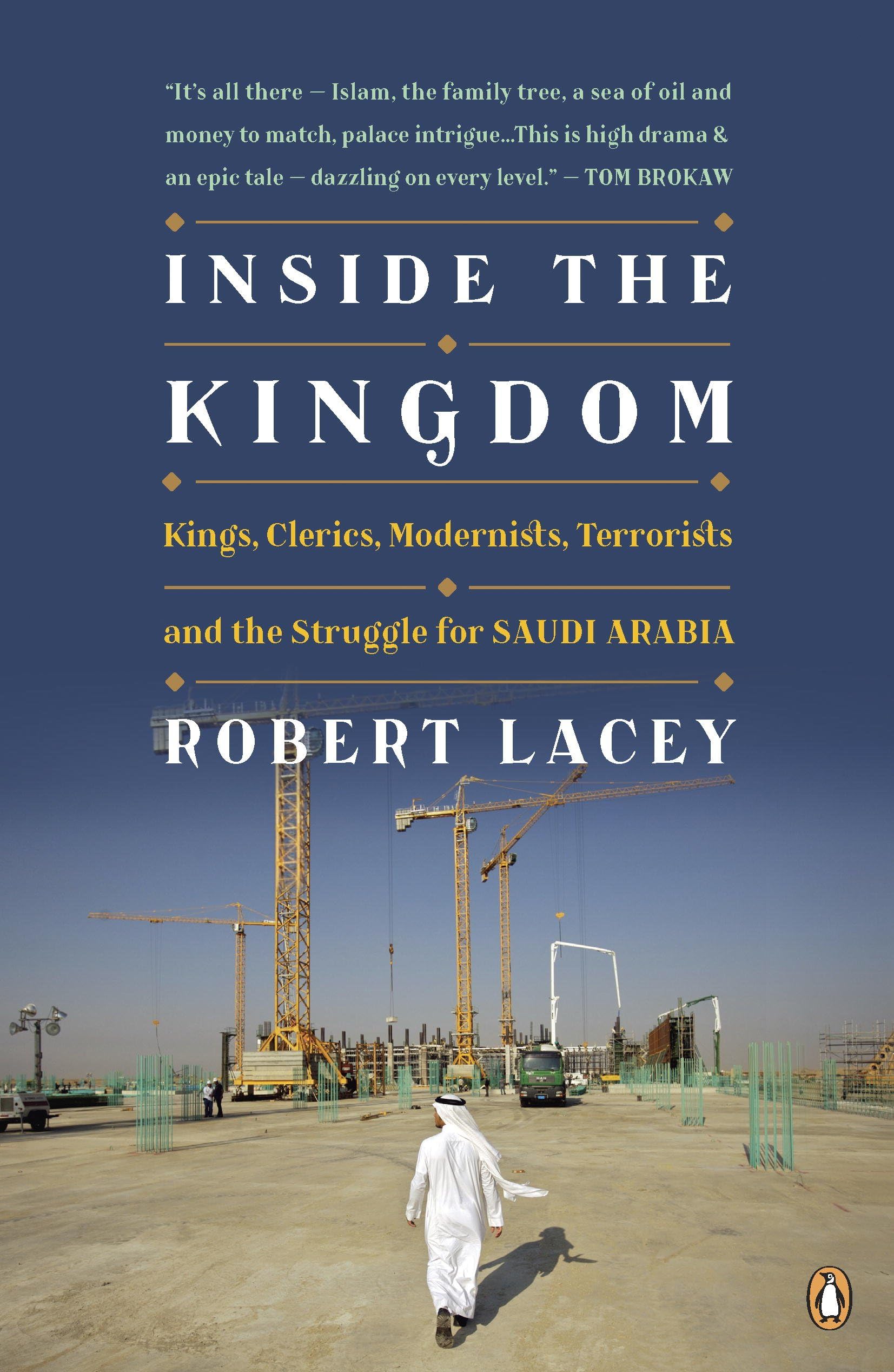
Inside the Kingdom: Kings, Clerics, Modernists, Terrorists, and the Struggle for Saudi Arabia
Product ID: 106011632
Desertcart purchases this item on your behalf and handles shipping, customs, and support to USA.
desertcart.com: Inside the Kingdom: Kings, Clerics, Modernists, Terrorists, and the Struggle for Saudi Arabia eBook : Lacey, Robert: Kindle Store Review: The long-awaited sequel... - ... to The Kingdom: Arabia and the House of Sa'Ud which ends at the beginning of the `80's. At the beginning of his previous work, Lacey relates how a Georgetown educated member of the House of Saud told him that he had lived in the Kingdom for 30 years, and if he tried to explain the country, and how it worked, the best he could do is get a B+ on the paper, and therefore, Lacey, as an outsider, could only hope to earn a C. I disagreed, and in my review, said that Lacey deserved at least a B+, if not an A-. For this work, which covers the last 30 years, he deserves a solid A. Lacey starts with "Angry Face," Juhayman, and his followers, including the expected "Mahdi," who seized the mosque in Mecca (Makkah) in 1979. (This event is also covered well by Trofimov, in The Siege of Mecca: The 1979 Uprising at Islam's Holiest Shrine ). The author selected a wonderfully appropriate epigraph for this section, from Dostoevsky: "Nothing is easier than to denounce the evildoer. Nothing is more difficult than to understand him." Lacey did a commendable job in explaining the grievances of those being overwhelmed by the "future shock" that was roiling the Kingdom as a result of the influx of money and foreigners (and their ideas) following the sharp increase in oil prices after 1973. This event, plus the revolt of the Shia, in the eastern town of Qateef, in the same year, had the net effect of nudging Saudi Arabia to a much more conservative governmental social policy, yes, in effect, co-opting a portion of Juhayman's agenda... and the women disappeared from the TV, and the "Opera House" remained closed for many a year! Lacey also covers the Saudi-American alliance of the `80's, ironical in retrospect, openly supported "jihad," certainly when it was fighting the "godless" Soviet Union in Afghanistan. And now both countries suffer from the "blowback," in CIA parlance. Part Two deals with the second decade of the 30 year period, the `90's. The author again commences with an all too appropriate epigraph, this time from Edward Gibbon: "So intimate is the connection between the throne and the alter that the banner of church has very seldom been seen on the side of the people." The seminal event in this decade was Saddam's invasion of Kuwait, and his expulsion, lead by an American coalition. The net effect on the Kingdom, who saw American female soldiers driving, which was emulated by their Saudi counterparts, was to again nudge the Kingdom into a more conservative mode. Still, despite the various "fetishes" developed by the religious police, say, against red roses on Valentine's day, the country continues to be overwhelmed by Western (and world) influences, and sadly, the upholders of tradition saw nothing wrong in the influx of fast food restaurants, which led to an "epidemic" of diabetes. Paralleling events in the Kingdom, Lacey devotes space to events in not so far off Afghanistan, where the "students," (the Taliban) were seizing power, and welcomed Bin Laden from the Sudan. The last third of the book starts with "15 flying Saudis," the events of 9/11, and the aftermath, and the Kingdom's own "9/11", which occurred on May 12, 2003, when three upscale compounds were attacked by suicide bombers in Riyadh. Clearly Lacey empathizes with the modernizing goals of now King Abdullah, who had been de facto ruler of Saudi Arabia since King Fahd's stroke in '95, but only obtained the full title after his death in 2005. He closes his epilogue poignantly, with the King praying longer one evening after seeing the progress at KAUST, the university that bears his name, slower than he had hoped. There is a small "cottage industry" which publishes books, and promotes articles that depict the Kingdom as "mysterious," that wants to "rip the veil" off Saudi society, that "exposes" the Kingdom, that produces sheer fantasies of life in the Kingdom. Lacey might have foregone a few book sales by not following this gamut, but for those who want to understand the country (and even ponder how we in the West perceive the country), this book is an essential read. The author has an extraordinary range of contacts in the Kingdom, and has woven the stories of real Saudis into his story, such as the "jihadis," Mansour Al-Nogaidan and Khaled Al-Hubayshi. Overall, through the sheer number of Saudis who were willing to speak "on the record," you had a sense that they trusted Lacey to tell the story in a balanced way, which I think he has. Tis a shame that it will be one more book on the Kingdom that will be banned by their Ministry of Information. I loved the way Lacey utilized Saudi parables, as Saudis themselves do, to make a point, with my favorite being "The Donkey from Yemen." Lacey should also be commended for correctly translated the meaning of "Tash ma Tash," the Saudi sit-com, unlike the authors of a couple other books on the Kingdom. Quibbles? Well, I have a few, and they only underscore the difficulty for a foreigner to get it "all right," but often they can, even better than a Saudi, due to the perspective, and "lack of baggage," including tribal ones. Per Lippman, in Inside The Mirage: America's Fragile Partnership with Saudi Arabia it is unlikely American women were in Al Kharj before 1950, not 1944, as Lacey indicates (p 9). There would have been no "hilal" moon (or any other), on Muharram 01, 1400 (p 22). I'd love to know how the M113 armored personnel carrier was a "success" story of the Vietnam War (p 32). Al-Nakba (the disaster) is usually associated with the Palestinian expulsion of 1948, not the defeat of `67 (p 56). Steve Coll, in his The Bin Ladens: An Arabian Family in the American Century says that there are two versions of how Osama's father, Mohammed, lost his eye, but both occurred in Ethiopia and neither involved soccer; Lacey says that it happened in the Sudan, as a result of a soccer game (p 58). Concerning the formation of "Al Qaeda", the BBC documentary "The Power of Nightmares, directed by Adam Curtis, gives a much more plausible explanation its origins - it was invented by Americans, (!!) for the trials of the 1993 bombers of the WTC, legally, so that RICO laws could be utilized, which involve "conspiracy" and an organization. Later, Bin Laden co-opted the term! It is extremely unlikely that Bin Laden had (has) a "database" of names of all the muhahideen and their contact details, save in his brain (p 148). "Only" three compounds in Riyadh were attacked on May 12, 2003 - the Oasis compound was not (p 244). And Lacey entitles a chapter on the women of Saudi Arabia the "girls" of Saudi - and not a single "girl" was in the chapter (p 274). Overall, though, a thoroughly researched, and balanced book, written to illuminate Western and in particular, American readers on Saudi Arabia, (Lacey, a British writer even explains that Sandhurst is the "West Point of England.") and should be read in conjunction with Lacey's earlier work, The Kingdom: Arabia and the House of Sa'Ud Though I'm sure Lacey would demur that "it is beyond the scope of this course," should not all Americans ponder the progress made after each countries "9/11" concerning the issues he only discusses about the Kingdom, be it educational policies, human rights, detention facilities, employment of youth and counteracting those who advocate endless conflict with "the other." An essential 5-star read. Review: A very informative and interesting read - Lacey has produced a very interesting history of Saudi Arabia (and by extend the House of Saud) from circa 1979 to 2009. He has managed to balance a chronological history of events in those tumultuous 30 years whilst also exploring themes such as the appeasement of religious in the wake of the 1979 storming of the Grand Mosque, modernisation, interaction with the West and the status of the minority Shia community. Whilst Lacey has included some small amount of social commentary, ie a brief discussion of same sex lesbian relationships, rape, the social repression of Saudi society the book is very much in the Great Man school of history so dont buy this book if your looking for a man on the street view of Saudi society. Otherwise it is excellent. I dont know if Lacey will live long enough to produce a trilogy but it is also worth mentioning that this book will be interesting to pick up in 20 years to see if some of the factors Lacey identifies have come to fruition. For example he talks about King Abdullah taking a strategic decision to seek other allies to the United States in 2004 in the wake of the invasion of Iraq. It will be interesting to see how this develops over the decades ahead and how prescient Lacey has been on this score and others.
| ASIN | B002N83H66 |
| Accessibility | Learn more |
| Best Sellers Rank | #898,124 in Kindle Store ( See Top 100 in Kindle Store ) #19 in Saudi Arabia History #29 in History of Saudi Arabia #955 in Middle Eastern Politics |
| Customer Reviews | 4.4 4.4 out of 5 stars (464) |
| Enhanced typesetting | Enabled |
| File size | 4.1 MB |
| ISBN-13 | 978-1101140734 |
| Language | English |
| Page Flip | Enabled |
| Print length | 432 pages |
| Publication date | August 29, 2009 |
| Publisher | Penguin Books |
| Reading age | 18 years and up |
| Screen Reader | Supported |
| Word Wise | Enabled |
| X-Ray | Not Enabled |
J**I
The long-awaited sequel...
... to The Kingdom: Arabia and the House of Sa'Ud which ends at the beginning of the `80's. At the beginning of his previous work, Lacey relates how a Georgetown educated member of the House of Saud told him that he had lived in the Kingdom for 30 years, and if he tried to explain the country, and how it worked, the best he could do is get a B+ on the paper, and therefore, Lacey, as an outsider, could only hope to earn a C. I disagreed, and in my review, said that Lacey deserved at least a B+, if not an A-. For this work, which covers the last 30 years, he deserves a solid A. Lacey starts with "Angry Face," Juhayman, and his followers, including the expected "Mahdi," who seized the mosque in Mecca (Makkah) in 1979. (This event is also covered well by Trofimov, in The Siege of Mecca: The 1979 Uprising at Islam's Holiest Shrine ). The author selected a wonderfully appropriate epigraph for this section, from Dostoevsky: "Nothing is easier than to denounce the evildoer. Nothing is more difficult than to understand him." Lacey did a commendable job in explaining the grievances of those being overwhelmed by the "future shock" that was roiling the Kingdom as a result of the influx of money and foreigners (and their ideas) following the sharp increase in oil prices after 1973. This event, plus the revolt of the Shia, in the eastern town of Qateef, in the same year, had the net effect of nudging Saudi Arabia to a much more conservative governmental social policy, yes, in effect, co-opting a portion of Juhayman's agenda... and the women disappeared from the TV, and the "Opera House" remained closed for many a year! Lacey also covers the Saudi-American alliance of the `80's, ironical in retrospect, openly supported "jihad," certainly when it was fighting the "godless" Soviet Union in Afghanistan. And now both countries suffer from the "blowback," in CIA parlance. Part Two deals with the second decade of the 30 year period, the `90's. The author again commences with an all too appropriate epigraph, this time from Edward Gibbon: "So intimate is the connection between the throne and the alter that the banner of church has very seldom been seen on the side of the people." The seminal event in this decade was Saddam's invasion of Kuwait, and his expulsion, lead by an American coalition. The net effect on the Kingdom, who saw American female soldiers driving, which was emulated by their Saudi counterparts, was to again nudge the Kingdom into a more conservative mode. Still, despite the various "fetishes" developed by the religious police, say, against red roses on Valentine's day, the country continues to be overwhelmed by Western (and world) influences, and sadly, the upholders of tradition saw nothing wrong in the influx of fast food restaurants, which led to an "epidemic" of diabetes. Paralleling events in the Kingdom, Lacey devotes space to events in not so far off Afghanistan, where the "students," (the Taliban) were seizing power, and welcomed Bin Laden from the Sudan. The last third of the book starts with "15 flying Saudis," the events of 9/11, and the aftermath, and the Kingdom's own "9/11", which occurred on May 12, 2003, when three upscale compounds were attacked by suicide bombers in Riyadh. Clearly Lacey empathizes with the modernizing goals of now King Abdullah, who had been de facto ruler of Saudi Arabia since King Fahd's stroke in '95, but only obtained the full title after his death in 2005. He closes his epilogue poignantly, with the King praying longer one evening after seeing the progress at KAUST, the university that bears his name, slower than he had hoped. There is a small "cottage industry" which publishes books, and promotes articles that depict the Kingdom as "mysterious," that wants to "rip the veil" off Saudi society, that "exposes" the Kingdom, that produces sheer fantasies of life in the Kingdom. Lacey might have foregone a few book sales by not following this gamut, but for those who want to understand the country (and even ponder how we in the West perceive the country), this book is an essential read. The author has an extraordinary range of contacts in the Kingdom, and has woven the stories of real Saudis into his story, such as the "jihadis," Mansour Al-Nogaidan and Khaled Al-Hubayshi. Overall, through the sheer number of Saudis who were willing to speak "on the record," you had a sense that they trusted Lacey to tell the story in a balanced way, which I think he has. Tis a shame that it will be one more book on the Kingdom that will be banned by their Ministry of Information. I loved the way Lacey utilized Saudi parables, as Saudis themselves do, to make a point, with my favorite being "The Donkey from Yemen." Lacey should also be commended for correctly translated the meaning of "Tash ma Tash," the Saudi sit-com, unlike the authors of a couple other books on the Kingdom. Quibbles? Well, I have a few, and they only underscore the difficulty for a foreigner to get it "all right," but often they can, even better than a Saudi, due to the perspective, and "lack of baggage," including tribal ones. Per Lippman, in Inside The Mirage: America's Fragile Partnership with Saudi Arabia it is unlikely American women were in Al Kharj before 1950, not 1944, as Lacey indicates (p 9). There would have been no "hilal" moon (or any other), on Muharram 01, 1400 (p 22). I'd love to know how the M113 armored personnel carrier was a "success" story of the Vietnam War (p 32). Al-Nakba (the disaster) is usually associated with the Palestinian expulsion of 1948, not the defeat of `67 (p 56). Steve Coll, in his The Bin Ladens: An Arabian Family in the American Century says that there are two versions of how Osama's father, Mohammed, lost his eye, but both occurred in Ethiopia and neither involved soccer; Lacey says that it happened in the Sudan, as a result of a soccer game (p 58). Concerning the formation of "Al Qaeda", the BBC documentary "The Power of Nightmares, directed by Adam Curtis, gives a much more plausible explanation its origins - it was invented by Americans, (!!) for the trials of the 1993 bombers of the WTC, legally, so that RICO laws could be utilized, which involve "conspiracy" and an organization. Later, Bin Laden co-opted the term! It is extremely unlikely that Bin Laden had (has) a "database" of names of all the muhahideen and their contact details, save in his brain (p 148). "Only" three compounds in Riyadh were attacked on May 12, 2003 - the Oasis compound was not (p 244). And Lacey entitles a chapter on the women of Saudi Arabia the "girls" of Saudi - and not a single "girl" was in the chapter (p 274). Overall, though, a thoroughly researched, and balanced book, written to illuminate Western and in particular, American readers on Saudi Arabia, (Lacey, a British writer even explains that Sandhurst is the "West Point of England.") and should be read in conjunction with Lacey's earlier work, The Kingdom: Arabia and the House of Sa'Ud Though I'm sure Lacey would demur that "it is beyond the scope of this course," should not all Americans ponder the progress made after each countries "9/11" concerning the issues he only discusses about the Kingdom, be it educational policies, human rights, detention facilities, employment of youth and counteracting those who advocate endless conflict with "the other." An essential 5-star read.
D**C
A very informative and interesting read
Lacey has produced a very interesting history of Saudi Arabia (and by extend the House of Saud) from circa 1979 to 2009. He has managed to balance a chronological history of events in those tumultuous 30 years whilst also exploring themes such as the appeasement of religious in the wake of the 1979 storming of the Grand Mosque, modernisation, interaction with the West and the status of the minority Shia community. Whilst Lacey has included some small amount of social commentary, ie a brief discussion of same sex lesbian relationships, rape, the social repression of Saudi society the book is very much in the Great Man school of history so dont buy this book if your looking for a man on the street view of Saudi society. Otherwise it is excellent. I dont know if Lacey will live long enough to produce a trilogy but it is also worth mentioning that this book will be interesting to pick up in 20 years to see if some of the factors Lacey identifies have come to fruition. For example he talks about King Abdullah taking a strategic decision to seek other allies to the United States in 2004 in the wake of the invasion of Iraq. It will be interesting to see how this develops over the decades ahead and how prescient Lacey has been on this score and others.
R**L
Essential to understanding the Middle East and terrorism
My wife and I read The Year 1,000 by this (British I think) author, and loved it, so we looked for more of his works. Lacey writes with a straightforward, clear and entertaining style. This is a right-down-the-middle history of Saudi Arabia, with great details about the rise of Sunni jihad terrorism, Wahhabism, Al Qaeda and Bin Laden. It explores the struggle between Islamic fundamentalists and modernists in Saudi Arabia. This is neither a conservative nor a liberal book; Lacey says both positive and negative things about George Bush when he feels it is called for. He has lived in the Kingdom for many years, and obviously has an affection for the Saudis--but not all of them, and his views are not blinded by that. This is an essential book for understanding both the Middle East and the terrorist threat we are dealing with. I highly recommend it. Inshallah you will read it. Robert A. Hall Author: "The Coming Collapse of the American Republic."
S**L
A review from inside the Kingdom
This is a very well researched and written account of the major events that have taken place in the Kingdom over the past 30 years. The description of the ruling Al-Saud family is very good and the portraits of the individual members are, in my opinion, very acurate. The rise of Osama bin Laden is very well accurately portrayed and the author has been prolific in his sources, including personal interviews. As a resident of Saudi Arabia, many of the characters are well know to me and I have met a few of them - this, of course, does a lot to bring the book to life for me. Having said that, I would not hesitate in recommending this as an introduction and explanation to what is currently going on in Saudi Arabia and the wider Middle East. The upheaval in Libya, Bahrain, Egypt etc becomes a lot clearer after reading books such as this. Thououghly recommended if you have any interest in the region.
A**E
Robert Lacey has achieved the apparently simple yet clever formula of writing a book that blends history and facts with a natural storytelling gift. History is about interpretation and while there may be disagreement with some of Lacey's perspectives, he has used research and evident first-hand experience to offer a rich flavour of Saudi Arabian politics, religion and its key protagonists. If you are looking for a list of basic, practical "do's and don't's" of Arab culture or for advice on how to do business in the region, then, perhaps, this is not the book for you. But don't walk away. Often the most powerful ingredient to connecting with others is by having a sense of their history, their contradictions, their successes and their failures. This work provides this in spades. It is difficult to put down (unusual for this genre in my experience) and it gives you a tangible sense of the tricky balance that the region struggles with, between religion, wealth, poverty, Arab and international politics. If you are familiar with the themes but less knowledgeable about the detail, this is an extremely useful introduction. It educates without preaching and finds a level of account that never over-complicates. Some may criticise this, but I found it a very acceptable compromise, keeping the reader enticed while educating and providing insight. I have since visited the region on business and plan to do so again. Day to day reality may feel a little different but this book certainly helped me to respect the different expectations and pressures on an individual living in Saudi Arabia. More importantly, while human beings are often not that different across the world, having a deeper sense of their particular context is fundamental to appreciating boundaries and customs. If you have an interest in the region and are less familiar with its history get this book on your shelf, it will be a good friend I believe.
A**ー
A book with intellectual insight embedded in a thrilling story for each episode was great
A**N
Everything is fine
C**S
Un análisis en profundidad de los aspectos mas estructurales y políticos de Arabia Saudita que están teniendo un profundo impacto sobre el mundo occidental y lo seguirán teniendo. Una información muy completa y de insider sobre los temas mas cruciales que han marcado la agenda del país: petróleo, educación, EEUU, Islam , Jihad, Casa Real, chiitas... que desmonta mucha tópicos, aclara la fuente de los problemas actuales y ayuda a comprender su visión, problemática y posicionamiento actual. Un libro clave.
I**Y
Libro scritto molto bene, mai pesante. Uno sguardo attento sull'Arabia Saudita, ricco di informazioni e testimonianze che aiutano a comprendere.
Trustpilot
1 week ago
1 month ago