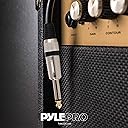
š¤ Elevate Your Audio Game with Pyle-Pro!
The Pyle-Pro 1/4" Audio Cord is a 50 ft, 12 gauge heavy-duty speaker cable designed for professional use. It features a ¼ā to ¼ā mono jack connection, ensuring high current capacity for powerful amplifiers. Built for durability, this cable delivers high-quality sound without interruptions, making it ideal for energetic performances.
| ASIN | B002UKZ99U |
| Best Sellers Rank | #114,495 in Musical Instruments ( See Top 100 in Musical Instruments ) #1,959 in Instrument Cables |
| Brand Name | Pyle |
| Cable Type | Composite |
| Color | Black |
| Compatible Devices | Speaker |
| Connector Gender | Male-to-Male |
| Connector Type | Mono-jack Speaker Cable |
| Customer Package Type | Standard Packaging |
| Customer Reviews | 4.5 4.5 out of 5 stars (1,668) |
| Gauge | 12.0 |
| Global Trade Identification Number | 00068888897358 |
| Indoor Outdoor Usage | Indoor, Outdoor |
| Item Shape | Round |
| Item Type Name | Pyle |
| Item Weight | 2 Pounds |
| Manufacturer | Sound Around |
| Model | PPJJ50 |
| Model Name | 1/4" to 1/4" Audio Cord - ¼" To ¼ Inch Mono Jack Male Connection 50 ft 12 Gauge Black Heavy Duty Professional Speaker Ca |
| Number of Items | 1 |
| Number of Pins | 2 |
| Recommended Uses For Product | Audio Transmission |
| UPC | 792273562476 611101554288 887487274939 068888897358 |
| Unit Count | 50.0 Feet |
| Warranty Description | 90 days. |
S**E
Much better sound compared to my old setup
We can go into all the factors that go into making a professional quality speaker cable, and many have done that already. I'm just going to say for me these cables made a night an day difference for my home studio. You see I'm a musician on a budget that is slowly finding ways to make the studio even better. I got some nice nearfield speakers and a good line mixer. However I always heard some level of hum from the speakers. My first thought is I don't have the levels set up right or I am putting in too much trim (or not enough). Then I learned a valuable lesson that I should have picked up on years ago: balanced vs. unbalanced cables. You see I was using standard instrument cables to send the audio signal between the mixer and the speakers. The speakers have inputs for both balanced and unbalanced signals, but I think I had the unbalanced instrument cables plugged into the balanced inputs on the speakers. Granted the mixer is unbalanced, but in situations like this your best bet is to go as balanced as possible. When I replaced the instrument cables with these Pyle-Pro speaker cables the difference was staggering. All that hum was gone and the signal sounded really clean. For any of you out there cobbling together a home recording studio if you are using speakers that have balanced inputs you will get a great sound using balanced cables like these.
D**Y
Good product at a good price
I teach aerobics classes and needed to replace worn-out speaker cables for my sound system. This is a good, solid, well-made cable at a reasonable price. The 1/4" plugs are very substantial and there is "flexible" rubber piece where the plug connects to the cable so there can be bending without breaking the wires inside the cable. I was pleasantly surprised to see this function as the wires in my old cables were breaking because of constantly plugging and unplugging them into the speakers. I have to put my system away after every class and put it back up before class so the speaker cables need to be durable. This cable fits the bill and I'm very pleased with it.
B**R
speaker wires
AMAZON I've been playing music for many years now. But I haven't used my sound system for a while. My band asked me to bring my monitor speakers for our next gig and when they asked me if I had my speaker wires for the monitors all I could find was mixed wires. some of them didn't work. I used instrument wires some short some long. After seening your listing on speaker wires and the price. First I ordered two speaker wires, then I thought to myself that I really need three speaker wires. So I ordered another one and had to pay for an additional shipping. I guess I to excided and jumped the gun. I couldn't have found anything better than your Pyle PPJJ-30 1/4 Inch Professional Speaker cable (30 feet). Perfect size and lenght. Thank you AMAZON for a great affordable and reliable product. Thank You and Much Aloha from Hawaii Olson Keliiwaiwaiole
B**E
Nice cable. Wire size a bit misleading.
This is a very nice cable and I am very happy with it. I do though somewhat agree with what a lot of reviews here are saying. Mine is brand new so of course it does work perfectly. Because of the reviews here though once I received the cable I disassembled one end. The soldering is not great and I can easily see this become a point of failure. For me this is no issue at all as I happen to be pretty competent at soldering and have some very nice soldering equipment. So why still give it 5 stars? I guess because I feel that the parts are of very good quality and getting two good quality jacks and 15 feet of cable would cost more. So if you look at these as a sum of their individual parts but come preassembled but you may need to reassemble at some point in the future they are still a good deal. One thing I plan to do in the near future is measure the wire to determine if they are indeed 12AWG or not. It is impossible to tell from from the outside of the cable what the actual wire gauge is. This is because the insulation thickness plus the actual copper wire is what determines the overall thickness of the cable. Thicker isn't nessesarily better. some cable are made thicker for a reason, I.e. internal reinforcement, hard service, higher voltage insulation, etc. Many, especially in audio applications, do this just to make the cable appear larger and therefore better. For audio the voltage is so low that the insulation can be extremely thin and still be effective. Therefore the cable can be fairly compact and still contain good sized conductors. Once I get them measures and calculate their actual wire conductor size I will post my conclusion. Update! This evening I had a chance to measure the copper conductor or each wire in this cable. What I measure is .0735 inches. What I found is that AWG #12 is .092 and AWG #14 is .073. So this cable is misrepresented right? Not so fast. The cable is marked "12 gauge" not "12 AWG." But that's the same thing right? Well not really. AWG is American Wire Gauge and is by far the most common system in the USA but not the only system. There is also SAE and SWG and a few others too. SAE would be the second most common in the USA but not actually very common at all. This wire appears to in fact be SAE 12 gauge. So though they have not misrepresented their product it is misleading. Nearly anyone in the USA looking at a wire that says 12 gauge would assume it is #12 AWG. All is not bad necessarily though. First off if we were to assume this wire is actually #14 AWG not #12 how much would that change? There are two areas of concern, first is current capacity and second is resistance (which affects current capacity). 12 AWG wire has .0293 ohms resistance in 15 feet and #14 has .0471 ohms. Both of those number are so small that they will have nearly zero impact on the system. The difference in current capacity is a little more substantial but I'm not certain it would make a bit of difference in a 15 foot cable either. The rule of thumb (actually the NEC code allowance) is 20A for #12 and 15A for #14. But that's for permenantly installed premise wiring and already has a derating factor applied. The allowable current for conductors not in conduit, not sheathed, etc is quite different. But regardless of the actual maximum there is a somewhat substantial difference. I'm not sure what wattage amp you would have to run to overload (build up excessive heat) a 15 foot cable but I'm pretty sure it would be something huge. I highly doubt any comercially available amp puts out an average of over 20 or 30 amps on the output. It's important to also understand that for it to be a problem it would have to to be an average of current not just momentary peaks. So unless you are pushing huge power for extended periods I wouldn't give it a second thought. If you are then you should expect to have to determine your maximum average output current, determine your maximum cable length and calculate the wire size needed. Then be certain what standard the cable manufacturer is using before buying. Or you can just feel the cable during use, if it's not getting hot you're fine. HTH
F**D
These are proper heavy duty stage speaker leads nice thick leads that can take some punishment on stage fitted with high quality jack plugs
S**M
Received with cloudtail at 600 only & lucky me. Bang for that buck.
R**L
excellent service value for money
E**S
Tengo un par de aƱos o mas trabajando con esta marca y ninguna falla hasta el momento.
I**E
Really great cables for connecting tube amp heads to cabs(Laney IRT120H in my case).
Trustpilot
2 weeks ago
3 days ago